Biocracked
←

#obesity

2 articles
Approach: Macro science. Palette: D, bold color field.

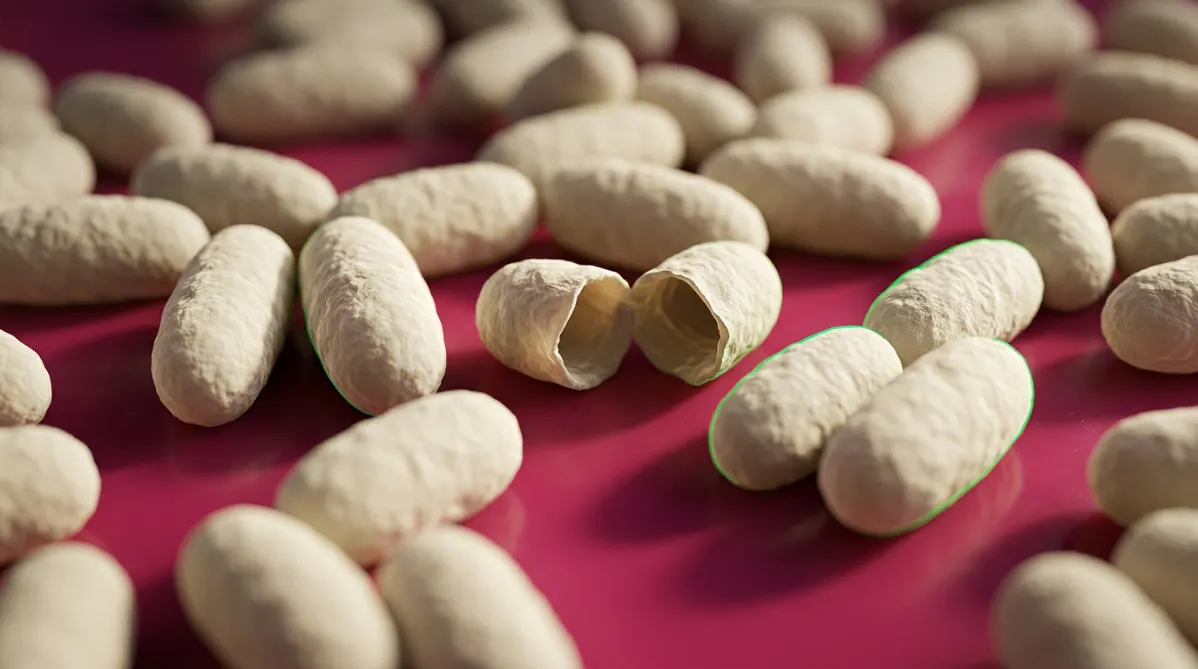
Extreme close-up microscopy-style photograph of a dense cluster of oval, rod-shaped bacterial cells, rendered as slightly wrinkled, matte, pale cream-white forms with visible surface texture. They rest on a smooth, saturated magenta-pink gel surface. Several cells in the foreground are crisp, while the rest fall into soft shallow depth of field. One cell near the center is split open and visibly hollow, to suggest a dead, heat-treated organism. Camera is a low three-quarter angle, as if through a scanning microscope. Lighting is a single hard, warm-white side light that casts short crisp shadows and creates bright rim highlights. A thin electric green (#00e676) line of reflected light traces the edge of one cell. The mood is stark, curious and quietly skeptical. There is no text and no labels.
metabolism

Vi khuẩn đường ruột hoạt động tốt hơn khi chết: Ưu thế 29% của Akkermansia

BY HELIX WARD ·

Trong thử nghiệm người đầu tiên với Akkermansia muciniphila, phiên bản đã qua xử lý nhiệt (giết chết) chứ không phải dạng sống đã tạo ra kết quả gây chú ý. Độ nhạy insulin tăng 28,62 % và mức insulin lúc đói giảm 34,08 % so với giả dược ở người trưởng thành thừa cân, kháng insulin. Thay đổi về cân nặng và mỡ không đạt mức có ý nghĩa thống kê, và một vài tác giả còn sở hữu bằng sáng chế và đồng sáng lập công ty bán vi khuẩn này. Bài viết sẽ tóm tắt những gì nghiên cứu phát hiện, những giới hạn và những điều cần xem xét trước khi mua thực phẩm chức năng.
A wide, editorial-style still life photographed from slightly above on a pale warm-gray stone surface, lit by soft diffused morning light from the left. At the center, a delicate chain of 16 small, glossy beads in alternating muted terracotta, sage green, and cream is arranged in a gentle S-curve, each bead slightly different in size, like a hand-strung necklace. It stands for a peptide chain in a tactile, abstract way. Beside the chain, a translucent glass petri dish holds a thin layer of pale amber liquid with a few soft ripples. Behind it, a cross-section of a ripe fig and a halved blood orange show their intricate internal textures, suggesting cellular structure and mitochondria without literal illustration.

On the left side of the frame, a small ceramic mouse figurine in matte off-white sits calmly next to a sprig of dried wheat. It is a subtle nod to the mouse study and is stylized and minimal, not cartoonish. On the right, an open, softly blurred notebook with thin hand-drawn circles and curved lines, like looping pathway diagrams, lies under a brass pen. A few pages are visible but the text is illegible.

Scatter a few elements for texture: a small sprig of eucalyptus, a folded linen napkin in oatmeal tone, and a single clear glass pipette resting diagonally across the lower foreground. The palette is warm neutrals with accents of sage, terracotta, and soft amber, giving a calm, modern wellness-journal look. Shallow depth of field keeps the bead chain crisp while the background gently dissolves into creamy bokeh. Generous negative space across the upper right leaves room for headline overlay. The overall mood is clean, contemporary, and intellectually curious: scientific but warm, like a premium health and science magazine cover, with fine grain, natural shadows, and no text, logos, or futuristic elements.
peptides

MOTS-c được giải thích: Peptide ty thể 16 axit amin kích hoạt AMPK và bảo vệ chuột khỏi béo phì do chế độ ăn

BY DR. SYNAPSE ·

Một peptide gồm 16 axit amin, được mã hoá trong DNA của ti thể thay vì trong nhân, đã kích hoạt AMPK trong cơ và bảo vệ chuột khỏi béo phì và kháng insulin do chế độ ăn. Đây là phát hiện chính của một bài báo *Cell Metabolism* năm 2015 và là lý do MOTS‑c trở thành một trong những từ khóa được tìm kiếm nhiều nhất trong cộng đồng peptide và biohacking. Tuy nhiên, nghiên cứu này chỉ là thí nghiệm trên chuột và khám phá cơ chế, chưa có dữ liệu lâm sàng ở người và MOTS‑c chưa được chấp thuận làm thuốc. Bài viết sẽ giải thích MOTS‑c là gì, cơ chế hoạt động qua chu trình folate và AMPK, kết quả ở chuột, và những gì người đọc nên và không nên suy luận.

This page is available in