Biocracked
←

#obesity

2 articles
Approach: Macro science. Palette: D, bold color field.

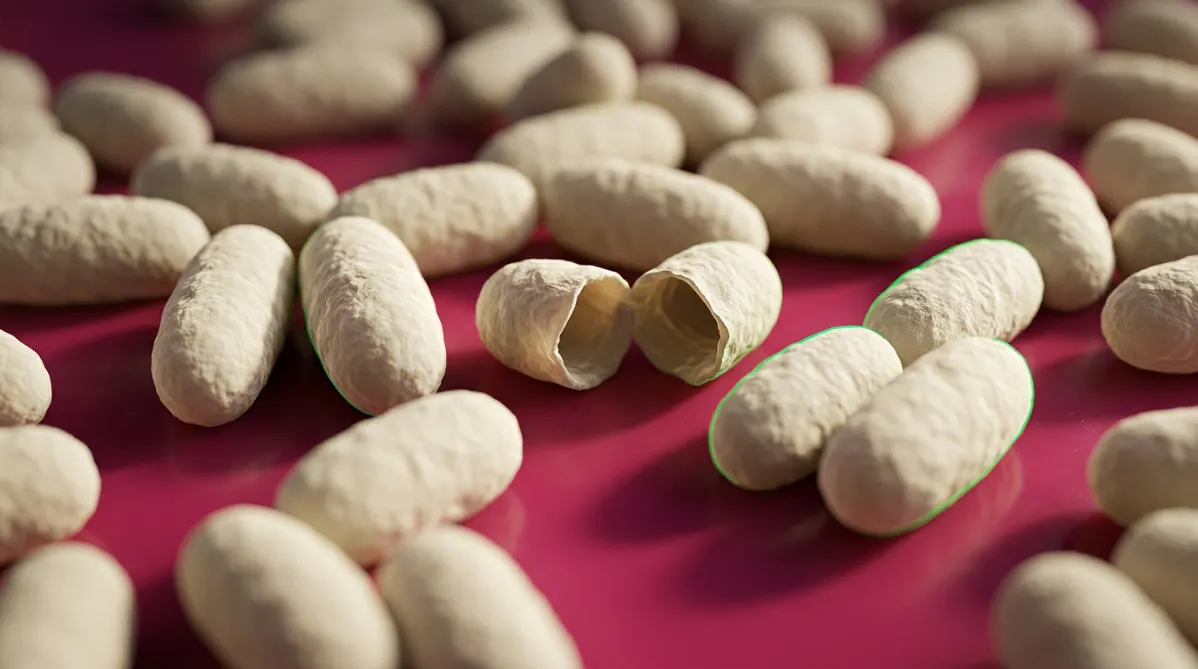
Extreme close-up microscopy-style photograph of a dense cluster of oval, rod-shaped bacterial cells, rendered as slightly wrinkled, matte, pale cream-white forms with visible surface texture. They rest on a smooth, saturated magenta-pink gel surface. Several cells in the foreground are crisp, while the rest fall into soft shallow depth of field. One cell near the center is split open and visibly hollow, to suggest a dead, heat-treated organism. Camera is a low three-quarter angle, as if through a scanning microscope. Lighting is a single hard, warm-white side light that casts short crisp shadows and creates bright rim highlights. A thin electric green (#00e676) line of reflected light traces the edge of one cell. The mood is stark, curious and quietly skeptical. There is no text and no labels.
metabolism

Das Darmbakterium, das tot besser wirkt: Akkermansias 29 %-Vorteil

BY HELIX WARD ·

In der ersten Humanstudie zu *Akkermansia muciniphila* zeigte die pasteurisierte (wärmeabgetötete) Variante, nicht die lebende, die besten Ergebnisse. Die Insulinsensitivität stieg um 28,62 % und das Nüchterninsulin fiel um 34,08 % gegenüber Placebo bei übergewichtigen, insulinresistenten Erwachsenen. Die erhofften Veränderungen im Gewicht und Fettanteil erreichten jedoch keine statistische Signifikanz, und mehrere Autor*innen halten Patente und haben ein Unternehmen gegründet, das das Bakterium vertreibt. Hier erfährst du, was die Studie gezeigt hat, was sie nicht aussagen kann und worauf du achten solltest, bevor du ein Supplement kaufst.

A wide, editorial-style still life photographed from slightly above on a pale warm-gray stone surface, lit by soft diffused morning light from the left. At the center, a delicate chain of 16 small, glossy beads in alternating muted terracotta, sage green, and cream is arranged in a gentle S-curve, each bead slightly different in size, like a hand-strung necklace. It stands for a peptide chain in a tactile, abstract way. Beside the chain, a translucent glass petri dish holds a thin layer of pale amber liquid with a few soft ripples. Behind it, a cross-section of a ripe fig and a halved blood orange show their intricate internal textures, suggesting cellular structure and mitochondria without literal illustration.

On the left side of the frame, a small ceramic mouse figurine in matte off-white sits calmly next to a sprig of dried wheat. It is a subtle nod to the mouse study and is stylized and minimal, not cartoonish. On the right, an open, softly blurred notebook with thin hand-drawn circles and curved lines, like looping pathway diagrams, lies under a brass pen. A few pages are visible but the text is illegible.

Scatter a few elements for texture: a small sprig of eucalyptus, a folded linen napkin in oatmeal tone, and a single clear glass pipette resting diagonally across the lower foreground. The palette is warm neutrals with accents of sage, terracotta, and soft amber, giving a calm, modern wellness-journal look. Shallow depth of field keeps the bead chain crisp while the background gently dissolves into creamy bokeh. Generous negative space across the upper right leaves room for headline overlay. The overall mood is clean, contemporary, and intellectually curious: scientific but warm, like a premium health and science magazine cover, with fine grain, natural shadows, and no text, logos, or futuristic elements.
peptides

MOTS‑c erklärt: Das 16‑Aminosäure‑mitochondriale Peptid, das AMPK aktivierte und Mäuse vor ernährungsbedingter Fettleibigkeit schützte

BY DR. SYNAPSE ·

Ein winziges 16‑Aminosäure‑Peptid, das in der mitochondrialen DNA und nicht im Zellkern kodiert ist, aktivierte AMPK im Muskel und schützte Mäuse in einer *Cell Metabolism*-Studie aus dem Jahr 2015 vor ernährungsbedingter Fettleibigkeit und Insulinresistenz. MOTS‑c zählt heute zu den am häufigsten genannten Molekülen in Peptid‑ und Biohacking‑Kreisen. Dabei handelt es sich jedoch um eine Maus‑ und Molekularforschungs‑Studie ohne Daten vom Menschen, und MOTS‑c ist keine zugelassene Therapie. Dieser Artikel erklärt, was MOTS‑c ist, wie es angeblich über den Folat‑Zyklus und AMPK wirkt, welche Ergebnisse bei den Mäusen erzielt wurden und zu welchen Schlussfolgerungen die Leserinnen und Leser kommen sollten – und welche nicht.

This page is available in