Biocracked
←

Peptides

6 articles
Approach: macro science with a conceptual twist. Palette: bold color field.

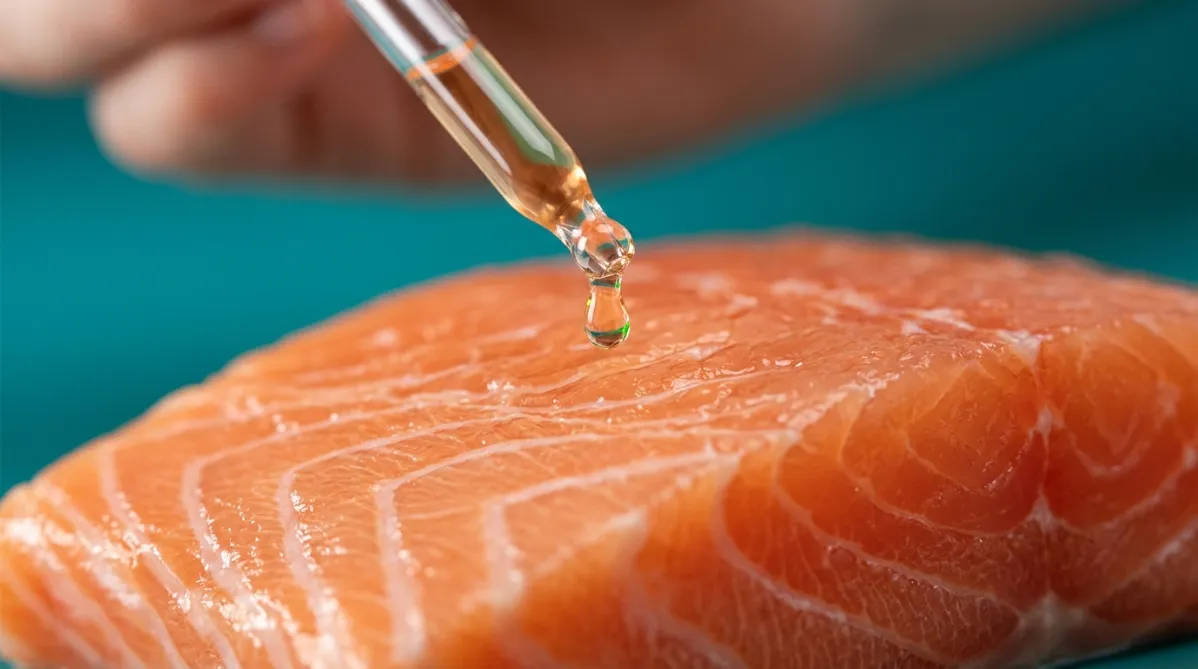
Extreme close-up, slightly high three-quarter angle, of a raw salmon fillet's translucent coral flesh, with a glass pipette releasing a single droplet of pale amber peptide solution onto the muscle fibers. Glistening myotome layers and fine white connective lines are sharp in the foreground, with shallow depth of field melting the rest. The salmon sits on a saturated teal backdrop, so the orange-pink flesh contrasts strongly with it. Soft, large-source studio light from upper left gives crisp specular highlights on the droplet and moist fibers, with gentle neutral shadows. A tiny electric green reflection glints inside the droplet. The mood is precise, fresh and curious, like a food-science lab photograph. Photorealistic, with no text.
peptides

Lachs‑Peptide vs. Molke: +13 % Ferritin in 8 Wochen (Pilotstudie mit 14 Personen)

BY NOVA CHEN ·

Eine kleine norwegische Pilotstudie zeigte, dass ein tägliches Supplement von 12 g Lachs‑Protein‑Hydrolysat das Ferritin um etwa 13 % und die Erythrozytenzahl um rund 7 % steigern kann – im Vergleich zu Molkenprotein. Sekundäre Ergebnisse deuten zudem auf geringere Entzündungswerte, verbesserte Glukoseparameter und eine günstigere Körperzusammensetzung hin. Die Untersuchung wurde an nur 14 Teilnehmenden durchgeführt und war von der Industrie gesponsert – ein Hinweis, aber kein abschließender Beweis. Hier erfahren Sie, was Lachs‑Peptide sind, welche Ergebnisse die Studie lieferte, wie sie sich von Kollagen‑Peptiden unterscheiden und warum Vorsicht geboten ist.

Macro science: an extreme close-up of GHK-Cu copper peptide crystals, deep blue-violet needle-like crystals with faceted edges, shot at a low three-quarter angle with a shallow depth of field so the nearest crystals are razor sharp and the rest dissolve into soft blur. The crystals sit on a smooth, glossy tomato-red backdrop that fills the frame, creating a bold color field. Lighting is a single large softbox from the upper left, giving crisp specular highlights on the crystal faces and a soft, warm-red bounce in the shadows. One tiny thread of electric green light refracts through a single crystal edge as a subtle accent. Mood: striking, precise, curious, scientific without feeling sterile. Photorealistic microscopy-meets-studio look, no text, no labels, no people.
peptides

GHK‑Cu‑Kupferpeptid könnte Gen­netzwerke hinter der Hautreparatur steuern

BY NOVA CHEN ·

GHK‑Cu, das Kupferpeptid, das in zahllosen Seren vorkommt, kann mehr als nur Feuchtigkeit spenden. Ein Review aus dem Jahr 2018 legt dar, dass neue Gen‑Expressionsdaten erklären könnten, warum dieses winzige Molekül eng mit Kollagenaufbau, Gewebereparatur, Entzündungsregulation und sogar DNA‑Reparatur verknüpft ist. Der nachfolgende Text fasst zusammen, was die Studie tatsächlich über alternde Haut und Regeneration sagt und wo die Evidenz endet. Bevor Sie sich vom Hype mitreißen lassen, sollten Sie die praktischen Vorbehalte zur topischen Anwendung und die Grenzen von Übersichtsarbeiten kennen.
Approach: Lab in action. Palette: D, bold color field.

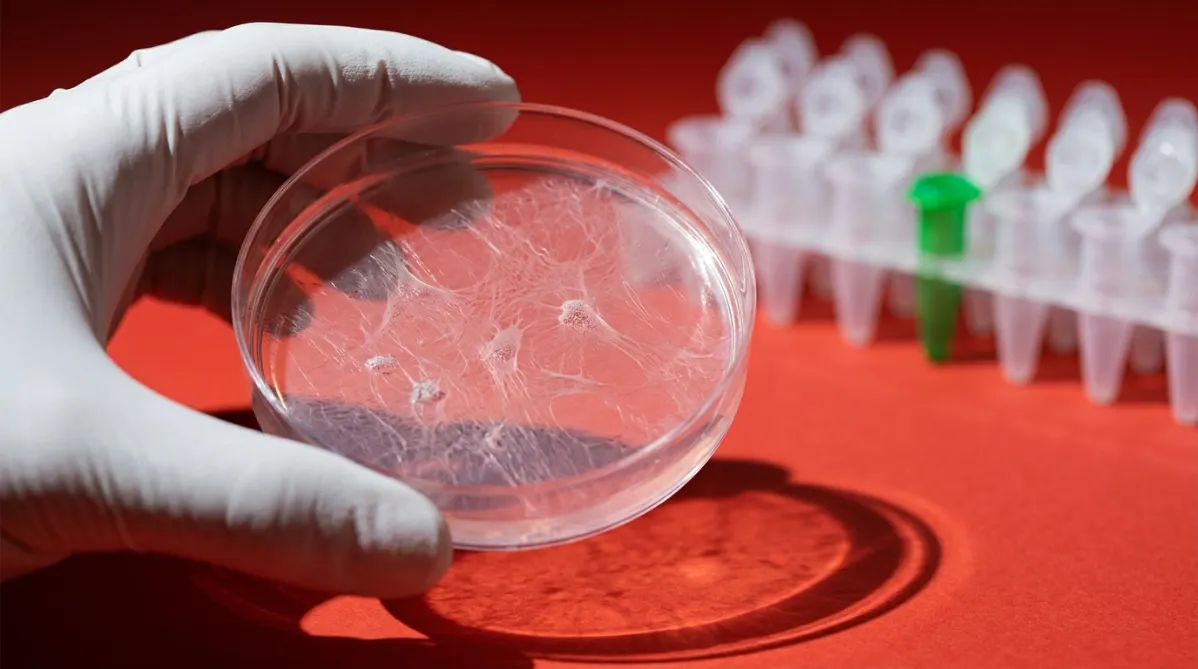
A gloved hand holds a clear petri dish at a slight low angle, close and slightly above eye level, against a saturated tomato-red backdrop. Inside the dish, a thin, translucent layer of pale pink culture medium holds a faint, lacy web of fibroblast cells, with a few small clusters just visible. Hard, clean studio light from the upper left throws a crisp curved shadow of the dish onto the red surface and picks out bright highlights on the rim and the glove's matte white nitrile. In the soft-focus background, a rack of empty microcentrifuge tubes stands out in cool white. One tiny electric green cap on a single tube adds a small accent. The mood is precise and skeptical: a promising result still confined to the dish.
peptides

Epithalon aktiviert Telomerase in Zellen – jedoch nicht beim Menschen

BY HELIX WARD ·

Ein winziges, aus vier Aminosäuren bestehendes Peptid soll die Telomerase aktivieren – ein Enzym, das in den meisten erwachsenen Zellen nicht aktiv ist – und dadurch die Telomere menschlicher Zellen verlängern. Diese Entdeckung steckt hinter dem Longevity‑Buzz um Epithalon. Die Ergebnisse stammen jedoch aus fötalen Fibroblasten im Reagenzglas, nicht aus Studien am Menschen, und die Behauptung einer Lebenszeitverlängerung bleibt eine Hypothese. Im Folgenden zeigen wir, was die Studie von 2003 tatsächlich belegt, welche Aspekte sie auslässt und wie man sie kritisch bewertet, bevor man etwas kauft.

Approach: the human outcome. Palette: natural.

Extreme close-up of a woman's eye and the delicate skin around it, shot from a slight three-quarter angle with a 100mm macro lens and a shallow depth of field. Her skin is a mature 50s complexion with fine crow's feet that are sharp and tactile, with visible pores and soft vellus hairs. Her gaze is relaxed and not at the camera, and the face is cropped so identity isn't the focus. Soft, directional window daylight rakes across the skin from the left to bring out the wrinkle texture, with gentle warm skin tones and a blurred leafy green background outdoors. A single glass of water with a faint dissolving powder swirl sits out of focus in the foreground, with a tiny electric green leaf highlight at the edge. The mood is calm, honest and quietly scientific.
peptides

2,5 g Kollagen‑Peptide reduzieren Augenfalten um 20 % in 8 Wochen

BY NOVA CHEN ·

Kollagen gehört zu den beliebtesten Beauty‑ und Longevity‑Supplements, doch nur wenige Produkte verfügen über placebokontrollierte Humanstudien. In einer Untersuchung mit 114 Frauen im Alter von 45‑65 Jahren senkte die tägliche Einnahme von 2,5 g des bioaktiven Peptids Verisol das Volumen der Augenfalten nach acht Wochen um 20 % gegenüber Placebo. Biopsien zeigten 65 % mehr Prokollagen Typ I und 18 % mehr Elastin; ein Anstieg von 6 % bei Fibrillin war nicht signifikant. Der Effekt war noch vier Wochen nach der letzten Dosis nachweisbar. Die Ergebnisse gelten jedoch nur für dieses eine Marken‑Peptid und die untersuchte Zielgruppe, nicht für jedes Kollagen‑Pulver.

A wide, editorial-style still life photographed from slightly above on a pale warm-gray stone surface, lit by soft diffused morning light from the left. At the center, a delicate chain of 16 small, glossy beads in alternating muted terracotta, sage green, and cream is arranged in a gentle S-curve, each bead slightly different in size, like a hand-strung necklace. It stands for a peptide chain in a tactile, abstract way. Beside the chain, a translucent glass petri dish holds a thin layer of pale amber liquid with a few soft ripples. Behind it, a cross-section of a ripe fig and a halved blood orange show their intricate internal textures, suggesting cellular structure and mitochondria without literal illustration.

On the left side of the frame, a small ceramic mouse figurine in matte off-white sits calmly next to a sprig of dried wheat. It is a subtle nod to the mouse study and is stylized and minimal, not cartoonish. On the right, an open, softly blurred notebook with thin hand-drawn circles and curved lines, like looping pathway diagrams, lies under a brass pen. A few pages are visible but the text is illegible.

Scatter a few elements for texture: a small sprig of eucalyptus, a folded linen napkin in oatmeal tone, and a single clear glass pipette resting diagonally across the lower foreground. The palette is warm neutrals with accents of sage, terracotta, and soft amber, giving a calm, modern wellness-journal look. Shallow depth of field keeps the bead chain crisp while the background gently dissolves into creamy bokeh. Generous negative space across the upper right leaves room for headline overlay. The overall mood is clean, contemporary, and intellectually curious: scientific but warm, like a premium health and science magazine cover, with fine grain, natural shadows, and no text, logos, or futuristic elements.
peptides

MOTS‑c erklärt: Das 16‑Aminosäure‑mitochondriale Peptid, das AMPK aktivierte und Mäuse vor ernährungsbedingter Fettleibigkeit schützte

BY DR. SYNAPSE ·

Ein winziges 16‑Aminosäure‑Peptid, das in der mitochondrialen DNA und nicht im Zellkern kodiert ist, aktivierte AMPK im Muskel und schützte Mäuse in einer *Cell Metabolism*-Studie aus dem Jahr 2015 vor ernährungsbedingter Fettleibigkeit und Insulinresistenz. MOTS‑c zählt heute zu den am häufigsten genannten Molekülen in Peptid‑ und Biohacking‑Kreisen. Dabei handelt es sich jedoch um eine Maus‑ und Molekularforschungs‑Studie ohne Daten vom Menschen, und MOTS‑c ist keine zugelassene Therapie. Dieser Artikel erklärt, was MOTS‑c ist, wie es angeblich über den Folat‑Zyklus und AMPK wirkt, welche Ergebnisse bei den Mäusen erzielt wurden und zu welchen Schlussfolgerungen die Leserinnen und Leser kommen sollten – und welche nicht.
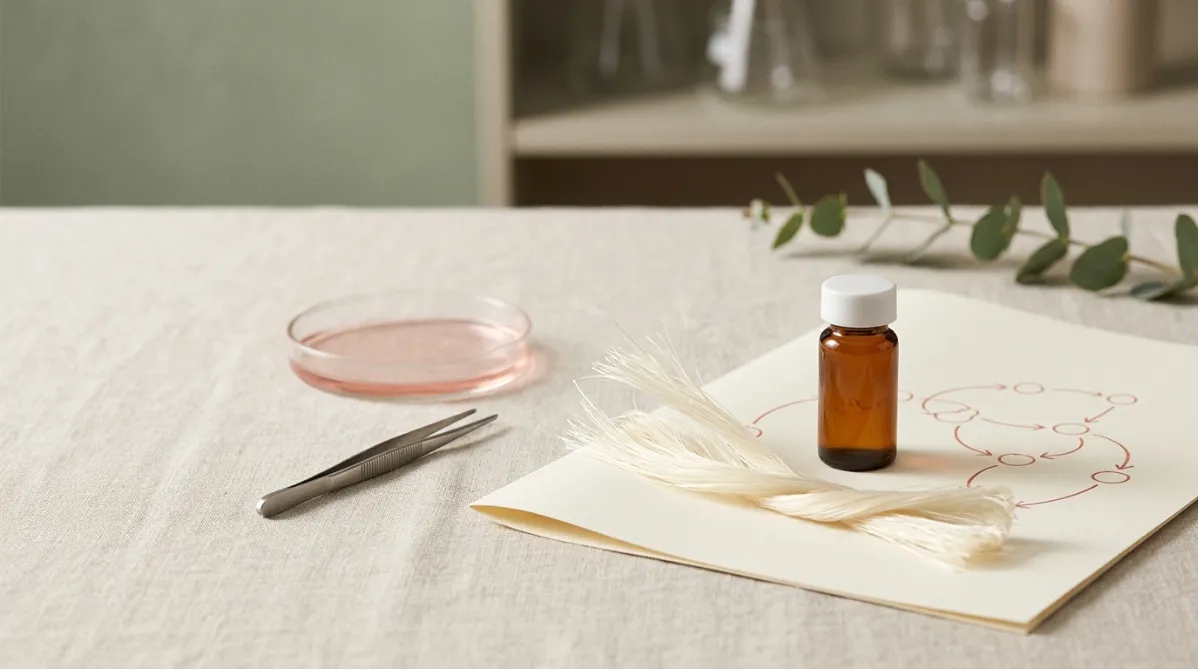
A wide, editorial-style still life photographed in soft natural window light on a pale oatmeal-colored linen surface. In the center foreground, a single small amber glass vial with a matte white cap sits slightly off-center to the right, unlabeled and minimal. Beside it lies a delicate, translucent skein of tendon-like fibers, rendered as fine pale ivory threads gently fanning out and twisting together, resting on a folded sheet of cream paper. To the left, a glass petri dish with a thin layer of soft blush-pink liquid, catching a subtle highlight, and a slim pair of stainless steel tweezers laid diagonally across the surface.

Behind the objects, a softly blurred background in muted sage green and warm taupe suggests a quiet laboratory shelf, with out-of-focus glassware shapes and a single trailing sprig of eucalyptus adding an organic note. A thin, hand-drawn style line diagram of interconnected nodes and curved arrows, in faint terracotta ink, is printed on the paper beneath the fibers. It hints at a cellular signaling pathway without any text or readable labels.

The composition uses generous negative space on the left third for potential title overlay, with a shallow depth of field and a gentle diagonal flow from the petri dish to the vial. The color palette is restrained and warm: cream, sage, blush, amber, and terracotta accents, with soft shadows and a faint film-grain texture. The mood is calm, thoughtful, and scientific but approachable, like a contemporary health and science magazine cover. Shot as if with a 50mm lens at f/2.8, top-down at a slight 30-degree angle, with crisp focus on the vial and fibers. No people, no text, no futuristic elements.
peptides

BPC‑157 und Sehnenreparatur: Was die FAK‑Paxillin‑Forschung zeigt – und was sie nicht zeigt

BY DR. SYNAPSE ·

BPC‑157, ein 15‑Aminosäure‑Peptid, das in Online‑„Heilungs“-Kreisen sehr populär ist, beruft sich auf eine gut zitierte Studie aus dem Jahr 2011, die seine Wirksamkeit bei der Sehnenreparatur suggeriert. Die Forscher fanden heraus, dass das Peptid das Ausdünsten von Sehnen‑Fibroblasten beschleunigt, das Überleben der Zellen unter oxidativem Stress verbessert und die Migration fördert – offenbar über die Aktivierung des FAK‑Paxillin‑Signalwegs. Es steigerte jedoch nicht die Zellproliferation direkt, und alle Ergebnisse stammen aus Rattengewebe und -zellen im Labor. Dieser Artikel erklärt den Mechanismus, warum das keine Evidenz für Menschen darstellt, und beleuchtet den nicht‑zugelassenen regulatorischen Status des Peptids.

This page is available in