Biocracked
←

Peptides

6 articles
Approach: macro science with a conceptual twist. Palette: bold color field.

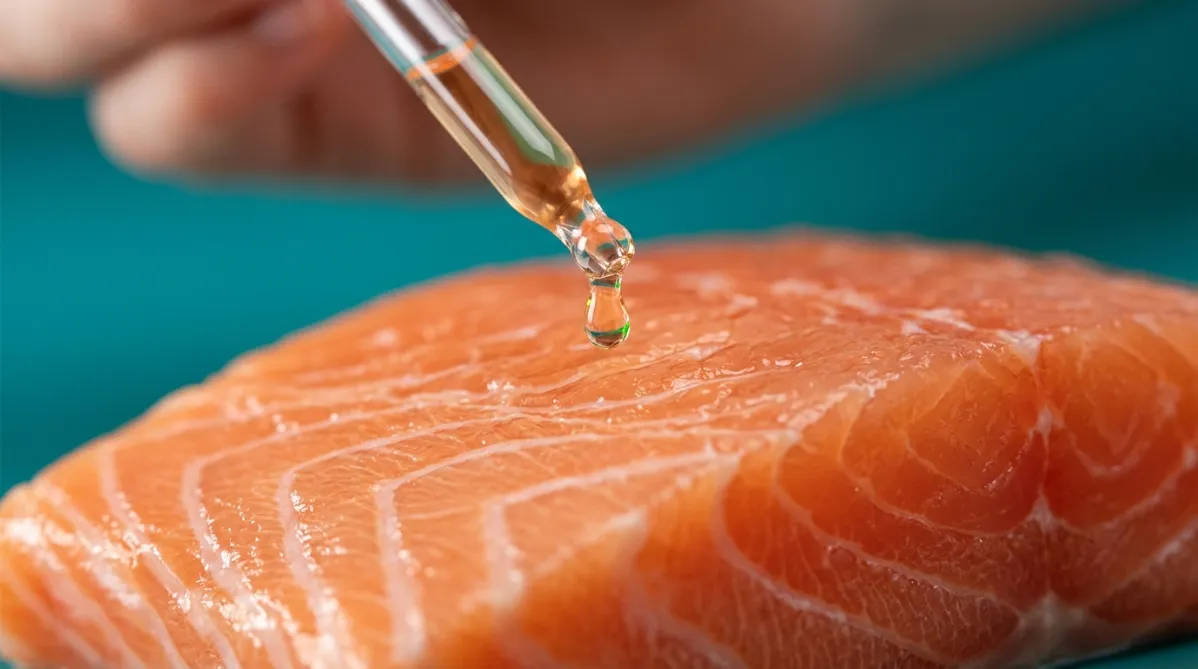
Extreme close-up, slightly high three-quarter angle, of a raw salmon fillet's translucent coral flesh, with a glass pipette releasing a single droplet of pale amber peptide solution onto the muscle fibers. Glistening myotome layers and fine white connective lines are sharp in the foreground, with shallow depth of field melting the rest. The salmon sits on a saturated teal backdrop, so the orange-pink flesh contrasts strongly with it. Soft, large-source studio light from upper left gives crisp specular highlights on the droplet and moist fibers, with gentle neutral shadows. A tiny electric green reflection glints inside the droplet. The mood is precise, fresh and curious, like a food-science lab photograph. Photorealistic, with no text.
peptides

Salmon Peptides vs Whey: +13% Ferritin in 8 Weeks (14-Person Pilot)

BY NOVA CHEN ·

A small Norwegian trial found that 12 g/day of salmon protein hydrolysate lifted ferritin by about 13% and red blood cells by about 7% compared with whey over eight weeks. Secondary results hinted at lower inflammation, better glucose markers and improved body composition. But the study had only 14 participants and was industry-sponsored, so it is a signal rather than proof. Here is what salmon peptides are, what the trial found, how they differ from collagen, and why caution is essential.

Macro science: an extreme close-up of GHK-Cu copper peptide crystals, deep blue-violet needle-like crystals with faceted edges, shot at a low three-quarter angle with a shallow depth of field so the nearest crystals are razor sharp and the rest dissolve into soft blur. The crystals sit on a smooth, glossy tomato-red backdrop that fills the frame, creating a bold color field. Lighting is a single large softbox from the upper left, giving crisp specular highlights on the crystal faces and a soft, warm-red bounce in the shadows. One tiny thread of electric green light refracts through a single crystal edge as a subtle accent. Mood: striking, precise, curious, scientific without feeling sterile. Photorealistic microscopy-meets-studio look, no text, no labels, no people.
peptides

GHK-Cu Copper Peptide May Tune Gene Networks Behind Skin Repair

BY NOVA CHEN ·

GHK-Cu, the copper peptide in countless serums, may do far more than moisturize. A 2018 review argues that new gene-expression data could explain how this one small molecule is linked to collagen building, tissue repair, inflammation control, and even DNA repair. Here's what the paper actually reports on aging skin and regeneration, and where the evidence stops. Before you buy into the hype, read the practical caveats on topical use and what a review can and can't prove.
Approach: Lab in action. Palette: D, bold color field.

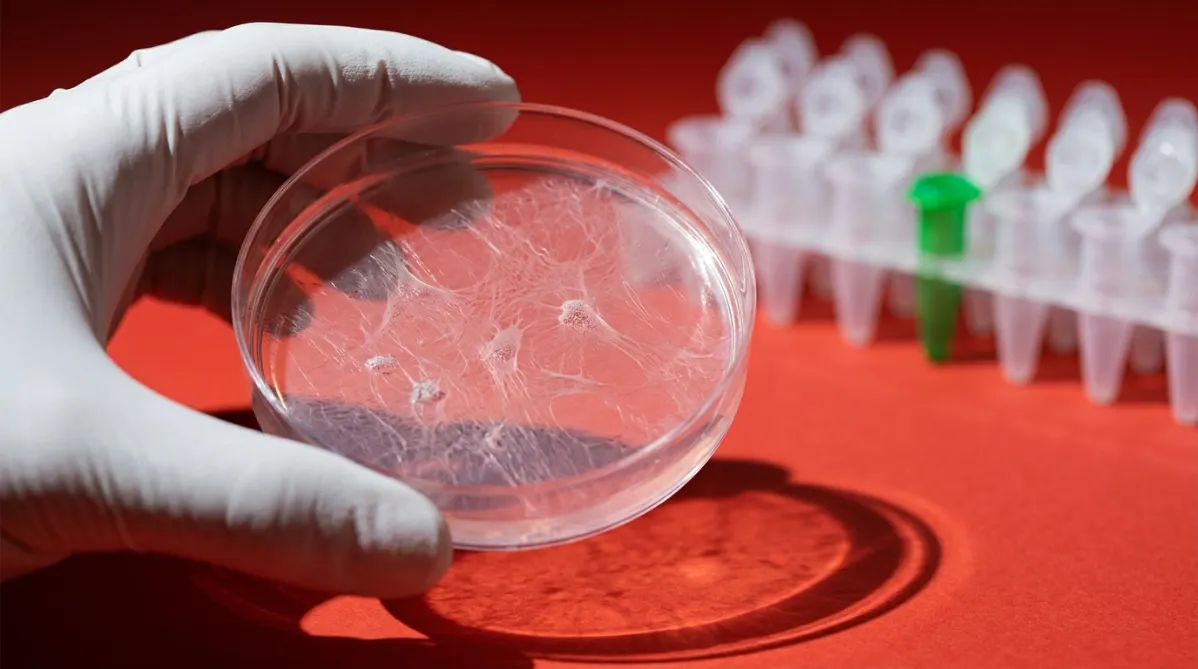
A gloved hand holds a clear petri dish at a slight low angle, close and slightly above eye level, against a saturated tomato-red backdrop. Inside the dish, a thin, translucent layer of pale pink culture medium holds a faint, lacy web of fibroblast cells, with a few small clusters just visible. Hard, clean studio light from the upper left throws a crisp curved shadow of the dish onto the red surface and picks out bright highlights on the rim and the glove's matte white nitrile. In the soft-focus background, a rack of empty microcentrifuge tubes stands out in cool white. One tiny electric green cap on a single tube adds a small accent. The mood is precise and skeptical: a promising result still confined to the dish.
peptides

Epithalon Switched On Telomerase in Cells—But Not in People

BY HELIX WARD ·

A tiny four-amino-acid peptide reportedly switched on telomerase, an enzyme most adult cells keep silent, and lengthened telomeres in human cells. That is the finding behind Epithalon's longevity buzz. But it came from fetal fibroblasts in a dish, not from people, and the paper's talk of extending lifespan is a hypothesis. Here is what the 2003 study actually showed, what it leaves out, and how to read it before you buy anything.

Approach: the human outcome. Palette: natural.

Extreme close-up of a woman's eye and the delicate skin around it, shot from a slight three-quarter angle with a 100mm macro lens and a shallow depth of field. Her skin is a mature 50s complexion with fine crow's feet that are sharp and tactile, with visible pores and soft vellus hairs. Her gaze is relaxed and not at the camera, and the face is cropped so identity isn't the focus. Soft, directional window daylight rakes across the skin from the left to bring out the wrinkle texture, with gentle warm skin tones and a blurred leafy green background outdoors. A single glass of water with a faint dissolving powder swirl sits out of focus in the foreground, with a tiny electric green leaf highlight at the edge. The mood is calm, honest and quietly scientific.
peptides

2.5 g of Collagen Peptides Cut Eye Wrinkles 20% in 8 Weeks

BY NOVA CHEN ·

Collagen is one of the most searched beauty and longevity supplements, but few products have placebo-controlled human data. In this trial of 114 women aged 45-65, 2.5 g a day of the specific bioactive peptide Verisol cut eye wrinkle volume by 20% versus placebo after 8 weeks. Biopsies showed 65% more procollagen type I and 18% more elastin, while a 6% fibrillin bump wasn't significant. The effect was still detectable 4 weeks after the last dose. But the results apply to one branded peptide in one population, not every collagen powder, so here's what the paper does and doesn't prove.

A wide, editorial-style still life photographed from slightly above on a pale warm-gray stone surface, lit by soft diffused morning light from the left. At the center, a delicate chain of 16 small, glossy beads in alternating muted terracotta, sage green, and cream is arranged in a gentle S-curve, each bead slightly different in size, like a hand-strung necklace. It stands for a peptide chain in a tactile, abstract way. Beside the chain, a translucent glass petri dish holds a thin layer of pale amber liquid with a few soft ripples. Behind it, a cross-section of a ripe fig and a halved blood orange show their intricate internal textures, suggesting cellular structure and mitochondria without literal illustration.

On the left side of the frame, a small ceramic mouse figurine in matte off-white sits calmly next to a sprig of dried wheat. It is a subtle nod to the mouse study and is stylized and minimal, not cartoonish. On the right, an open, softly blurred notebook with thin hand-drawn circles and curved lines, like looping pathway diagrams, lies under a brass pen. A few pages are visible but the text is illegible.

Scatter a few elements for texture: a small sprig of eucalyptus, a folded linen napkin in oatmeal tone, and a single clear glass pipette resting diagonally across the lower foreground. The palette is warm neutrals with accents of sage, terracotta, and soft amber, giving a calm, modern wellness-journal look. Shallow depth of field keeps the bead chain crisp while the background gently dissolves into creamy bokeh. Generous negative space across the upper right leaves room for headline overlay. The overall mood is clean, contemporary, and intellectually curious: scientific but warm, like a premium health and science magazine cover, with fine grain, natural shadows, and no text, logos, or futuristic elements.
peptides

MOTS-c Explained: The 16-Amino-Acid Mitochondrial Peptide That Activated AMPK and Shielded Mice From Diet-Induced Obesity

BY DR. SYNAPSE ·

A tiny 16-amino-acid peptide encoded in mitochondrial DNA, not the nucleus, activated AMPK in muscle and protected mice from diet-induced obesity and insulin resistance in a 2015 Cell Metabolism study. MOTS-c is now one of the most talked-about names in peptide and biohacking circles. But this was a mouse and molecular-discovery paper with no human outcome data, and MOTS-c is not an approved therapy. This article explains what MOTS-c is, how it appears to work through the folate cycle and AMPK, what the mice showed, and what readers should and should not conclude.
A wide, editorial-style still life photographed in soft natural window light on a pale oatmeal-colored linen surface. In the center foreground, a single small amber glass vial with a matte white cap sits slightly off-center to the right, unlabeled and minimal. Beside it lies a delicate, translucent skein of tendon-like fibers, rendered as fine pale ivory threads gently fanning out and twisting together, resting on a folded sheet of cream paper. To the left, a glass petri dish with a thin layer of soft blush-pink liquid, catching a subtle highlight, and a slim pair of stainless steel tweezers laid diagonally across the surface.

Behind the objects, a softly blurred background in muted sage green and warm taupe suggests a quiet laboratory shelf, with out-of-focus glassware shapes and a single trailing sprig of eucalyptus adding an organic note. A thin, hand-drawn style line diagram of interconnected nodes and curved arrows, in faint terracotta ink, is printed on the paper beneath the fibers. It hints at a cellular signaling pathway without any text or readable labels.

The composition uses generous negative space on the left third for potential title overlay, with a shallow depth of field and a gentle diagonal flow from the petri dish to the vial. The color palette is restrained and warm: cream, sage, blush, amber, and terracotta accents, with soft shadows and a faint film-grain texture. The mood is calm, thoughtful, and scientific but approachable, like a contemporary health and science magazine cover. Shot as if with a 50mm lens at f/2.8, top-down at a slight 30-degree angle, with crisp focus on the vial and fibers. No people, no text, no futuristic elements.
peptides

BPC-157 and Tendon Repair: What the FAK-Paxillin Research Shows, and What It Doesn't

BY DR. SYNAPSE ·

BPC-157, a 15-amino-acid peptide popular in online "healing" circles, has a well-cited 2011 study behind its tendon-repair reputation. Researchers found that it sped tendon fibroblast outgrowth, improved cell survival under oxidative stress, and boosted migration, apparently by activating the FAK-paxillin pathway. But it did not directly increase cell proliferation, and every result came from rat tissue and cells in the lab. This article unpacks the mechanism, explains why it doesn't amount to human evidence, and reviews the peptide's unapproved regulatory status.

This page is available in