Biocracked
←

Peptides

6 articles
Approach: macro science with a conceptual twist. Palette: bold color field.

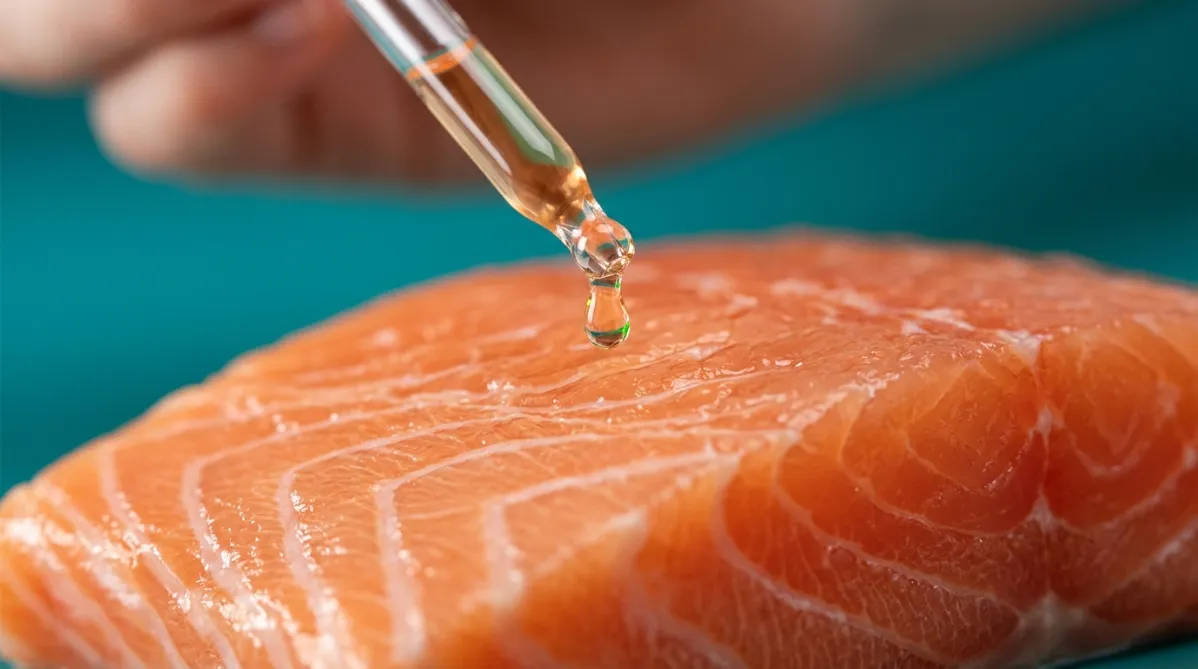
Extreme close-up, slightly high three-quarter angle, of a raw salmon fillet's translucent coral flesh, with a glass pipette releasing a single droplet of pale amber peptide solution onto the muscle fibers. Glistening myotome layers and fine white connective lines are sharp in the foreground, with shallow depth of field melting the rest. The salmon sits on a saturated teal backdrop, so the orange-pink flesh contrasts strongly with it. Soft, large-source studio light from upper left gives crisp specular highlights on the droplet and moist fibers, with gentle neutral shadows. A tiny electric green reflection glints inside the droplet. The mood is precise, fresh and curious, like a food-science lab photograph. Photorealistic, with no text.
peptides

Zalmpeptiden vs wei: +13 % ferritine in 8 weken (pilot met 14 personen)

BY NOVA CHEN ·

Een klein Noors onderzoek liet zien dat 12 g per dag van een zalm‑eiwit‑hydrolysaat de ferritine met circa 13 % en het aantal rode bloedcellen met circa 7 % verhoogde ten opzichte van wei‑eiwit gedurende acht weken. Secundaire uitkomsten wezen op minder ontstekingen, een betere glucoseregulatie en een gunstigere lichaamssamenstelling. De studie betrof slechts 14 deelnemers en werd door de industrie gesponsord, waardoor het meer een aanwijzing dan een definitief bewijs is. Hieronder lees je wat zalmpeptiden precies zijn, wat de pilot aantoont, hoe ze verschillen van collageenpeptiden en waarom voorzichtigheid geboden is.
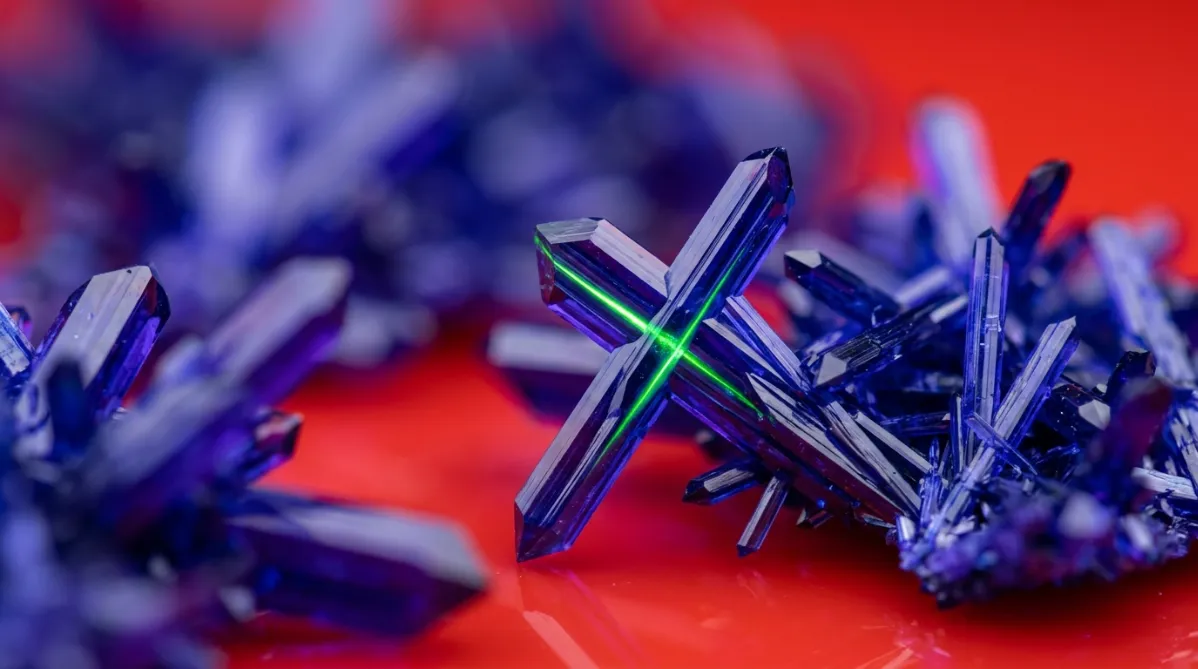
Macro science: an extreme close-up of GHK-Cu copper peptide crystals, deep blue-violet needle-like crystals with faceted edges, shot at a low three-quarter angle with a shallow depth of field so the nearest crystals are razor sharp and the rest dissolve into soft blur. The crystals sit on a smooth, glossy tomato-red backdrop that fills the frame, creating a bold color field. Lighting is a single large softbox from the upper left, giving crisp specular highlights on the crystal faces and a soft, warm-red bounce in the shadows. One tiny thread of electric green light refracts through a single crystal edge as a subtle accent. Mood: striking, precise, curious, scientific without feeling sterile. Photorealistic microscopy-meets-studio look, no text, no labels, no people.
peptides

GHK‑Cu‑koperpeptide kan genennetwerken achter huidherstel afstemmen

BY NOVA CHEN ·

GHK‑Cu, het koperpeptide dat in talloze serums zit, doet waarschijnlijk meer dan alleen hydrateren. Een review uit 2018 stelt dat nieuwe gen‑expressie‑data kunnen verklaren hoe dit kleine molecuul verband houdt met collageenopbouw, weefselherstel, ontstekingsregulatie en zelfs DNA‑reparatie. Hieronder vind je wat het artikel werkelijk meldt over verouderende huid en regeneratie, en waar het bewijs ophoudt. Lees eerst de praktische kanttekeningen over topisch gebruik voordat je de hype gelooft.
Approach: Lab in action. Palette: D, bold color field.

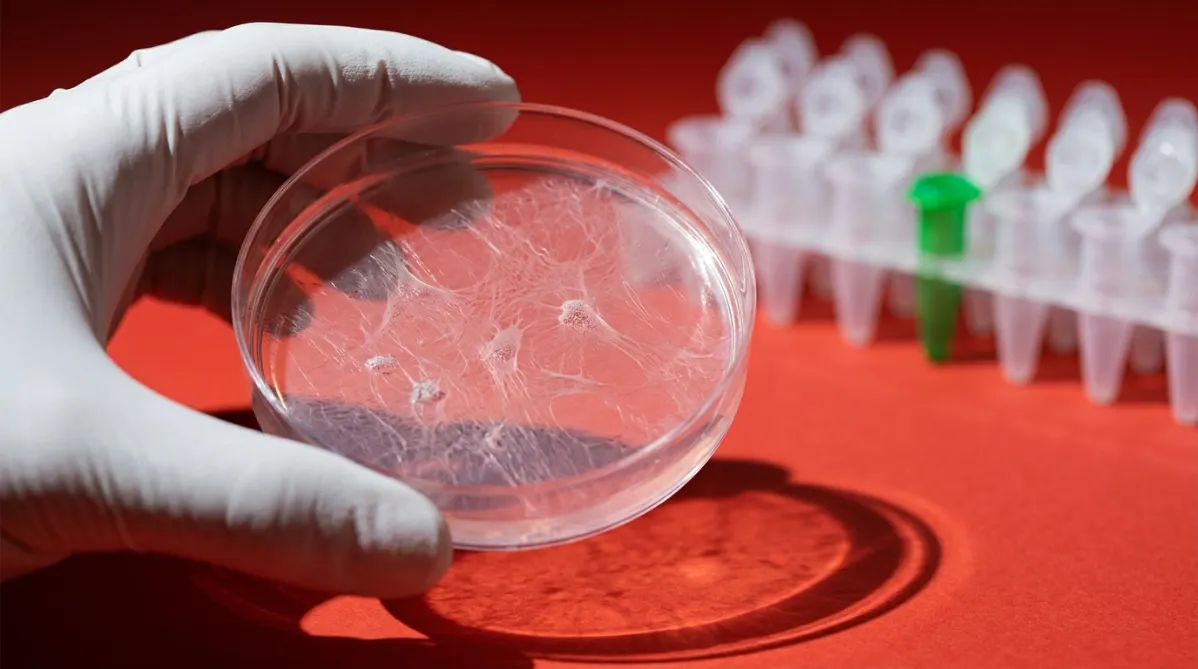
A gloved hand holds a clear petri dish at a slight low angle, close and slightly above eye level, against a saturated tomato-red backdrop. Inside the dish, a thin, translucent layer of pale pink culture medium holds a faint, lacy web of fibroblast cells, with a few small clusters just visible. Hard, clean studio light from the upper left throws a crisp curved shadow of the dish onto the red surface and picks out bright highlights on the rim and the glove's matte white nitrile. In the soft-focus background, a rack of empty microcentrifuge tubes stands out in cool white. One tiny electric green cap on a single tube adds a small accent. The mood is precise and skeptical: a promising result still confined to the dish.
peptides

Epithalon schakelt telomerase in cellen in – maar niet bij mensen

BY HELIX WARD ·

Een piepklein peptide van vier aminozuren zou telomerase activeren – een enzym dat de meeste volwassen cellen stilhoudt – en telomeren verlengen in menselijke cellen. Dat is de basis van de hype rond Epithalon. Het onderzoek werd echter uitgevoerd op foetale fibroblasten in een petrischaal, niet op mensen, en de bewering over levensverlenging blijft een hypothese. Hieronder lees je wat de studie van 2003 werkelijk aantoonde, wat er ontbrak en hoe je dit kritisch moet lezen voordat je iets koopt.
Approach: the human outcome. Palette: natural.

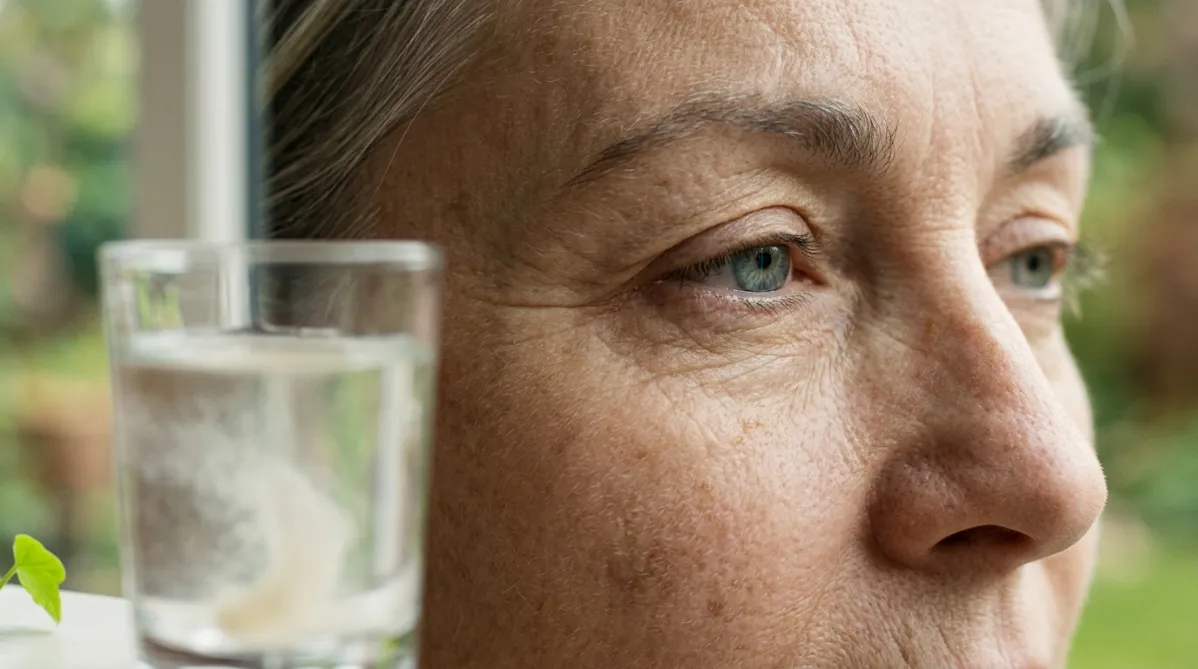
Extreme close-up of a woman's eye and the delicate skin around it, shot from a slight three-quarter angle with a 100mm macro lens and a shallow depth of field. Her skin is a mature 50s complexion with fine crow's feet that are sharp and tactile, with visible pores and soft vellus hairs. Her gaze is relaxed and not at the camera, and the face is cropped so identity isn't the focus. Soft, directional window daylight rakes across the skin from the left to bring out the wrinkle texture, with gentle warm skin tones and a blurred leafy green background outdoors. A single glass of water with a faint dissolving powder swirl sits out of focus in the foreground, with a tiny electric green leaf highlight at the edge. The mood is calm, honest and quietly scientific.
peptides

2,5 g collageenpeptide verminderen oogrimpels met 20 % in 8 weken

BY NOVA CHEN ·

Collageen is een van de meest gezochte beauty‑ en longevity‑supplementen, maar er zijn maar weinig placebogecontroleerde human data. In een proef met 114 vrouwen van 45‑65 jaar verminderde een dosis van 2,5 g per dag van het specifieke bioactieve peptide Verisol het volume van oogrimpels met 20 % ten opzichte van placebo na 8 weken. Biopten toonden 65 % meer procollageen type I en 18 % meer elastine, terwijl een stijging van 6 % in fibrilline niet significant was. Het effect was nog meetbaar 4 weken na de laatste dosering. De resultaten gelden echter alleen voor dit ene merk‑peptide en voor deze populatie, niet voor elke collageenpoeder.
A wide, editorial-style still life photographed from slightly above on a pale warm-gray stone surface, lit by soft diffused morning light from the left. At the center, a delicate chain of 16 small, glossy beads in alternating muted terracotta, sage green, and cream is arranged in a gentle S-curve, each bead slightly different in size, like a hand-strung necklace. It stands for a peptide chain in a tactile, abstract way. Beside the chain, a translucent glass petri dish holds a thin layer of pale amber liquid with a few soft ripples. Behind it, a cross-section of a ripe fig and a halved blood orange show their intricate internal textures, suggesting cellular structure and mitochondria without literal illustration.

On the left side of the frame, a small ceramic mouse figurine in matte off-white sits calmly next to a sprig of dried wheat. It is a subtle nod to the mouse study and is stylized and minimal, not cartoonish. On the right, an open, softly blurred notebook with thin hand-drawn circles and curved lines, like looping pathway diagrams, lies under a brass pen. A few pages are visible but the text is illegible.

Scatter a few elements for texture: a small sprig of eucalyptus, a folded linen napkin in oatmeal tone, and a single clear glass pipette resting diagonally across the lower foreground. The palette is warm neutrals with accents of sage, terracotta, and soft amber, giving a calm, modern wellness-journal look. Shallow depth of field keeps the bead chain crisp while the background gently dissolves into creamy bokeh. Generous negative space across the upper right leaves room for headline overlay. The overall mood is clean, contemporary, and intellectually curious: scientific but warm, like a premium health and science magazine cover, with fine grain, natural shadows, and no text, logos, or futuristic elements.
peptides

MOTS‑c uitgelegd: Het 16‑aminozuur mitochondriale peptide dat AMPK activeerde en muizen beschermde tegen dieet‑geïnduceerde obesitas

BY DR. SYNAPSE ·

Een piepklein peptide van 16 aminozuren, gecodeerd in het mitochondriale DNA in plaats van in de kern, schakelt een master‑regulator van de stofwisseling in spiercellen aan en beschermt muizen tegen dieet‑geïnduceerde obesitas en insulineresistentie. Dit is de belangrijkste bevinding van een *Cell Metabolism*‑artikel uit 2015 en de reden waarom MOTS‑c een van de meest besproken namen is in peptide‑ en bio‑hacking‑kringen. Het onderzoek werd echter uitgevoerd op muizen en op moleculair niveau; het is geen klinische proef met mensen en MOTS‑c is geen goedgekeurde therapie. In dit artikel wordt uitgelegd wat MOTS‑c is, hoe het vermoedelijk werkt via de folaat‑cyclus en AMPK, wat de muizen lieten zien en welke conclusies lezers wel of niet mogen trekken.
A wide, editorial-style still life photographed in soft natural window light on a pale oatmeal-colored linen surface. In the center foreground, a single small amber glass vial with a matte white cap sits slightly off-center to the right, unlabeled and minimal. Beside it lies a delicate, translucent skein of tendon-like fibers, rendered as fine pale ivory threads gently fanning out and twisting together, resting on a folded sheet of cream paper. To the left, a glass petri dish with a thin layer of soft blush-pink liquid, catching a subtle highlight, and a slim pair of stainless steel tweezers laid diagonally across the surface.

Behind the objects, a softly blurred background in muted sage green and warm taupe suggests a quiet laboratory shelf, with out-of-focus glassware shapes and a single trailing sprig of eucalyptus adding an organic note. A thin, hand-drawn style line diagram of interconnected nodes and curved arrows, in faint terracotta ink, is printed on the paper beneath the fibers. It hints at a cellular signaling pathway without any text or readable labels.

The composition uses generous negative space on the left third for potential title overlay, with a shallow depth of field and a gentle diagonal flow from the petri dish to the vial. The color palette is restrained and warm: cream, sage, blush, amber, and terracotta accents, with soft shadows and a faint film-grain texture. The mood is calm, thoughtful, and scientific but approachable, like a contemporary health and science magazine cover. Shot as if with a 50mm lens at f/2.8, top-down at a slight 30-degree angle, with crisp focus on the vial and fibers. No people, no text, no futuristic elements.
peptides

BPC‑157 en peesherstel: wat het FAK‑Paxillin‑onderzoek toont en wat het niet toont

BY DR. SYNAPSE ·

BPC‑157, een 15‑amino‑zuur‑peptide dat vaak wordt geprezen in online ‘genees‑kringen’, heeft een veel geciteerde studie uit 2011 achter zijn reputatie op het gebied van peesherstel. Onderzoekers vonden dat het de groei van pees‑fibroblasten versnelde, de overleving van cellen onder oxidatieve stress verbeterde en de migratie stimuleerde, vermoedelijk via de FAK‑paxillin‑route. Het verhoogde echter niet direct de celproliferatie, en alle resultaten komen uit rattenweefsel en -cellen in het laboratorium. Dit artikel legt het onderliggende mechanisme uit, verduidelijkt waarom er geen menselijk bewijs is, en bespreekt de niet‑goedgekeurde regelgevende status van het peptide.

This page is available in