Biocracked
Approach: Lab in action. Palette: D, bold color field.

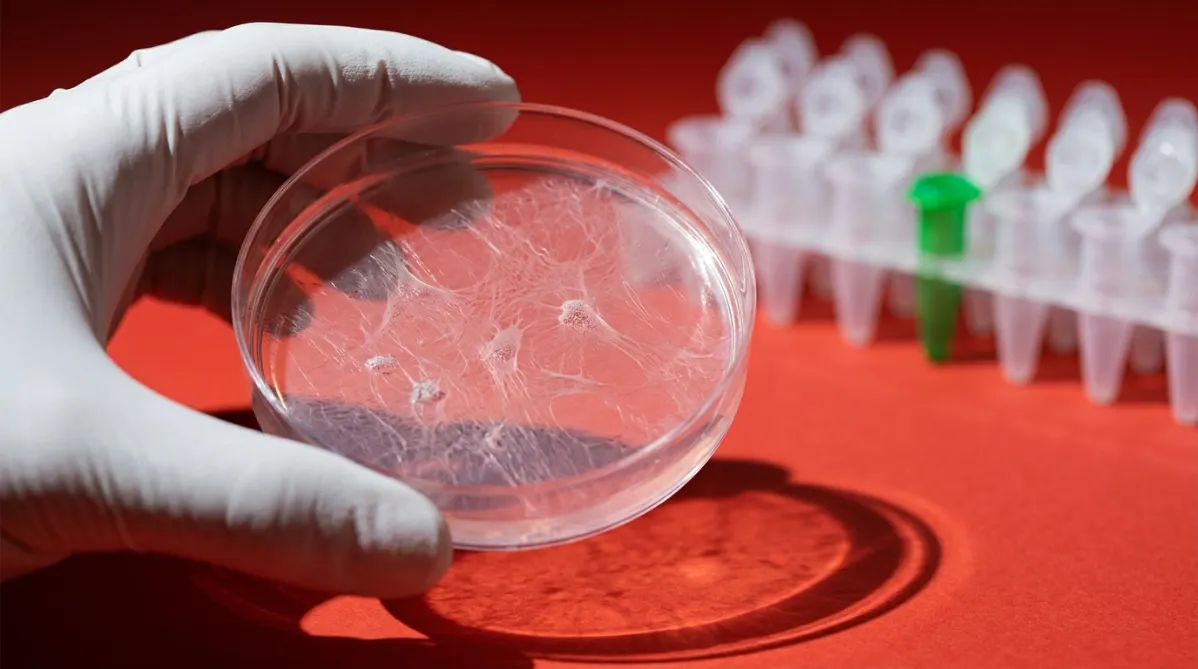
A gloved hand holds a clear petri dish at a slight low angle, close and slightly above eye level, against a saturated tomato-red backdrop. Inside the dish, a thin, translucent layer of pale pink culture medium holds a faint, lacy web of fibroblast cells, with a few small clusters just visible. Hard, clean studio light from the upper left throws a crisp curved shadow of the dish onto the red surface and picks out bright highlights on the rim and the glove's matte white nitrile. In the soft-focus background, a rack of empty microcentrifuge tubes stands out in cool white. One tiny electric green cap on a single tube adds a small accent. The mood is precise and skeptical: a promising result still confined to the dish.
Peptides

Epithalon Switched On Telomerase in Cells—But Not in People

Helix Ward · · 4 min read

A four-amino-acid peptide woke up a gene that most adult human cells keep silent. That is the hook behind Epithalon (also spelled Epitalon), and it is why the compound keeps showing up in longevity forums and peptide vendor catalogs. But the study behind the buzz was done on cells growing in a dish. Here is what it found, and what it does not tell you.

The short version

A 2003 paper in Bulletin of Experimental Biology and Medicine, by Khavinson, Bondarev and Butyugov, reported that adding Epithalon to telomerase-negative human fetal fibroblasts in culture did three things:

  • Induced expression of the catalytic subunit of telomerase
  • Produced measurable telomerase enzymatic activity
  • Led to telomere elongation

The authors suggested this may reflect reactivation of the telomerase gene in somatic cells. They also proposed that it "indicates the possibility" of prolonging the lifespan of a cell population and of the whole organism.

That last phrase is a hypothesis. The abstract describes a cell-culture experiment, not a lifespan result.

Why telomerase gets so much attention

Telomeres are repetitive DNA caps at the ends of chromosomes. In most normal somatic cells they shorten a little with each division. When they get short enough, cells stop dividing or enter senescence. Telomerase is the enzyme that adds telomere sequence back, and its catalytic subunit (hTERT) is usually the limiting piece. Most adult somatic cells express little or none of it.

So a compound that switches on hTERT and lengthens telomeres in cells that normally lack it is naturally interesting. It is also why "telomerase activation" is a double-edged phrase. Telomerase reactivation is a hallmark of many cancers, which use it to divide without limit. Whether a peptide can safely do this in a living human is a very different question from whether it did so in a dish.

What Epithalon is

Epithalon is a short synthetic peptide, generally described as Ala-Glu-Asp-Gly. It was developed in Russian research circles associated with Vladimir Khavinson, and it is modeled on a pineal-gland extract called epithalamin. Much of the published work on it comes from that same research network. That does not make the findings wrong, but independent replication matters, and it is thinner here than the marketing suggests.

The honest limits

This is the part vendors tend to skip.

1. It is a cell-culture study

The experiment used human fetal fibroblasts, which are young cells grown under lab conditions. Cultured cells lack the immune system, hormones, tissue architecture, metabolism and delivery barriers of a living person. A result in a dish often fails to carry over.

2. It is not a human clinical trial

No people were dosed in this paper. It tells you nothing about the dose, safety, route of administration, or whether any effect would occur in human tissue.

3. It does not show lifespan extension

The abstract speaks of the "possibility" of prolonging life span. Telomere length in cultured cells is not the same as healthspan or longevity in a person. Aging involves many pathways beyond telomeres.

4. It is a single, early paper

The abstract reports one experimental system. A stronger evidence base would include independent labs, different cell types, dose-response data, and eventually controlled human trials.

5. The cancer question is unresolved here

Inducing telomerase is exactly what you would want to study carefully for safety. This abstract does not address long-term risk, and it should not be read as evidence of safety.

What this means for peptide shoppers

If you are weighing whether to buy Epithalon, here is a practical way to read the evidence.

What the paper supports:

  • Epithalon is a legitimate subject of laboratory research
  • In one culture system, it was reported to induce hTERT expression, telomerase activity and telomere lengthening
  • It is a reasonable lead for further investigation

What the paper does not support:

  • That Epithalon lengthens telomeres in people who use it
  • That it slows or reverses human aging
  • That any particular dose, cycle or protocol is effective or safe
  • That products sold online contain what the label says

Questions worth asking before you spend money:

  • Is the seller marketing it as a "research chemical" while implying human benefits? That is a red flag.
  • Is there third-party testing for purity and identity?
  • Is it a regulated medicine in your country? In many places it is not approved for human use.
  • Have you talked to a clinician, especially if you have a personal or family history of cancer?

The bottom line

The 2003 study is a real, interesting finding: a tiny peptide reported to reactivate telomerase machinery in human cells that normally lack it. It is a starting point for questions, not an answer. The leap from "elongated telomeres in cultured fetal fibroblasts" to "a longevity supplement for you" skips the human trials that would be needed to justify it.

Treat Epithalon as a promising lab observation. Until controlled human data exist, claims that it extends human life remain unproven.

This article is for informational purposes only and is not medical advice.

Original study

Read the original research on pubmed.ncbi.nlm.nih.gov →

This article summarizes published research for general information. It is not medical advice.

HW

Written by

Helix Ward

Helix Ward writes for Biocracked: biohacking science, longevity & human performance.

Related Articles

**Approach: Conceptual metaphor. Palette: B, Warm.**

A close, slightly high three-quarter view of a single weathered hemp rope stretched horizontally across the frame, shot at a shallow depth of field. On the left the rope is thick and tightly twisted. On the right it has frayed down to a few thin strands, with a short, neat whipping of bright electric green thread binding the rope just where the fraying stops. Golden-hour sunlight enters low from the left and picks out each individual fiber in honey and copper tones. Soft amber shadows fall across a blurred, sun-warmed wooden dock in the background. The mood is quiet and cautiously hopeful, suggesting something worn down slowly but partly held in place. The image is photorealistic and has no text.
longevity

Vitamin D3 Preserved 140 Base Pairs of Telomere in a 4-Year RCT

BY DR. SYNAPSE ·

A large, randomized, placebo-controlled trial found that four years of vitamin D3 slowed telomere shortening by about 140 base pairs. The data come from the VITAL study of older U.S. adults taking 2,000 IU/day. The effect was modest and borderline significant (p=0.039), and telomere length is a surrogate marker, not proof of a longer life. Omega-3s, meanwhile, did nothing for telomeres in this trial. Here is what the numbers show, what the limits are, and how to use the finding sensibly.

Approach: macro science. Palette: warm (amber and copper).

Extreme close-up of a freshly sliced king oyster mushroom stem and gill edge, shot at a slight 30-degree overhead angle with a macro lens and shallow depth of field. The pale cream flesh shows individual fibrous hyphae and glistening moisture beads. Warm low-angle golden light rakes across from the left, turning the gill ridges into amber and copper lines with deep honey-brown shadows. A single tiny droplet on the cut surface catches a pinpoint of electric green reflection, as if lit from a hidden source. Background melts into out-of-focus burnished orange and chocolate tones. The mood is quiet, intimate and investigative, with real organic texture and no text.
longevity

Mushroom 'Longevity Vitamin' Raised NAD+ in Aged Rats via H2S Switch

BY HELIX WARD ·

Ergothioneine, the mushroom compound nicknamed the 'longevity vitamin,' just got a mechanism to match its buzz. In a Cell Metabolism study, aged rats given ET ran farther, gained vascularization and muscle, and showed higher muscle NAD+. The effect traced back to a hydrogen sulfide pathway: CSE, persulfidation, and the enzyme cGPDH. Knock out CSE or cGPDH and the benefits vanished. But this is animal and lab work, and the effective rat dose scales to roughly 10x what supplements typically provide.

Macro science: an extreme close-up of GHK-Cu copper peptide crystals, deep blue-violet needle-like crystals with faceted edges, shot at a low three-quarter angle with a shallow depth of field so the nearest crystals are razor sharp and the rest dissolve into soft blur. The crystals sit on a smooth, glossy tomato-red backdrop that fills the frame, creating a bold color field. Lighting is a single large softbox from the upper left, giving crisp specular highlights on the crystal faces and a soft, warm-red bounce in the shadows. One tiny thread of electric green light refracts through a single crystal edge as a subtle accent. Mood: striking, precise, curious, scientific without feeling sterile. Photorealistic microscopy-meets-studio look, no text, no labels, no people.
peptides

GHK-Cu Copper Peptide May Tune Gene Networks Behind Skin Repair

BY NOVA CHEN ·

GHK-Cu, the copper peptide in countless serums, may do far more than moisturize. A 2018 review argues that new gene-expression data could explain how this one small molecule is linked to collagen building, tissue repair, inflammation control, and even DNA repair. Here's what the paper actually reports on aging skin and regeneration, and where the evidence stops. Before you buy into the hype, read the practical caveats on topical use and what a review can and can't prove.

Approach: macro science. Palette: bold color field (violet).

Extreme close-up of fisetin crystals, a small cluster of pale yellow needle-like flavonoid crystals with translucent, faceted edges, resting on a smooth glossy deep violet surface. The camera sits low at a shallow three-quarter angle with a very shallow depth of field, so the front crystals are razor sharp and the rest dissolves into soft magenta-violet blur. Lighting is a single crisp, slightly warm studio key from upper left that makes the crystal edges glow and throws long soft shadows across the violet. A few tiny electric green (#00e676) specks of reflected light catch on the crystal tips. The mood is precise, curious and quietly promising, like a sample under inspection, with plenty of clear violet space on the right side of the frame.
longevity

Fisetin Senolytic Extended Mouse Lifespan—Human Proof Still Missing

BY HELIX WARD ·

Fisetin, a plant flavonoid, emerged as the most potent senolytic among ten compounds in a widely cited 2018 EBioMedicine study. In aged mice, treatment late in life reduced senescence markers, eased age-related pathology and extended both median and maximum lifespan. The catch is that this is mouse and lab evidence, not a completed human longevity trial. This article explains what the researchers found, what the dosing context really means, and who should pay attention as human studies develop.

This page is available in