Biocracked
←

#telomeres

2 articles
Approach: Lab in action. Palette: D, bold color field.

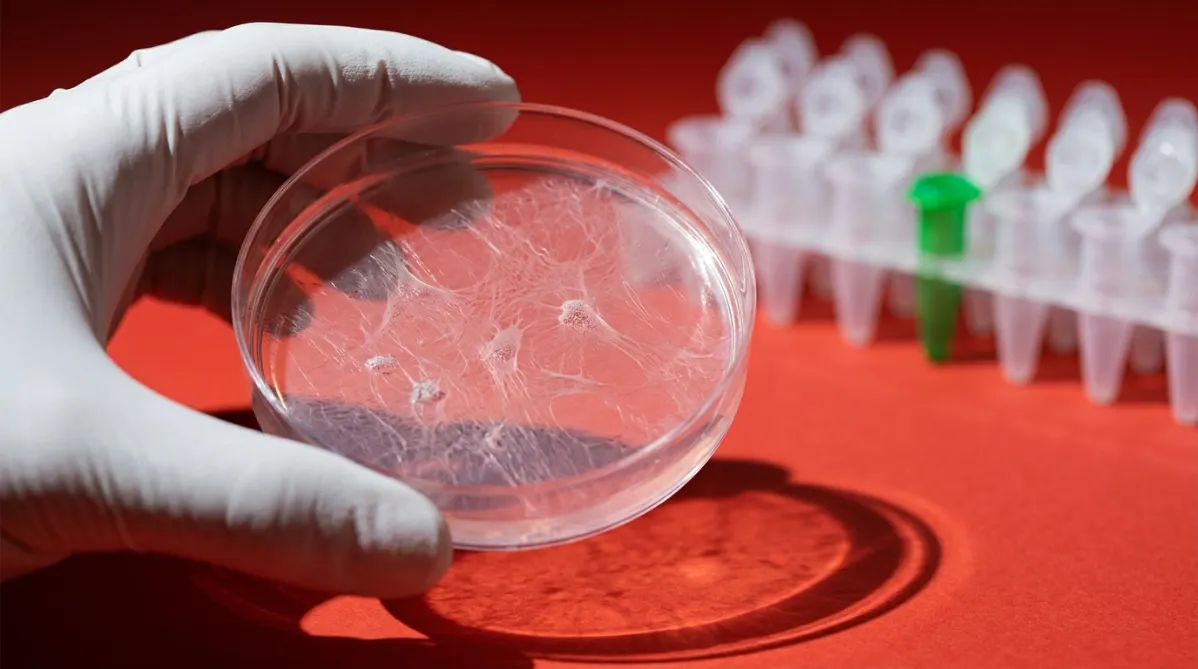
A gloved hand holds a clear petri dish at a slight low angle, close and slightly above eye level, against a saturated tomato-red backdrop. Inside the dish, a thin, translucent layer of pale pink culture medium holds a faint, lacy web of fibroblast cells, with a few small clusters just visible. Hard, clean studio light from the upper left throws a crisp curved shadow of the dish onto the red surface and picks out bright highlights on the rim and the glove's matte white nitrile. In the soft-focus background, a rack of empty microcentrifuge tubes stands out in cool white. One tiny electric green cap on a single tube adds a small accent. The mood is precise and skeptical: a promising result still confined to the dish.
peptides

Epithalon Switched On Telomerase in Cells—But Not in People

BY HELIX WARD ·

A tiny four-amino-acid peptide reportedly switched on telomerase, an enzyme most adult cells keep silent, and lengthened telomeres in human cells. That is the finding behind Epithalon's longevity buzz. But it came from fetal fibroblasts in a dish, not from people, and the paper's talk of extending lifespan is a hypothesis. Here is what the 2003 study actually showed, what it leaves out, and how to read it before you buy anything.

**Approach: Conceptual metaphor. Palette: B, Warm.**

A close, slightly high three-quarter view of a single weathered hemp rope stretched horizontally across the frame, shot at a shallow depth of field. On the left the rope is thick and tightly twisted. On the right it has frayed down to a few thin strands, with a short, neat whipping of bright electric green thread binding the rope just where the fraying stops. Golden-hour sunlight enters low from the left and picks out each individual fiber in honey and copper tones. Soft amber shadows fall across a blurred, sun-warmed wooden dock in the background. The mood is quiet and cautiously hopeful, suggesting something worn down slowly but partly held in place. The image is photorealistic and has no text.
longevity

Vitamin D3 Preserved 140 Base Pairs of Telomere in a 4-Year RCT

BY DR. SYNAPSE ·

A large, randomized, placebo-controlled trial found that four years of vitamin D3 slowed telomere shortening by about 140 base pairs. The data come from the VITAL study of older U.S. adults taking 2,000 IU/day. The effect was modest and borderline significant (p=0.039), and telomere length is a surrogate marker, not proof of a longer life. Omega-3s, meanwhile, did nothing for telomeres in this trial. Here is what the numbers show, what the limits are, and how to use the finding sensibly.

This page is available in