BPC-157, a 15-amino-acid peptide often marketed as a "healing peptide," has become a fixture of online biohacking and sports-injury conversations. Much of the enthusiasm traces back to a small set of preclinical studies. One of the most frequently cited mechanistic papers, published in the Journal of Applied Physiology in 2011 by Chang and colleagues, asked how the peptide might help injured tendon heal. The answer points to cell movement and survival rather than cell multiplication. The study is also a good example of why cell-culture findings should not be mistaken for clinical evidence.
Where BPC-157 Comes From
BPC-157 is a pentadecapeptide, meaning it is made of 15 amino acids. It is a partial sequence of a larger "body protection compound" originally described in human gastric juice. In earlier animal experiments, it was reported to speed the healing of several types of wounds, including transected rat Achilles tendon. Those findings raised an obvious question: what is the peptide actually doing at the cellular level? The 2011 Taiwanese study set out to address that.
What the Researchers Did
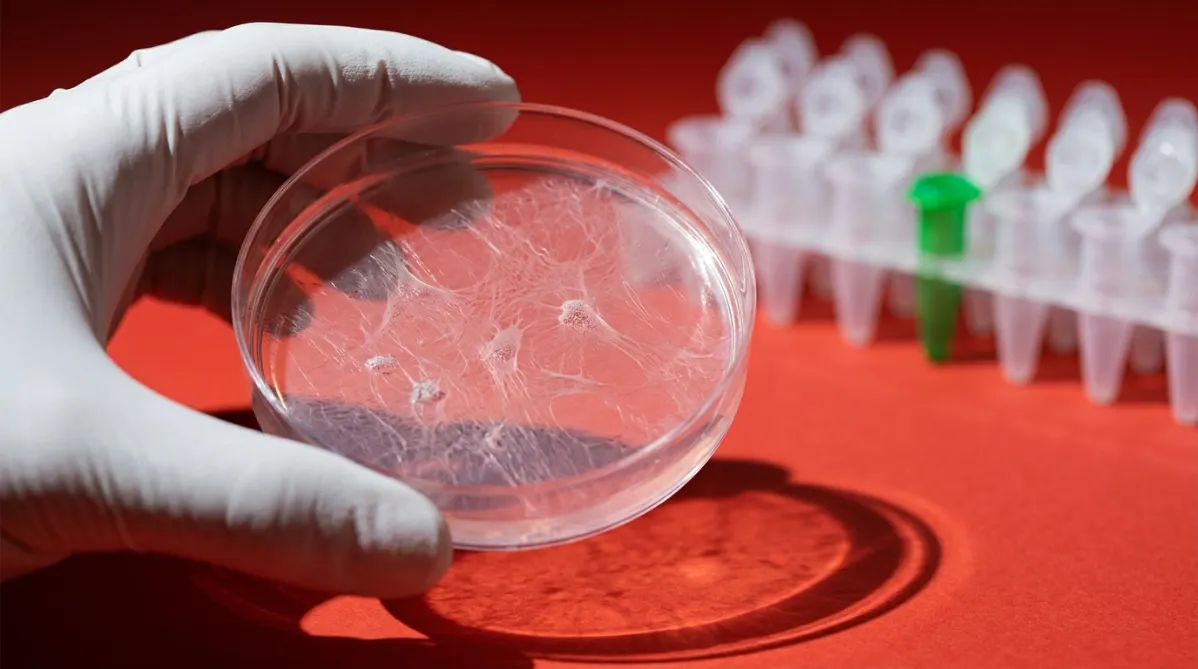
The team worked with rat tissue. They cultured tendon explants, small pieces of Achilles tendon, with or without BPC-157 and measured how many fibroblasts grew out from them. They also isolated tendon fibroblasts from rat Achilles tendon and tested the peptide's effects on proliferation, survival under oxidative stress, migration, spreading, cytoskeletal changes, and intracellular signaling.
These are laboratory models, either cells in dishes or tissue fragments kept alive ex vivo. They show what can happen to isolated rat cells under controlled conditions. They do not show what happens in a living, injured human tendon.
Key Findings
Outgrowth. BPC-157 significantly accelerated the outgrowth of fibroblasts from tendon explants. Fibroblasts are the cells that produce and remodel tendon's collagen-rich matrix, so faster outgrowth is a plausible proxy for repair-related activity.
No direct effect on proliferation. Using an MTT assay, the researchers found that BPC-157 did not directly change fibroblast proliferation. This undercuts the simple idea that the peptide works by making more cells.
Survival under stress. When cells were exposed to hydrogen peroxide, an oxidative stressor, those treated with BPC-157 survived significantly better. Oxidative stress is a feature of injured tissue, so this is a potentially relevant observation, though it remains a cell-culture result.
Migration and spreading. In a transwell filter assay, BPC-157 increased fibroblast migration in a dose-dependent manner. It also accelerated how quickly the cells spread on culture dishes, and it induced F-actin formation, the cytoskeletal remodeling that cells need in order to move.
The FAK-Paxillin Pathway
The mechanistic centerpiece of the paper is the signaling analysis. Focal adhesion kinase (FAK) and paxillin are proteins found at focal adhesions, the structures that anchor a cell to its surroundings and relay mechanical and chemical signals. Activation of this pathway is closely tied to cell motility, spreading, and survival.
Using Western blots, the authors found that BPC-157 dose-dependently increased the phosphorylation of both FAK and paxillin, while the total amount of each protein stayed the same. In other words, the peptide appeared to switch existing proteins on rather than increase their production. The authors concluded that the effects on migration and spreading are likely mediated by FAK-paxillin activation.
The word "likely" matters. The study shows an association between BPC-157 exposure and pathway activation, but it does not prove that this pathway is the sole or even the principal route by which BPC-157 acts. It also does not identify the receptor or upstream trigger.
Why This Is Not Evidence for Use in People
Several limits are worth stating plainly:
- Species and setting. The work used rat-derived tendon tissue and cells in vitro and ex vivo. Cultured fibroblasts lack blood supply, immune cells, mechanical loading, and the other complexities of a healing tendon.
- Mechanism, not outcome. The paper reports cellular behaviors, not restored tendon strength, function, or recovery time.
- No human trials here. This study contains no human participants. Published human data on BPC-157 overall are extremely sparse, and the claims in supplement and peptide marketing far outrun the controlled clinical evidence.
- Dose-dependence is not guidance. The study describes dose-dependent effects in cell culture. Those concentrations cannot be translated into amounts for people, and this article does not offer any dosing recommendations.
Regulatory Status
BPC-157 is not an approved drug in the United States or in other major jurisdictions. The U.S. FDA has placed it on a list of bulk drug substances that raise safety concerns for compounding, citing limited safety information and potential risks such as immunogenicity and impurities. The World Anti-Doping Agency also prohibits it as a non-approved substance, a matter of real concern for competitive athletes. Products sold online as "research chemicals" are not manufactured or tested to pharmaceutical standards, so their identity, purity, and sterility cannot be assumed.
What Comes Next
The Chang study is a useful piece of basic science. It suggests that BPC-157's tendon-related effects may come from enhancing cell migration, cytoskeletal dynamics, and stress resistance through FAK-paxillin signaling, not from stimulating cell division. For drug-delivery and tissue-repair researchers, that gives a testable hypothesis. Answering it would require identifying the molecular target, replicating the findings independently, running rigorous animal studies with functional endpoints, and ultimately conducting well-designed, controlled human trials with proper safety monitoring.
Until that evidence exists, BPC-157 remains an investigational peptide with an intriguing preclinical profile. Anyone with a tendon injury should rely on established care from a qualified clinician rather than on cell-culture results.