Biocracked
←

#obesity

2 articles
Approach: Macro science. Palette: D, bold color field.

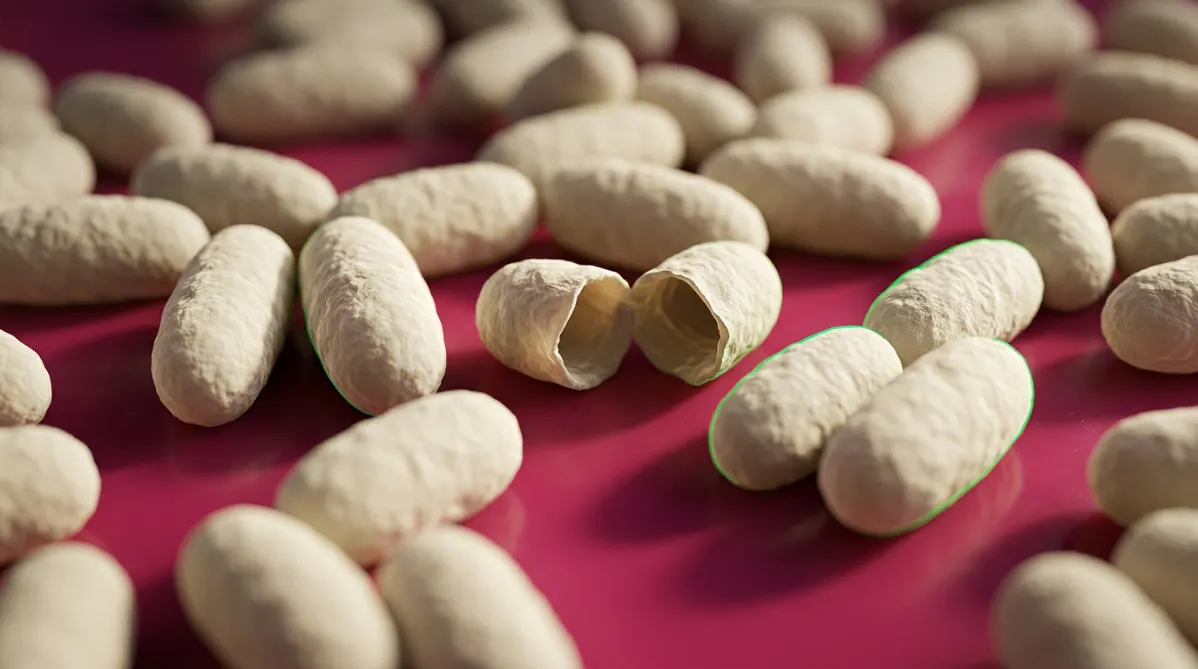
Extreme close-up microscopy-style photograph of a dense cluster of oval, rod-shaped bacterial cells, rendered as slightly wrinkled, matte, pale cream-white forms with visible surface texture. They rest on a smooth, saturated magenta-pink gel surface. Several cells in the foreground are crisp, while the rest fall into soft shallow depth of field. One cell near the center is split open and visibly hollow, to suggest a dead, heat-treated organism. Camera is a low three-quarter angle, as if through a scanning microscope. Lighting is a single hard, warm-white side light that casts short crisp shadows and creates bright rim highlights. A thin electric green (#00e676) line of reflected light traces the edge of one cell. The mood is stark, curious and quietly skeptical. There is no text and no labels.
metabolism

De darmbacterie die dood beter werkt: 29 % voordeel van Akkermansia

BY HELIX WARD ·

In de eerste klinische studie naar *Akkermansia muciniphila* leverde de gepasteuriseerde (verhitte) variant, en niet de levende, de sterkste resultaten. De insulinegevoeligheid nam met 28,62 % toe en het nuchtere insulineniveau daalde met 34,08 % ten opzichte van placebo bij overgewichtige, insulineresistente volwassenen. Het gewichts‑ en vetverlies waar iedereen op hoopt, bereikte geen statistische significantie, en enkele auteurs hebben patenten aangevraagd en een bedrijf opgericht dat de bacterie commercieel aanbiedt. Hieronder vind je wat de studie aantoonde, wat ze niet kan bewijzen en waar je op moet letten voordat je een supplement aanschaft.
A wide, editorial-style still life photographed from slightly above on a pale warm-gray stone surface, lit by soft diffused morning light from the left. At the center, a delicate chain of 16 small, glossy beads in alternating muted terracotta, sage green, and cream is arranged in a gentle S-curve, each bead slightly different in size, like a hand-strung necklace. It stands for a peptide chain in a tactile, abstract way. Beside the chain, a translucent glass petri dish holds a thin layer of pale amber liquid with a few soft ripples. Behind it, a cross-section of a ripe fig and a halved blood orange show their intricate internal textures, suggesting cellular structure and mitochondria without literal illustration.

On the left side of the frame, a small ceramic mouse figurine in matte off-white sits calmly next to a sprig of dried wheat. It is a subtle nod to the mouse study and is stylized and minimal, not cartoonish. On the right, an open, softly blurred notebook with thin hand-drawn circles and curved lines, like looping pathway diagrams, lies under a brass pen. A few pages are visible but the text is illegible.

Scatter a few elements for texture: a small sprig of eucalyptus, a folded linen napkin in oatmeal tone, and a single clear glass pipette resting diagonally across the lower foreground. The palette is warm neutrals with accents of sage, terracotta, and soft amber, giving a calm, modern wellness-journal look. Shallow depth of field keeps the bead chain crisp while the background gently dissolves into creamy bokeh. Generous negative space across the upper right leaves room for headline overlay. The overall mood is clean, contemporary, and intellectually curious: scientific but warm, like a premium health and science magazine cover, with fine grain, natural shadows, and no text, logos, or futuristic elements.
peptides

MOTS‑c uitgelegd: Het 16‑aminozuur mitochondriale peptide dat AMPK activeerde en muizen beschermde tegen dieet‑geïnduceerde obesitas

BY DR. SYNAPSE ·

Een piepklein peptide van 16 aminozuren, gecodeerd in het mitochondriale DNA in plaats van in de kern, schakelt een master‑regulator van de stofwisseling in spiercellen aan en beschermt muizen tegen dieet‑geïnduceerde obesitas en insulineresistentie. Dit is de belangrijkste bevinding van een *Cell Metabolism*‑artikel uit 2015 en de reden waarom MOTS‑c een van de meest besproken namen is in peptide‑ en bio‑hacking‑kringen. Het onderzoek werd echter uitgevoerd op muizen en op moleculair niveau; het is geen klinische proef met mensen en MOTS‑c is geen goedgekeurde therapie. In dit artikel wordt uitgelegd wat MOTS‑c is, hoe het vermoedelijk werkt via de folaat‑cyclus en AMPK, wat de muizen lieten zien en welke conclusies lezers wel of niet mogen trekken.

This page is available in