Biocracked
←

#alzheimers

2 articles
Approach: conceptual metaphor. Palette: D, bold color field.

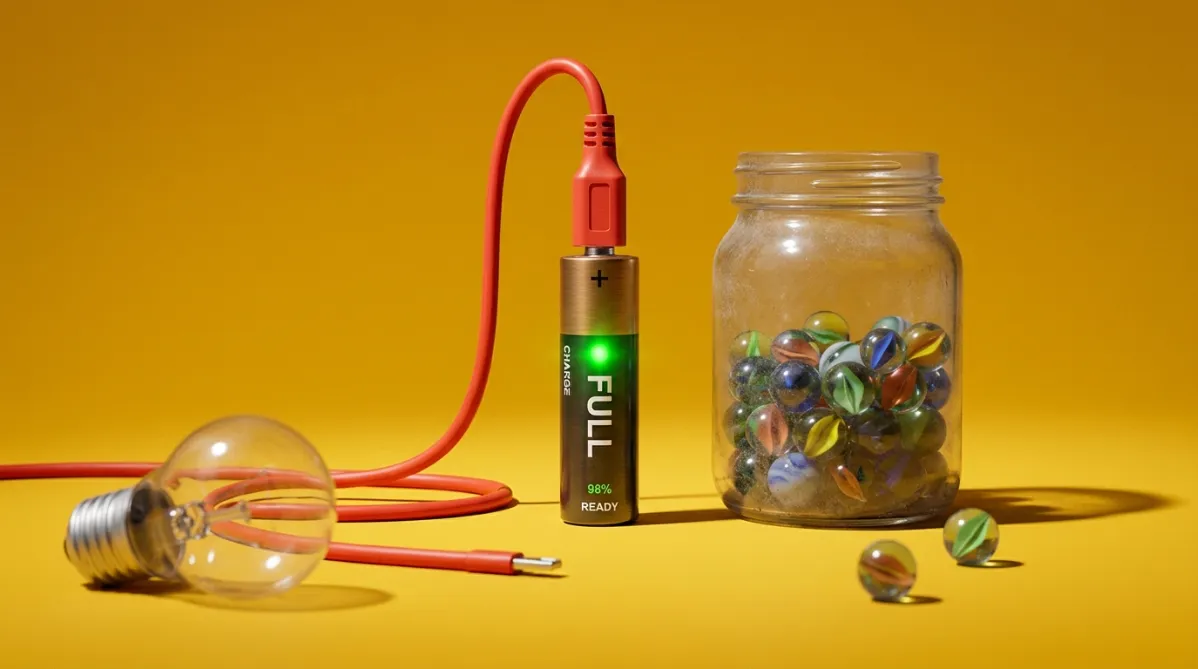
A single AA-style cylindrical battery stands upright, fully charged, on a seamless saturated mustard-yellow backdrop. Beside it sits a matching, untouched, slightly dusty glass jar of marbles, so the charge shows no visible link to any result. More precisely, a bright tomato-red extension cord plugs into the battery's top. Its other end curls away unconnected, lying on the floor beside an unlit incandescent bulb. A small electric green LED glows on the battery's side as the only green accent. Camera: low three-quarter angle, 50mm lens, shallow depth of field, with the bulb softly blurred in the foreground. Lighting: hard, clean studio key light from the upper left, with crisp shadows falling to the right on the yellow surface. Mood: puzzled, wry, a full power source that fails to light anything.
supplements

Nicotinamide riboside a doublé le NAD+ mais n’a pas amélioré la mémoire

BY NOVA CHEN ·

Un complément a doublé une molécule clé dans le sang, mais la mémoire est restée inchangée. Dans un essai randomisé de 12 semaines chez des personnes âgées atteintes d’un trouble cognitif léger amnésique, le nicotinamide riboside a multiplié par deux le taux de NAD+ sans améliorer la cognition, le flux sanguin cérébral total ni la pression artérielle. Une analyse exploratoire suggère une légère hausse du flux sanguin hippocampique, mais cela reste très préliminaire. Voici ce que révèle réellement l’étude, ses limites et ce que cela signifie si vous pensez acheter un booster de NAD+.
Approach: macro science, a lithium-themed image built around the actual metal and tissue. Palette: bold color field in saturated teal.

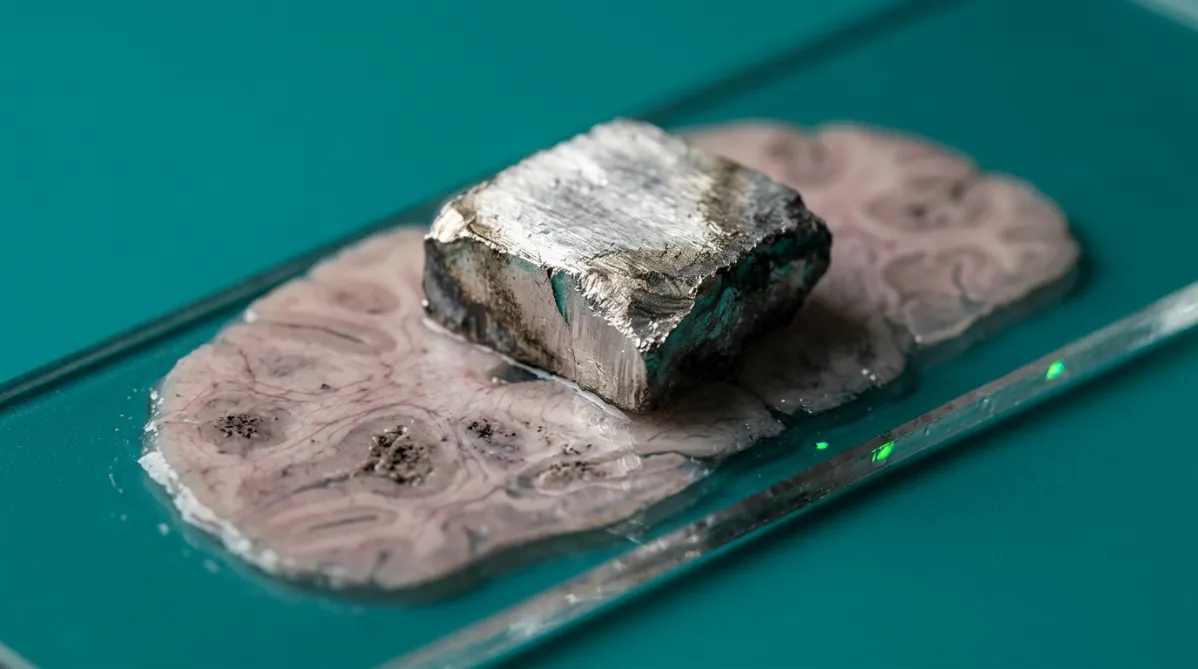
Extreme close-up photograph of a single freshly cut piece of silvery lithium metal, its surface partly tarnishing to grey and matte black at the edges, resting on a thin slice of translucent brain tissue on a glass microscope slide. The slice shows fine pink-grey folds and a few dark clumped plaque-like specks. The backdrop is a smooth saturated teal field, with the slide placed diagonally. Shallow depth of field keeps the metal edge razor sharp while the tissue softens toward the corners. Lighting is a crisp, slightly warm side light from the left, with a small specular highlight on the metal and a soft shadow on the teal. A tiny electric green reflection glints in the glass edge. The mood is quiet, investigative and precise. Shot from a low 30-degree angle, with no text or labels.
research

Le minéral trace qui disparaît du cerveau avant l’apparition de la maladie d’Alzheimer

BY DR. SYNAPSE ·

Une étude phare publiée dans *Nature* par Harvard a montré que le lithium était le seul métal nettement diminué dans le cerveau des personnes présentant des troubles cognitifs légers. Chez la souris, réduire le lithium de moitié a déclenché l’accumulation d’amyloïde, une pathologie tau, de l’inflammation et des pertes de mémoire, tandis qu’une faible dose de lithium orotate a tout empêché. Le composé semble échapper aux plaques amyloïdes qui capturent les autres sels de lithium. Mais ces résultats concernent uniquement les souris, aucune étude clinique humaine n’a encore été menée, et le lithium comporte de réels risques rénaux, thyroïdiens et d’interactions médicamenteuses.

This page is available in