Biocracked
←

#alzheimers

2 articles
Approach: conceptual metaphor. Palette: D, bold color field.

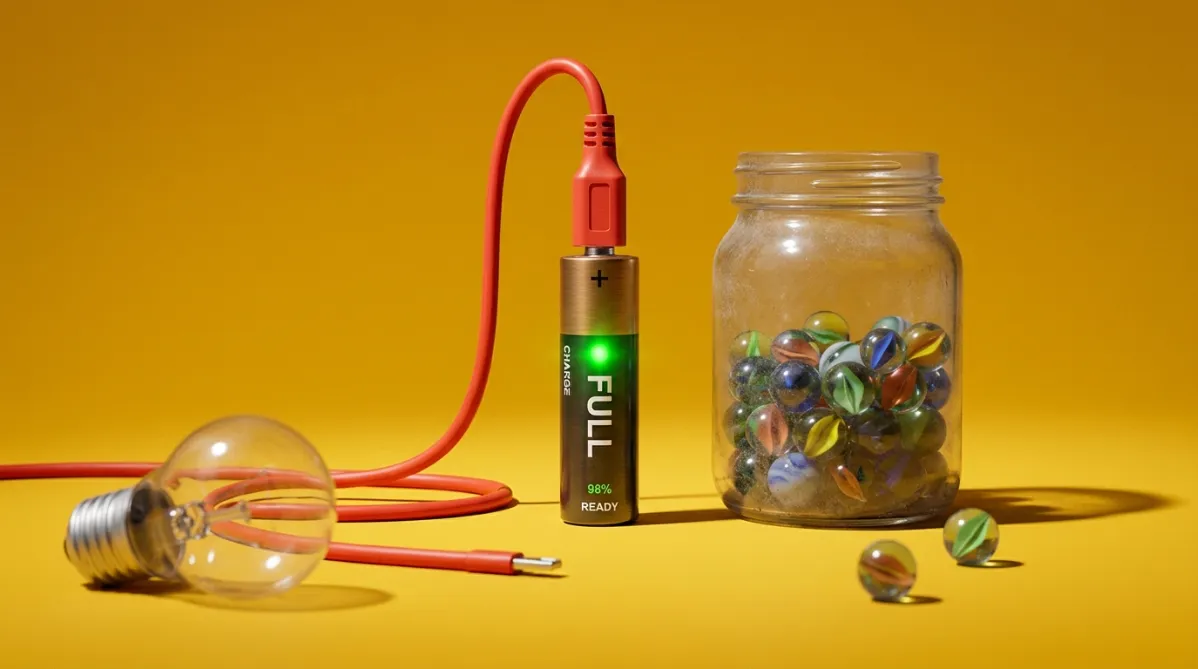
A single AA-style cylindrical battery stands upright, fully charged, on a seamless saturated mustard-yellow backdrop. Beside it sits a matching, untouched, slightly dusty glass jar of marbles, so the charge shows no visible link to any result. More precisely, a bright tomato-red extension cord plugs into the battery's top. Its other end curls away unconnected, lying on the floor beside an unlit incandescent bulb. A small electric green LED glows on the battery's side as the only green accent. Camera: low three-quarter angle, 50mm lens, shallow depth of field, with the bulb softly blurred in the foreground. Lighting: hard, clean studio key light from the upper left, with crisp shadows falling to the right on the yellow surface. Mood: puzzled, wry, a full power source that fails to light anything.
supplements

Nicotinamid‑Ribosid verdoppelte NAD+ – brachte aber keinen Gedächtniszuwachs

BY NOVA CHEN ·

Ein Nahrungsergänzungsmittel verdoppelte die Konzentration eines Schlüsselmoleküls im Blut, doch die Gedächtnisleistung blieb unverändert. In einer zwölf‑wöchigen, randomisierten Studie mit älteren Menschen, die an amnestischer leichter kognitiver Beeinträchtigung litten, wurde NAD+ zwar zweifach erhöht, aber weder die kognitive Funktion, der gesamte Hirn‑Blutfluss noch der Blutdruck verbesserten sich. Ein vorsichtig zu interpretierender Hinweis auf einen erhöhten Hippocampus‑Blutfluss wurde gefunden, was jedoch kein Beweis für einen Nutzen darstellt. Der Artikel erklärt, was die Studie tatsächlich beweist, wo ihre Grenzen liegen und was das für potenzielle Käufer von NAD+-Boostern bedeutet.
Approach: macro science, a lithium-themed image built around the actual metal and tissue. Palette: bold color field in saturated teal.

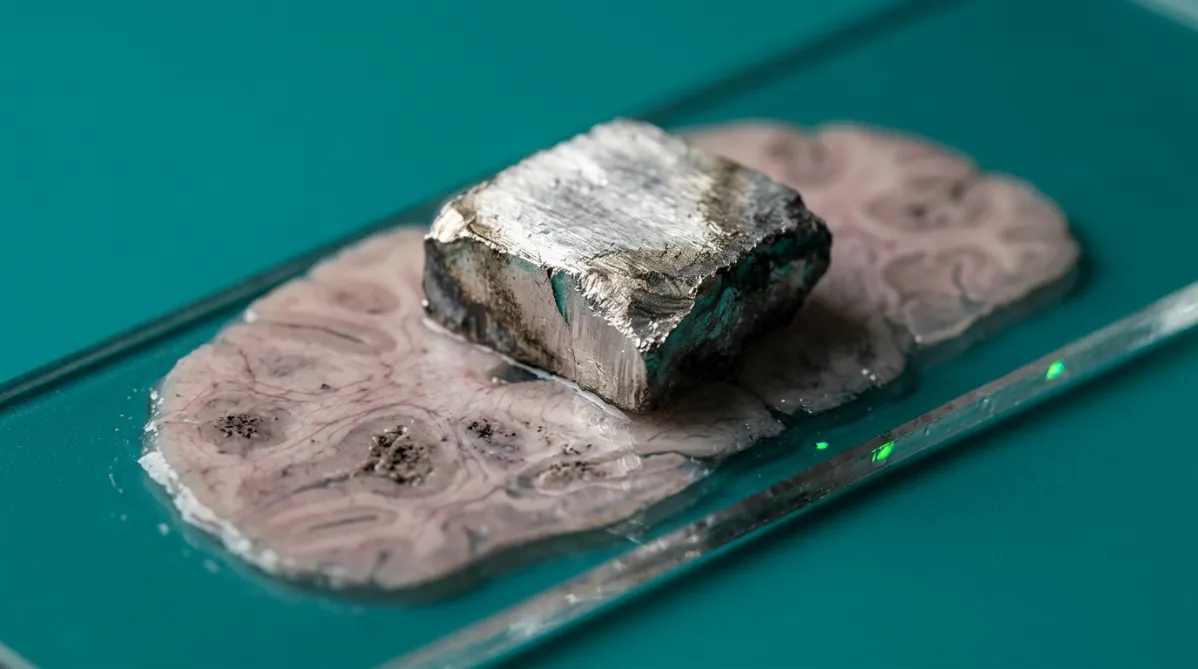
Extreme close-up photograph of a single freshly cut piece of silvery lithium metal, its surface partly tarnishing to grey and matte black at the edges, resting on a thin slice of translucent brain tissue on a glass microscope slide. The slice shows fine pink-grey folds and a few dark clumped plaque-like specks. The backdrop is a smooth saturated teal field, with the slide placed diagonally. Shallow depth of field keeps the metal edge razor sharp while the tissue softens toward the corners. Lighting is a crisp, slightly warm side light from the left, with a small specular highlight on the metal and a soft shadow on the teal. A tiny electric green reflection glints in the glass edge. The mood is quiet, investigative and precise. Shot from a low 30-degree angle, with no text or labels.
research

Das Spurenelement, das bereits vor dem Auftreten von Alzheimer aus dem Gehirn verschwindet

BY DR. SYNAPSE ·

Eine wegweisende Studie in *Nature* von Harvard hat gezeigt, dass Lithium das einzige Metall ist, das im Gehirn von Menschen mit leichter kognitiver Beeinträchtigung deutlich reduziert ist. Bei Mäusen führte eine Reduktion des Lithiumspiegels um etwa die Hälfte zu Amyloid‑Ablagerungen, Tau‑Pathologie, Entzündungen und Gedächtnisverlust, während eine niedrige Dosis Lithium‑Orotate dies verhinderte. Das Salz scheint den Amyloid‑Plaques zu entgehen, die andere Lithiumsalze festhalten. Die Ergebnisse stammen jedoch ausschließlich aus Mausmodellen, es gibt noch keine klinische Studie am Menschen, und Lithium birgt echte Risiken für Niere, Schilddrüse und Wechselwirkungen. Im Folgenden wird erklärt, was die Studie wirklich belegt, was nicht und worauf man achten sollte.

This page is available in