Biocracked
←

#supplements

9 articles
Approach: The human outcome. Palette: C, Natural.

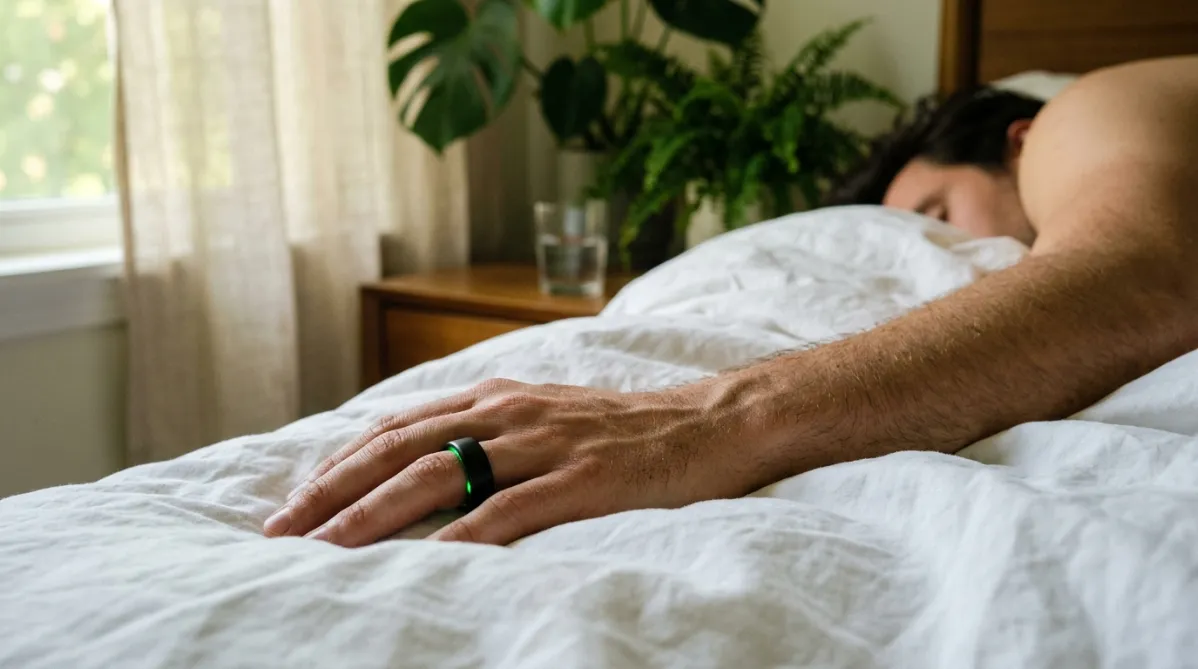
A close, low-angle shot of a sleeping person's bare forearm and hand resting on a rumpled white cotton duvet, a matte black smart ring on the index finger, with a small electric green LED glint on the ring's inner edge. Early morning daylight comes through a sheer curtain at the left and casts soft golden-green light across the skin, showing fine arm hair and natural skin texture. In the background, out of focus, are a wooden nightstand with a glass of water and the blurred green leaves of a houseplant by the window. The face is not shown. Shot at a 35mm equivalent with shallow depth of field, focused on the ring and knuckles. The mood is calm, restorative and quietly observational, as if the night's data were about to be checked.
supplements

Le magnésium L‑thréonate améliore les scores de sommeil profond et REM d’Oura en 3 semaines

BY NOVA CHEN ·

Un essai randomisé de 2024 a testé une forme de magnésium ciblant le cerveau, le magnésium L‑thréonate (Magtein), chez 80 adultes présentant des troubles du sommeil. Après 21 jours à raison de 1 g/j, le groupe MgT affichait de meilleurs scores de sommeil profond et REM sur l’Oura que le placebo, ainsi qu’une amélioration de l’humeur, de l’énergie et de la vigilance. Cependant, le groupe placebo s’est également détérioré, le décompte des stades de sommeil provient d’un dispositif wearable grand public, et l’étude n’a jamais comparé le thréonate au glycinate ou au citrate. Voici ce que montre réellement l’essai, ce que délivre une dose de 1 g en magnésium élémentaire, et où se situent les réserves.
Approach: Macro science. Palette: B, warm.

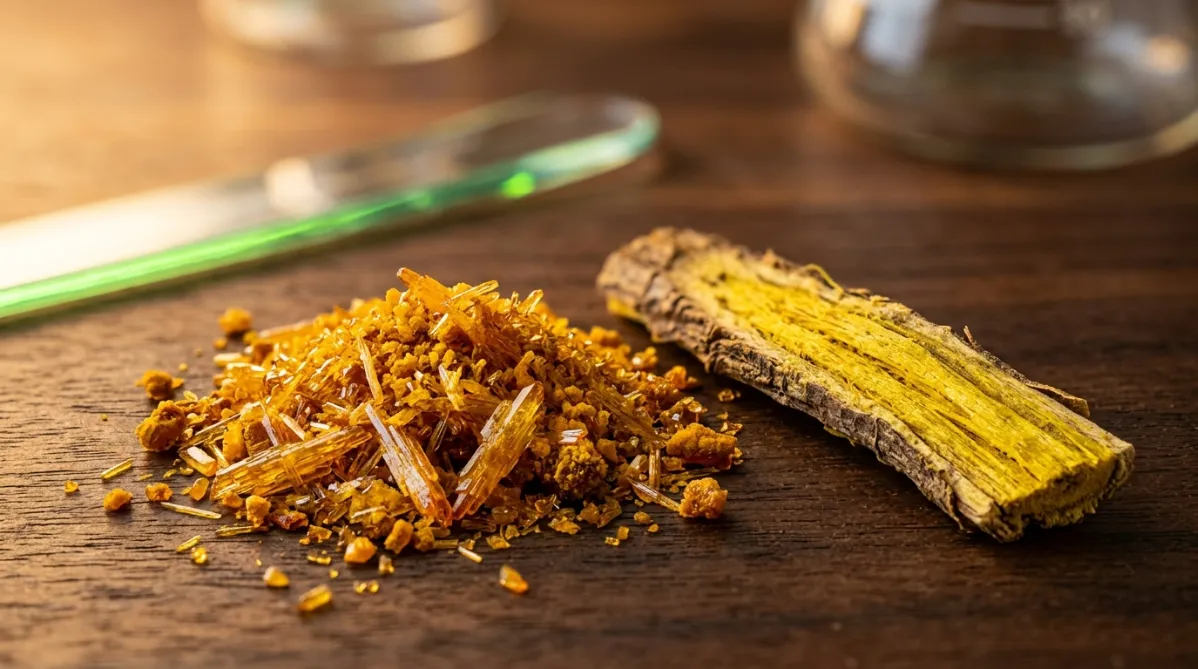
Extreme macro photograph of raw berberine: a small heap of vivid yellow-orange crystalline powder with needle-like crystal clusters, shot at a low 30-degree angle with a shallow depth of field. Beside it, a dry sliver of Berberis root bark shows its bright yellow inner wood and fibrous grain. The surface is a smooth dark walnut board. Low golden-hour side light from the left makes the crystals glint like amber glass and throws long warm copper shadows across the wood. One tiny electric green highlight reflects off a glass spatula edge in the soft background blur. The mood is quiet and investigative, with rich saturated honey and burnt-orange tones and no blue cast. Photorealistic, microscopy-like texture, no text or labels.
metabolism

Berbérine vs. Metformine : l’essai pilote derrière une baisse d’HbA1c de 9,5 % à 7,5 %

BY HELIX WARD ·

En 2008, un petit essai pilote a opposé la berbérine à la metformine chez des diabétiques de type 2 récemment diagnostiqués ; l’effet hypoglycémiant semblait comparable. Le groupe berbérine a vu son HbA1c passer de 9,5 % à 7,5 % en trois mois. Une seconde étude, menée chez 48 patients déjà traités, a fait baisser l’HbA1c de 8,1 % à 7,3 % et le HOMA‑IR de 44,7 %. Ces travaux restent modestes, portent sur des patients diabétiques et ont signalé des effets indésirables gastro‑intestinaux chez environ un tiers des participants. Voici ce que les données montrent, ce qu’elles ne montrent pas, et ce qu’il faut savoir avant d’envisager la berbérine.

**Approach: Conceptual metaphor. Palette: B, Warm.**

A close, slightly high three-quarter view of a single weathered hemp rope stretched horizontally across the frame, shot at a shallow depth of field. On the left the rope is thick and tightly twisted. On the right it has frayed down to a few thin strands, with a short, neat whipping of bright electric green thread binding the rope just where the fraying stops. Golden-hour sunlight enters low from the left and picks out each individual fiber in honey and copper tones. Soft amber shadows fall across a blurred, sun-warmed wooden dock in the background. The mood is quiet and cautiously hopeful, suggesting something worn down slowly but partly held in place. The image is photorealistic and has no text.
longevity

Vitamine D3 préserve 140 paires de bases des télomères dans un essai randomisé de 4 ans

BY DR. SYNAPSE ·

Un vaste essai randomisé, en double‑aveugle, à contrôle placebo, a montré que quatre ans de supplémentation en vitamine D3 ralentissent la perte de longueur des télomères d’environ 140 paires de bases. Les données proviennent de l’étude VITAL, menée chez des adultes américains plus âgés prenant 2 000 UI/jour. L’effet est modestement significatif (p = 0,039) ; la longueur des télomères reste cependant un biomarqueur de substitution, et non la preuve d’une espérance de vie accrue. Les oméga‑3, quant à eux, n’ont montré aucun effet sur les télomères dans cet essai. Voici ce que les chiffres révèlent, leurs limites, et comment exploiter ce résultat de façon sensée.
Approach: the human outcome. Palette: natural.

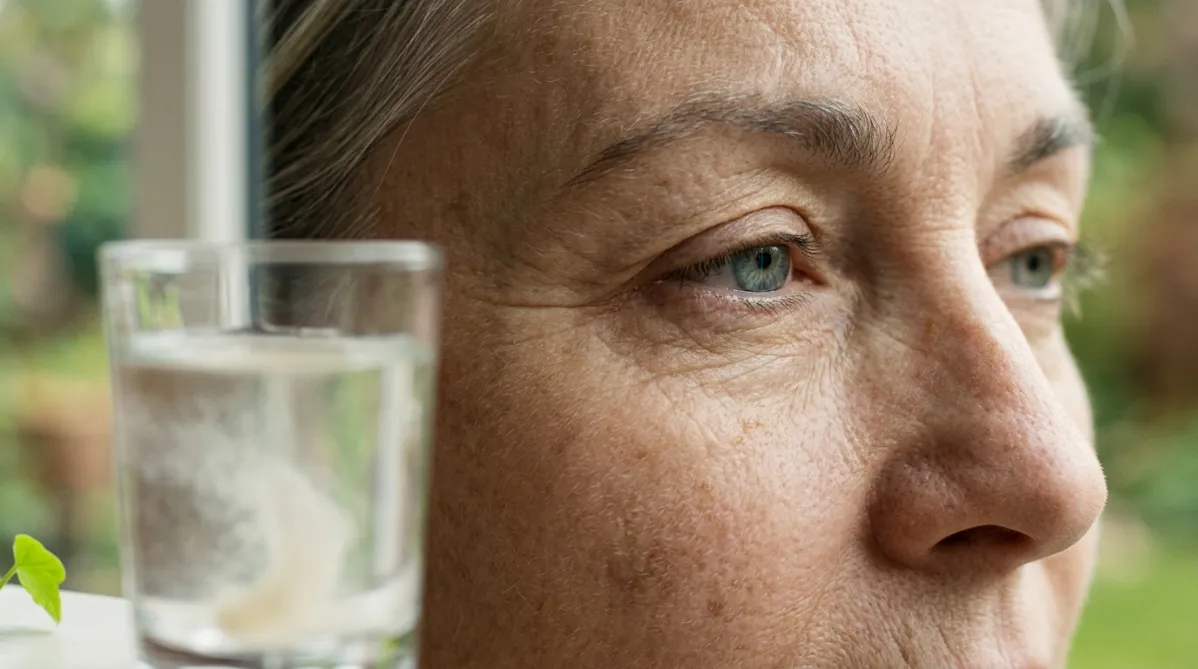
Extreme close-up of a woman's eye and the delicate skin around it, shot from a slight three-quarter angle with a 100mm macro lens and a shallow depth of field. Her skin is a mature 50s complexion with fine crow's feet that are sharp and tactile, with visible pores and soft vellus hairs. Her gaze is relaxed and not at the camera, and the face is cropped so identity isn't the focus. Soft, directional window daylight rakes across the skin from the left to bring out the wrinkle texture, with gentle warm skin tones and a blurred leafy green background outdoors. A single glass of water with a faint dissolving powder swirl sits out of focus in the foreground, with a tiny electric green leaf highlight at the edge. The mood is calm, honest and quietly scientific.
peptides

2,5 g de peptides de collagène réduisent les rides du contour des yeux de 20 % en 8 semaines

BY NOVA CHEN ·

Le collagène fait partie des compléments beauté et longévité les plus recherchés, mais peu de produits sont appuyés par des études humaines contrôlées par placebo. Dans un essai portant sur 114 femmes de 45 à 65 ans, 2,5 g/j du peptide bioactif Verisol ont diminué le volume des rides du contour des yeux de 20 % par rapport au placebo après 8 semaines. Les biopsies ont montré +65 % de procollagène de type I et +18 % d’élastine, tandis que le gain de fibrilline (+6 %) n’était pas statistiquement significatif. L’effet était encore perceptible 4 semaines après la dernière prise. Ces résultats concernent un seul peptide de marque dans une population précise : ils ne s’appliquent pas à toutes les poudres de collagène.

A wide landscape editorial photograph of a minimalist laboratory-meets-wellness still life on a pale, warm-gray stone countertop, softly lit by diffused morning window light from the left. In the center foreground, a small amber glass supplement jar with a plain matte white label sits beside a scattering of fine white powder and a few loose white capsules on a ceramic dish. Next to it rests a clean, open notebook with faint hand-drawn line graphs, two diverging curves rising gently, one slightly higher than the other, drawn in muted sage-green and charcoal ink. A slim brass pen lies across the page.

In the soft-focus midground, a delicate glass beaker filled with clear liquid catches a thin streak of light, casting a gentle caustic shimmer across the stone. A sprig of dried eucalyptus and a small sliver of citrus peel add organic texture. Behind them, an out-of-focus wall of pale oat-colored tiles and a floating wooden shelf holds a few blurred ceramic vessels and a small potted fern.

The color palette is calm and editorial: warm creams, sage green, soft amber, muted terracotta accents, and touches of charcoal. Shallow depth of field with a crisp focus on the jar and notebook, creamy bokeh in the background. Subtle film-like grain, natural shadows, and generous negative space on the right third of the frame, suitable for headline overlay. The mood is thoughtful, measured, and trustworthy, like a contemporary science and wellness journal cover: modern, tactile, quietly optimistic, and grounded rather than hyped.
longevity

Le calcium alpha‑cétoglutarate prolonge la durée de vie des souris femelles jusqu’à 16,6 % : ce que cela signifie (et ne signifie pas) pour l’homme

BY DR. SYNAPSE ·

Une étude de 2020 publiée dans *Cell Metabolism* a montré qu’une alimentation contenant 2 % de calcium α‑cétoglutarate prolongeait la durée de vie médiane des souris femelles de jusqu’à 16,6 % et réduisait leur fragilité. L’effet était plus modeste dans la seconde cohorte (10,5 %) et les gains chez les mâles n’étaient pas statistiquement significatifs. Les auteurs expliquent ce bénéfice par une diminution de l’inflammation systémique et une possible hausse de l’IL‑10. Il s’agit toutefois d’une étude réalisée exclusivement sur des souris ; aucune preuve ne montre que le CaAKG prolonge la vie humaine. Voici ce que les données révèlent réellement, en quoi elles diffèrent du marketing des compléments, et pourquoi le CaAKG doit rester sur une liste de veille scientifique plutôt que sur un protocole validé.

A wide, minimalist editorial still life on a soft, warm-gray linen surface lit by gentle diffused morning window light. At center sit two identical small amber glass supplement bottles, one slightly in front of the other, with plain matte cream labels and no readable text. In front of them, two matching shallow ceramic dishes in muted sage green hold identical small ivory capsules. The capsules are nearly indistinguishable, which quietly suggests placebo versus active. Beside the dishes, a few wheat germ grains, a small cluster of aged cheddar-toned cheese shards, and a halved ripe mushroom hint at natural spermidine food sources. They are arranged with careful negative space.

On the left, a delicate balance scale in brushed brass sits perfectly level, its two small pans empty and even, as a subtle visual metaphor for "no difference." On the right, a neat open notebook with soft blurred pencil lines and a single sprig of dried eucalyptus lies beside a pair of thin round tortoiseshell reading glasses, suggesting older adults and memory without showing any people.

The background is a softly blurred pale oat-colored wall with a long gentle shadow cast diagonally across the scene from a window. The color palette is muted and modern: warm cream, sage green, amber, soft brass, and dusty terracotta accents. Shallow depth of field keeps the bottles and scale crisp while the edges melt into a creamy blur. The mood is calm, thoughtful, and quietly skeptical, like a trendy health and science journal feature. Fine film grain, a subtle matte finish, and a balanced asymmetrical composition leave open space in the upper right for headline overlay. Photographed from a slightly elevated three-quarter angle, high-end editorial photography style.
supplements

Spermidine pour la mémoire ? Un essai de 12 mois chez 100 adultes âgés n’a révélé aucun avantage par rapport au placebo

BY DR. SYNAPSE ·

La spermidine a été présentée comme un complément protecteur du cerveau, soutenue par la recherche sur l’autophagie et les études animales. L’essai clinique SmartAge a testé cette promesse chez 100 personnes âgées présentant un déclin cognitif subjectif, en administrant environ 0,9 mg par jour pendant 12 mois. Le critère principal de mémoire n’a pas surpassé le placebo (différence –0,03 ; p = 0,47) et les critères secondaires étaient également négatifs. Les signaux exploratoires sur l’inflammation et la mémoire verbale restent non confirmés. Voici ce que cela implique pour quiconque envisage un supplément de spermidine et les limites de l’étude.

A bright, minimalist editorial still life on a pale warm-white stone surface, shot from a slightly elevated three-quarter angle in soft natural window light. At center, a small amber glass supplement bottle with a matte cream label, unbranded, sits beside a few loose white capsules. A pair of weathered hands in a light oatmeal linen sleeve, belonging to an older adult, rests gently near the bottle, with a ceramic mug of tea just out of focus. To the right, a clean glass vial and a delicate glass beaker filled with clear liquid catch the light, hinting at laboratory research without any futuristic touch. A small paper notebook with a handwritten simple line graph rising in a gentle curve lies open nearby, along with a sharpened pencil. Scattered at the edges are soft sprigs of dried eucalyptus and a few pale sage-green leaves, adding an organic note. A faint, abstract molecular diagram printed in muted teal ink on a card leans against the bottle, subtle and graphic. The palette is calm and modern: warm ivory, sage green, soft teal, muted amber, and touches of dusty peach. Long, gentle shadows fall across the surface, and the shallow depth of field blurs the background into creamy neutral tones. The composition leaves generous negative space on the left third for headline text. The overall feel is a trendy health and science journal: clean, airy, trustworthy, and quietly sophisticated, with fine film-like grain and true-to-life color. Ultra-detailed, 16:9 landscape.
supplements

1 000 mg de nicotinamide riboside quotidien augmentent le NAD+ des cellules sanguines d’environ 60 % chez les personnes âgées : le résultat d’un essai randomisé

BY DR. SYNAPSE ·

Un essai croisé publié en 2018 dans *Nature Communications* a testé la nicotinamide riboside à raison de 500 mg deux fois par jour (1 000 mg/jour) pendant six semaines chez des adultes en bonne santé d’âge moyen et avancé. Le supplément a été bien toléré et a augmenté le NAD+ dans les cellules immunitaires sanguines d’environ 60 % par rapport au placebo. Les chercheurs ont également observé des signaux précoces d’une pression artérielle plus basse et d’une rigidité artérielle réduite, qu’ils ont présentés comme des pistes pour de plus grands essais, et non comme des bénéfices prouvés. Cet article explique pourquoi le NAD+ est censé diminuer avec l’âge, ce que l’étude a fait, et ce qu’elle ne peut pas nous dire sur les issues de maladie ou la longévité.
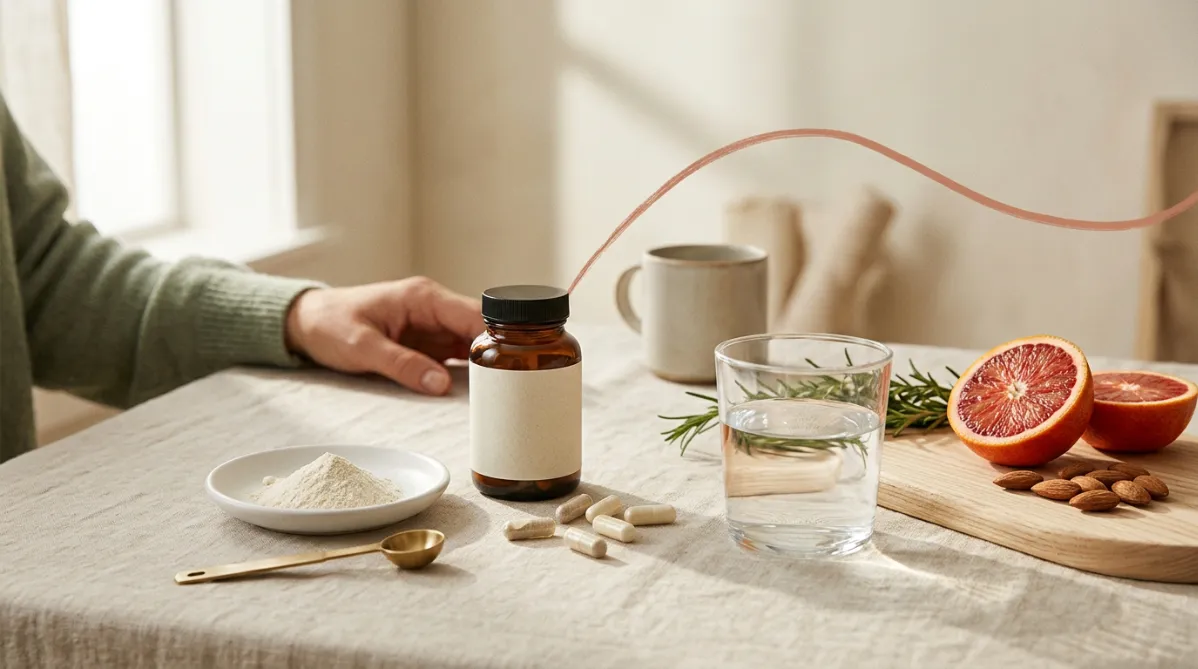
A softly lit editorial still life on a pale oat-colored linen surface, shot from a slightly elevated three-quarter angle in a wide landscape frame. At center-left, a small matte white ceramic dish holds a modest pile of fine off-white powder, with a tiny brushed-brass measuring spoon resting beside it. Next to the dish stands a minimalist amber glass supplement bottle with a plain cream label and no readable text. A few capsules spill casually across the linen, some translucent and some opaque ivory.

On the right side of the composition, a ripe blood orange cut in half and a handful of raw almonds sit on a light ash-wood board. A sprig of fresh rosemary adds a muted green accent. A sheer glass of water catches the light and throws a soft, rippled caustic pattern across the fabric.

In the background, out of focus, a woman's hand in a soft sage-green knit sleeve rests near a ceramic mug. This suggests a calm morning routine without showing a face. Behind her, a tall window casts diffused, golden-hour light from the upper left, with gentle shadows and a creamy, shallow depth of field.

The palette is warm and restrained: oat, ivory, terracotta, sage, and amber, with a single pop of coral from the blood orange. A thin, abstract line of muted terracotta paint, like a brushed arc, sweeps across the upper right background. It subtly evokes a rising curve without becoming a literal chart.

The mood is calm, trustworthy, and contemporary, like a premium wellness and science journal feature. The image has crisp focus on the powder and bottle, natural film-like grain, soft contrast, and generous negative space in the upper third for headline overlay. It looks like a high-end editorial photograph with no text, logos, or futuristic elements.
metabolism

Premier succès humain du NMN : 250 mg par jour ont accru la sensibilité musculaire à l’insuline d’environ 25 % chez les femmes prédiabétiques

BY DR. SYNAPSE ·

Le NMN est depuis longtemps la star du marché de la longévité, mais les données humaines étaient rares jusqu’à l’essai de l’Université de Washington publié dans *Science* en 2021. Chez les femmes ménopausées prédiabétiques, en surpoids ou obèses, 250 mg de NMN quotidiens pendant 10 semaines ont amélioré la sensibilité à l’insuline du muscle d’environ 25 %. Le signal insulinique musculaire et l’expression des gènes liés au remodelage musculaire se sont également renforcés, tandis que le groupe placebo n’a montré aucune évolution. Cependant, le bénéfice reste limité et l’étude n’a pas démontré que le NMN réduisait la glycémie ou inversait le prédiabète. Voici ce que l’essai a révélé, à qui il s’applique et ce qu’il n’a pas changé.
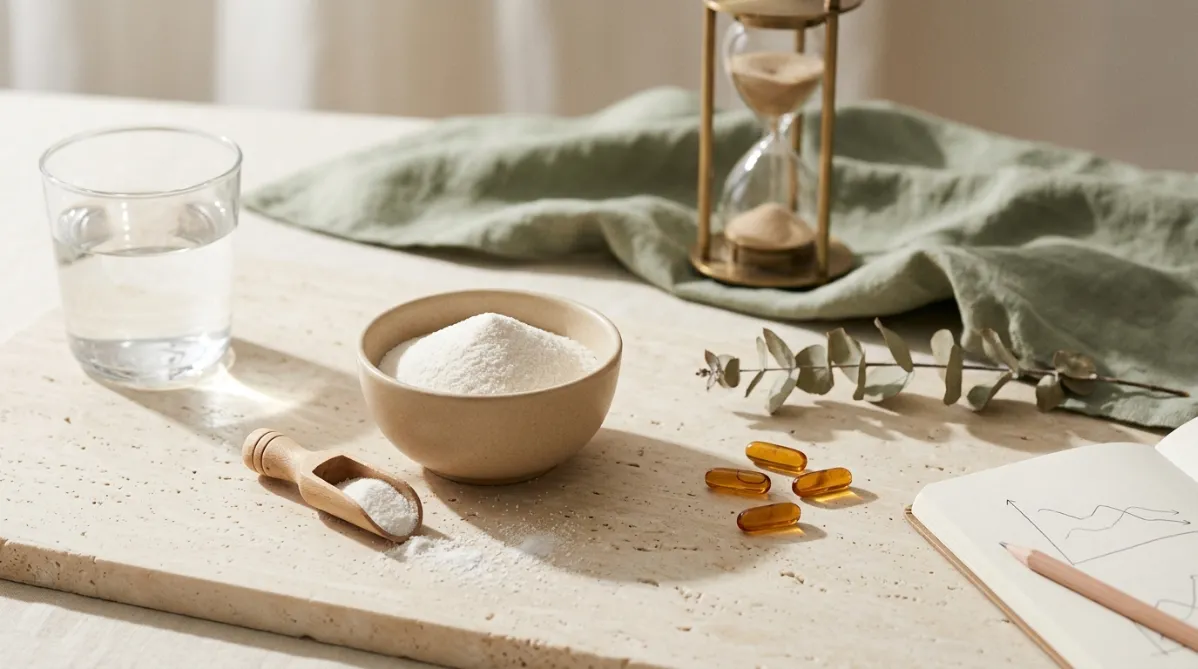
A serene editorial still life shot from a slightly elevated angle on a pale travertine surface, bathed in soft morning window light with gentle long shadows. At the center sits a small matte ceramic bowl in warm oatmeal tone, holding a fine mound of white crystalline powder, with a delicate wooden scoop resting beside it. A few grains are scattered naturally across the stone. To the left, a clear glass of water catches the light, throwing a subtle caustic shimmer onto the surface. To the right, a neatly arranged trio of translucent amber glass capsules and a single sprig of dried eucalyptus add organic texture.

In the softly blurred background, a sage-green linen cloth drapes across the frame, and a vintage brass hourglass stands upright, its sand halfway through. This is a subtle nod to aging and time. A small open notebook with faint, abstract hand-drawn line graphs trending gently downward, with no legible text, rests at the edge of the composition, with a slim pencil placed across it.

The palette is calm and modern: creamy ivory, warm sand, muted sage, soft terracotta, and touches of honey amber. The mood is quiet, thoughtful, and scientific without being clinical, like a contemporary wellness and science magazine cover. Shallow depth of field keeps the powder bowl crisp, with creamy bokeh behind it. Generous negative space on the right side of the wide 16:9 frame leaves room for headline overlay. Fine film-like grain, natural color grading, and minimalist composition give it a refined, trendy journal feel.
longevity

Taurine, l’acide aminé bon marché qui prolonge la durée de vie des souris de jusqu’à 12 % et diminue avec l’âge chez l’homme

BY DR. SYNAPSE ·

Une étude de 2023 publiée dans *Science* a montré que le taux sanguin de taurine chute avec l’âge chez la souris, le singe et l’homme. Chez les souris d’âge moyen, une supplémentation quotidienne a prolongé l’espérance de vie médiane de 10 à 12 % et a amélioré plusieurs marqueurs de santé. Les effets observés touchent la sénescence cellulaire, les dommages à l’ADN, la fonction mitochondriale et l’inflammage. Les données humaines restent observationnelles et les doses utilisées chez la souris équivalent à plusieurs grammes par jour chez l’homme, ce qui rend les conclusions encore préliminaires. Les chercheurs insistent donc sur la nécessité d’essais cliniques avant d’envisager la taurine comme pilule anti‑âge.

This page is available in