Biocracked
←

#peptides

4 articles
Approach: Data as art, with a conceptual twist. Palette: bold color field (D).

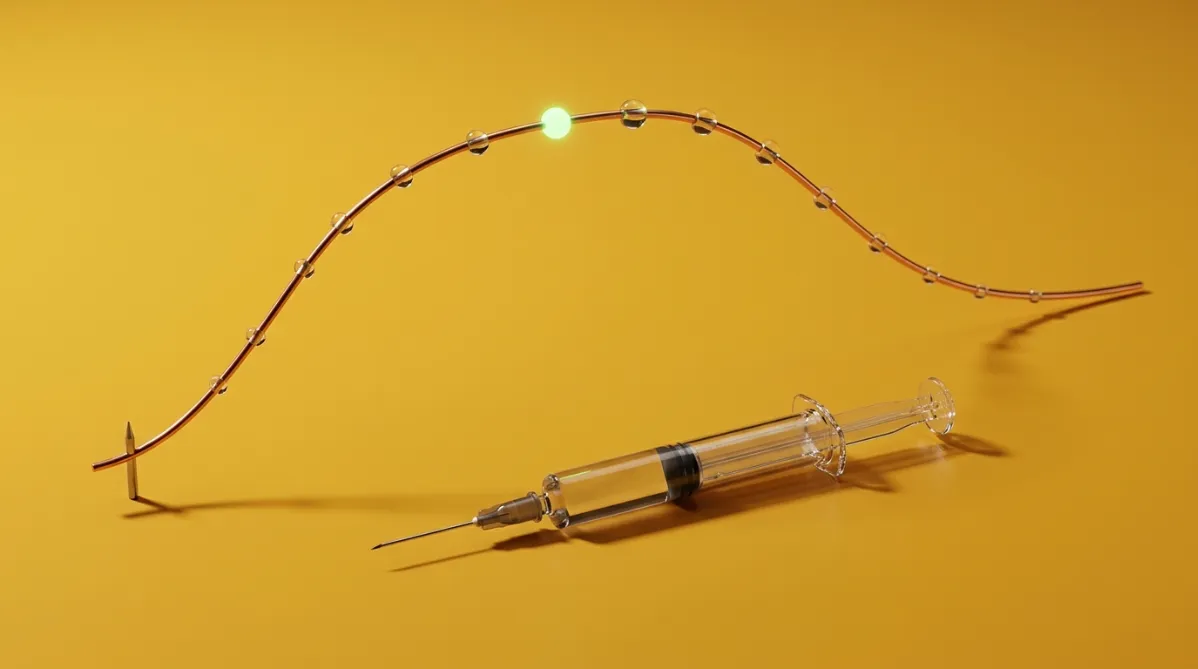
Subject: a single glass syringe lying on a saturated mustard-yellow acrylic surface, shot from a low three-quarter angle with a shallow depth of field. Behind it, a long arc of thin copper wire rises in a gentle curve from a small spike to a broad plateau and then slowly tapers, echoing a hormone curve stretched across days. Small, evenly spaced glass beads sit along the wire, each slightly larger toward the plateau. One bead glows soft electric green.

Lighting: hard single softbox from the upper left, creating crisp, short shadows in warm umber on the yellow. Specular highlights on the glass and copper.

Mood: precise, patient, and quietly analytical, with a slow-release rhythm. No text or markings anywhere.
peptides

Essai humain du CJC‑1295 : ce que révèlent les données originales sur la GH et l’IGF‑I

BY HELIX WARD ·

Une injection unique de CJC‑1295 a fait augmenter l’hormone de croissance (GH) de 2 à 10 fois pendant six jours ou plus, et l’IGF‑I de 1,5 à 3 fois pendant 9 à 11 jours chez des adultes sains de 21 à 61 ans. La demi‑vie du peptide a été estimée entre 5,8 et 8,1 jours, et l’IGF‑I est resté au‑dessus du niveau de base jusqu’à 28 jours après des doses répétées. Aucun effet indésirable grave n’a été signalé, les doses de 30 à 60 µg/kg étant les mieux tolérées. Cependant, cet essai de 2006 mesurait uniquement les hormones et la sécurité, pas la masse ou la force musculaire, la perte de graisse ou la performance. Voici ce que montrent réellement les données originales, en quoi le CJC‑1295 avec DAC diffère du mod GRF 1‑29, et pourquoi ce peptide reste non approuvé et interdit par l’AMA.
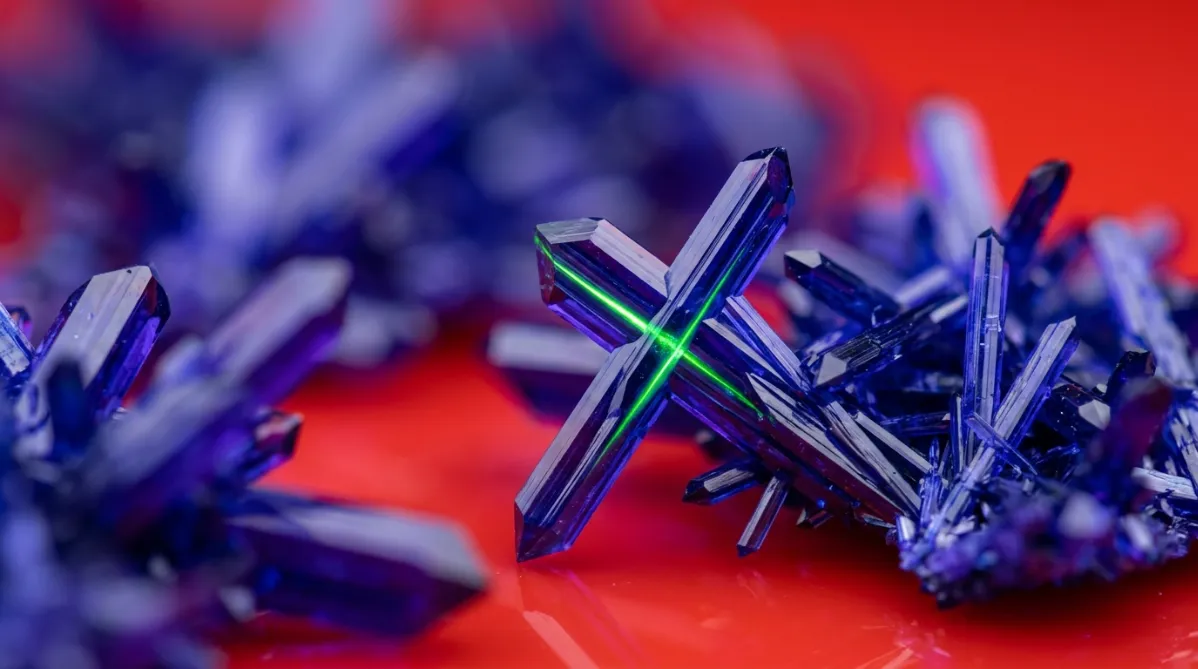
Macro science: an extreme close-up of GHK-Cu copper peptide crystals, deep blue-violet needle-like crystals with faceted edges, shot at a low three-quarter angle with a shallow depth of field so the nearest crystals are razor sharp and the rest dissolve into soft blur. The crystals sit on a smooth, glossy tomato-red backdrop that fills the frame, creating a bold color field. Lighting is a single large softbox from the upper left, giving crisp specular highlights on the crystal faces and a soft, warm-red bounce in the shadows. One tiny thread of electric green light refracts through a single crystal edge as a subtle accent. Mood: striking, precise, curious, scientific without feeling sterile. Photorealistic microscopy-meets-studio look, no text, no labels, no people.
peptides

Le peptide de cuivre GHK‑Cu pourrait moduler les réseaux génétiques de la réparation cutanée

BY NOVA CHEN ·

GHK‑Cu, le peptide de cuivre présent dans d'innombrables sérums, pourrait faire bien plus que simplement hydrater la peau. Une revue de 2018 suggère que de nouvelles données d’expression génétique pourraient expliquer pourquoi cette petite molécule est associée à la protection du collagène, à la réparation tissulaire, à la régulation de l’inflammation et même à la réparation de l’ADN. Voici ce que l’article rapporte réellement concernant le vieillissement cutané et la régénération, ainsi que les limites de ces preuves. Avant de céder à l’engouement, lisez les mises en garde pratiques sur l’usage topique et ce qu’une revue peut ou ne peut pas prouver.
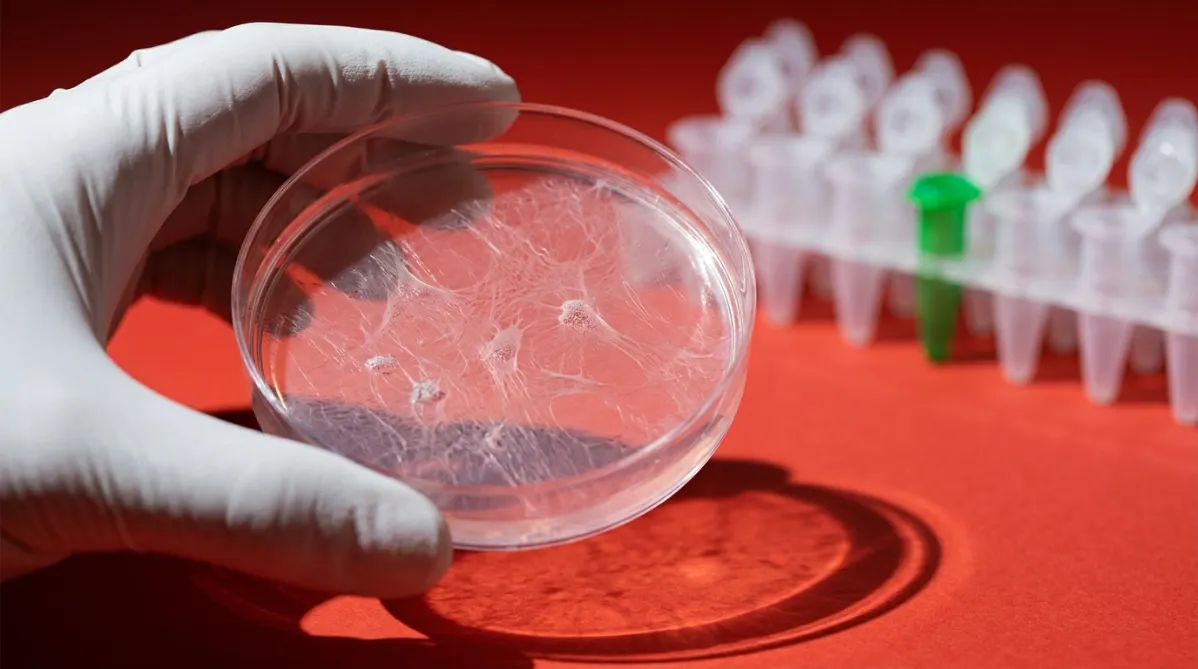
Approach: Lab in action. Palette: D, bold color field.

A gloved hand holds a clear petri dish at a slight low angle, close and slightly above eye level, against a saturated tomato-red backdrop. Inside the dish, a thin, translucent layer of pale pink culture medium holds a faint, lacy web of fibroblast cells, with a few small clusters just visible. Hard, clean studio light from the upper left throws a crisp curved shadow of the dish onto the red surface and picks out bright highlights on the rim and the glove's matte white nitrile. In the soft-focus background, a rack of empty microcentrifuge tubes stands out in cool white. One tiny electric green cap on a single tube adds a small accent. The mood is precise and skeptical: a promising result still confined to the dish.
peptides

Epithalon a activé la télomérase dans les cellules — mais pas chez les humains

BY HELIX WARD ·

Un petit peptide de quatre acides aminés aurait réactivé la télomérase, une enzyme que la plupart des cellules adultes gardent silencieuse, et allongé les télomères de fibroblastes fœtaux cultivés. Ce résultat a créé le buzz autour d’Epithalon et de ses promesses de longévité, mais les travaux proviennent uniquement de cellules en laboratoire, pas d’essais humains. De plus, les affirmations relatives à l’allongement de la durée de vie restent purement hypothétiques. Voici ce que montre réellement l’étude de 2003, ce qu’elle omet et comment l’interpréter avant d’acheter quoi que ce soit.
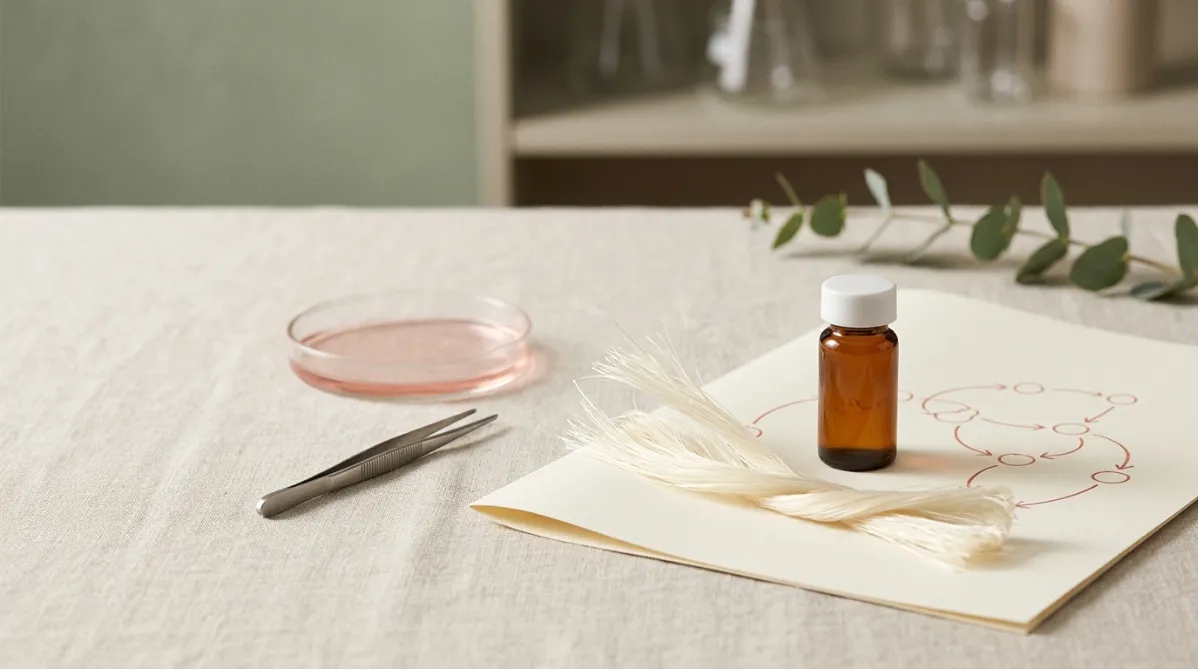
A wide, editorial-style still life photographed in soft natural window light on a pale oatmeal-colored linen surface. In the center foreground, a single small amber glass vial with a matte white cap sits slightly off-center to the right, unlabeled and minimal. Beside it lies a delicate, translucent skein of tendon-like fibers, rendered as fine pale ivory threads gently fanning out and twisting together, resting on a folded sheet of cream paper. To the left, a glass petri dish with a thin layer of soft blush-pink liquid, catching a subtle highlight, and a slim pair of stainless steel tweezers laid diagonally across the surface.

Behind the objects, a softly blurred background in muted sage green and warm taupe suggests a quiet laboratory shelf, with out-of-focus glassware shapes and a single trailing sprig of eucalyptus adding an organic note. A thin, hand-drawn style line diagram of interconnected nodes and curved arrows, in faint terracotta ink, is printed on the paper beneath the fibers. It hints at a cellular signaling pathway without any text or readable labels.

The composition uses generous negative space on the left third for potential title overlay, with a shallow depth of field and a gentle diagonal flow from the petri dish to the vial. The color palette is restrained and warm: cream, sage, blush, amber, and terracotta accents, with soft shadows and a faint film-grain texture. The mood is calm, thoughtful, and scientific but approachable, like a contemporary health and science magazine cover. Shot as if with a 50mm lens at f/2.8, top-down at a slight 30-degree angle, with crisp focus on the vial and fibers. No people, no text, no futuristic elements.
peptides

BPC‑157 et réparation des tendons : ce que montre la recherche sur la voie FAK‑paxilline, et ce qu’elle ne montre pas

BY DR. SYNAPSE ·

Le BPC‑157, peptide de 15 acides aminés très présent dans les cercles en ligne qui promettent « guérison », s’appuie sur une étude de 2011 fréquemment citée pour sa réputation de stimulant de la réparation tendineuse. Les chercheurs y ont constaté une accélération de la sortie des fibroblastes tendineux, une meilleure survie cellulaire sous stress oxydatif et une migration accrue, via l’activation de la voie FAK‑paxilline. En revanche, aucune hausse directe de la prolifération n’a été observée, et tous les résultats proviennent de tissus et de cellules de rats étudiés in vitro. Cet article décortique le mécanisme, explique pourquoi ces données ne constituent pas une preuve chez l’homme, et passe en revue le statut réglementaire non autorisé du peptide.

This page is available in