Biocracked
←

#ampk

2 articles
Approach: Macro science. Palette: B, warm.

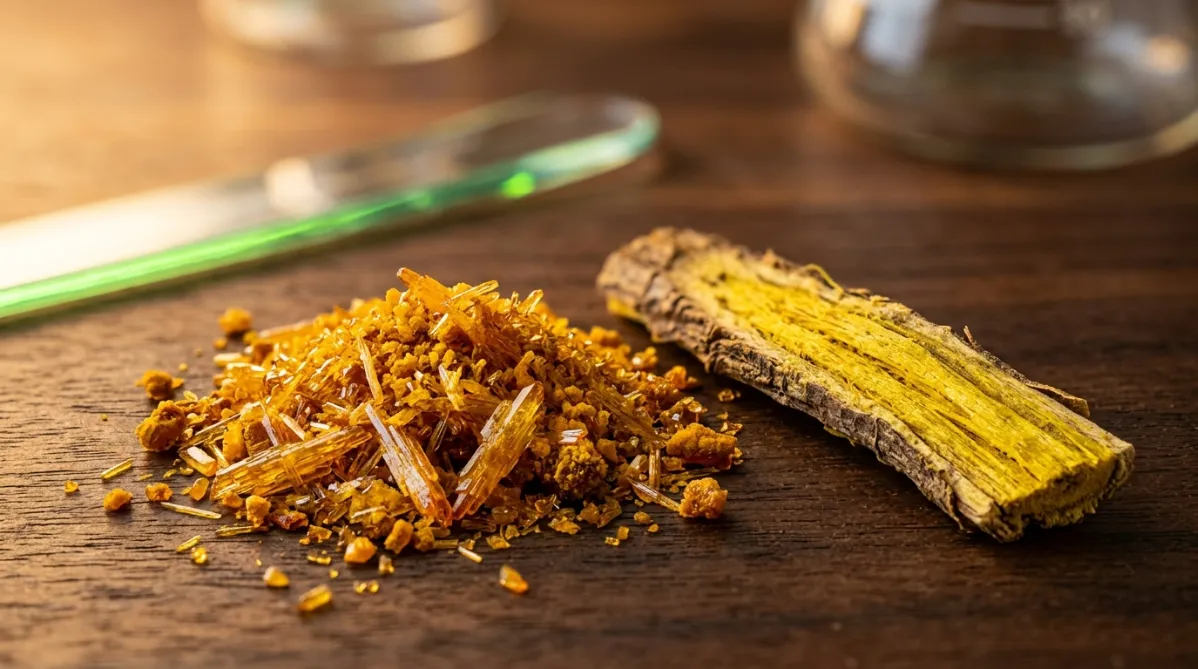
Extreme macro photograph of raw berberine: a small heap of vivid yellow-orange crystalline powder with needle-like crystal clusters, shot at a low 30-degree angle with a shallow depth of field. Beside it, a dry sliver of Berberis root bark shows its bright yellow inner wood and fibrous grain. The surface is a smooth dark walnut board. Low golden-hour side light from the left makes the crystals glint like amber glass and throws long warm copper shadows across the wood. One tiny electric green highlight reflects off a glass spatula edge in the soft background blur. The mood is quiet and investigative, with rich saturated honey and burnt-orange tones and no blue cast. Photorealistic, microscopy-like texture, no text or labels.
metabolism

Berberin vs. metformin: pilotní studie s poklesem HbA1c z 9,5 % na 7,5 %

BY HELIX WARD ·

Malá pilotní studie z roku 2008 srovnávala berberin a metformin u čerstvě diagnostikovaných pacientů s diabetem 2. typu a ukázala podobný vliv na hladinu glukózy. Ve skupině užívající berberin klesl HbA1c ze 9,5 % na 7,5 % během tří měsíců. Další studie na 48 lidech, kteří již léky užívali, zaznamenala pokles HbA1c z 8,1 % na 7,3 % a snížení HOMA‑IR o 44,7 %. Jedná se však o malé studie na diabetikách a přibližně třetina účastníků měla gastrointestinální potíže. Podívejme se, co data skutečně ukazují, co ne, a na co si dát pozor, pokud uvažujete o berberinu.
A wide, editorial-style still life photographed from slightly above on a pale warm-gray stone surface, lit by soft diffused morning light from the left. At the center, a delicate chain of 16 small, glossy beads in alternating muted terracotta, sage green, and cream is arranged in a gentle S-curve, each bead slightly different in size, like a hand-strung necklace. It stands for a peptide chain in a tactile, abstract way. Beside the chain, a translucent glass petri dish holds a thin layer of pale amber liquid with a few soft ripples. Behind it, a cross-section of a ripe fig and a halved blood orange show their intricate internal textures, suggesting cellular structure and mitochondria without literal illustration.

On the left side of the frame, a small ceramic mouse figurine in matte off-white sits calmly next to a sprig of dried wheat. It is a subtle nod to the mouse study and is stylized and minimal, not cartoonish. On the right, an open, softly blurred notebook with thin hand-drawn circles and curved lines, like looping pathway diagrams, lies under a brass pen. A few pages are visible but the text is illegible.

Scatter a few elements for texture: a small sprig of eucalyptus, a folded linen napkin in oatmeal tone, and a single clear glass pipette resting diagonally across the lower foreground. The palette is warm neutrals with accents of sage, terracotta, and soft amber, giving a calm, modern wellness-journal look. Shallow depth of field keeps the bead chain crisp while the background gently dissolves into creamy bokeh. Generous negative space across the upper right leaves room for headline overlay. The overall mood is clean, contemporary, and intellectually curious: scientific but warm, like a premium health and science magazine cover, with fine grain, natural shadows, and no text, logos, or futuristic elements.
peptides

MOTS‑c: 16‑aminokyselinový mitochondriální peptid, který aktivoval AMPK a ochránil myši před dietou vyvolanou obezitou

BY DR. SYNAPSE ·

Malý 16‑aminokyselinový peptid zakódovaný v mitochondriální DNA, nikoli v jádru, aktivoval AMPK ve svalech a ochránil myši před dietou vyvolanou obezitou a inzulínovou rezistencí ve studii *Cell Metabolism* z roku 2015. MOTS‑c se tak stal jedním z nejčastěji vyhledávaných názvů mezi výzkumníky peptidů a biohackery. Je však důležité si uvědomit, že se jedná o výzkum na myších a molekulární mechaniku, bez jakýchkoli klinických dat u lidí, a MOTS‑c není schválená terapie. Tento článek objasňuje, co MOTS‑c je, jak podle autorů funguje přes folátový cyklus a AMPK, co ukázaly myši a jaké závěry si čtenáři mohou a nemohou odvodit.

This page is available in