Biocracked
←

#ampk

2 articles
Approach: Macro science. Palette: B, warm.

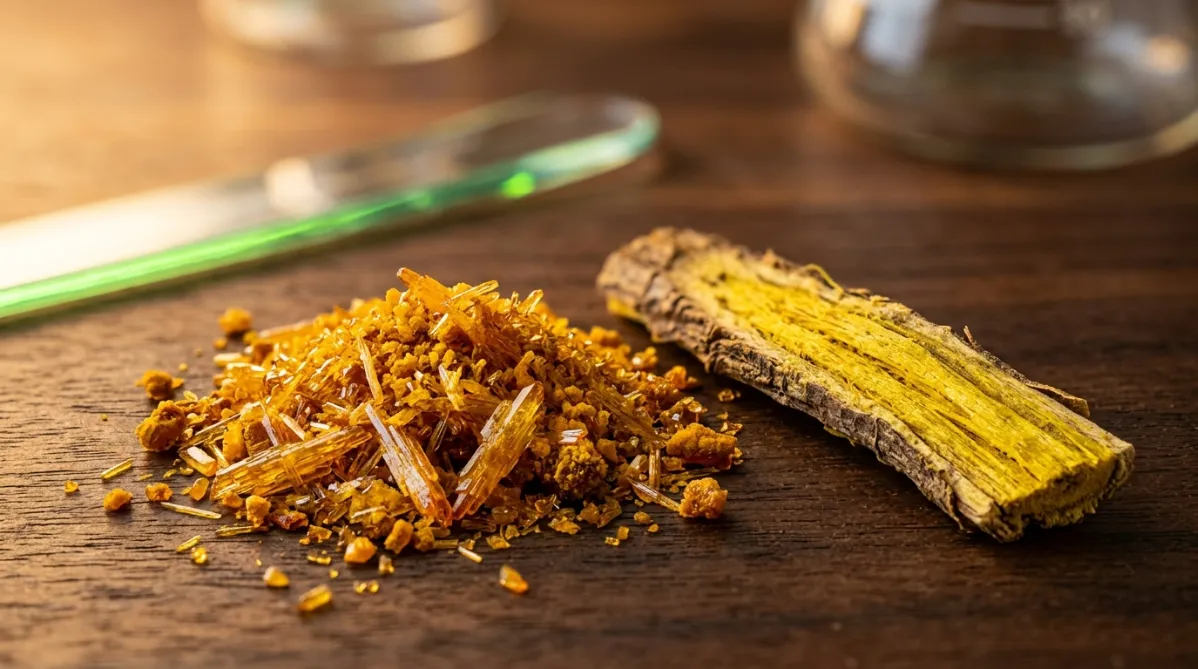
Extreme macro photograph of raw berberine: a small heap of vivid yellow-orange crystalline powder with needle-like crystal clusters, shot at a low 30-degree angle with a shallow depth of field. Beside it, a dry sliver of Berberis root bark shows its bright yellow inner wood and fibrous grain. The surface is a smooth dark walnut board. Low golden-hour side light from the left makes the crystals glint like amber glass and throws long warm copper shadows across the wood. One tiny electric green highlight reflects off a glass spatula edge in the soft background blur. The mood is quiet and investigative, with rich saturated honey and burnt-orange tones and no blue cast. Photorealistic, microscopy-like texture, no text or labels.
metabolism

Berberină vs. Metformin: Studiul pilot din spatele scăderii HbA1c de la 9,5 % la 7,5 %

BY HELIX WARD ·

Un mic studiu pilot din 2008 a comparat direct berberina cu metforminul la pacienți cu diabet de tip 2 recent diagnosticați. În grupul care a primit berberină, HbA1c a scăzut de la 9,5 % la 7,5 % în trei luni. Un al doilea studiu pe 48 de persoane deja tratate a arătat o reducere a HbA1c de la 8,1 % la 7,3 % și o scădere a HOMA‑IR cu 44,7 %. Aceste rezultate provin din studii mici, desfășurate la pacienți cu diabet, iar aproximativ o treime dintre participanți au raportat efecte secundare gastrointestinale. Iată ce arată datele, ce nu arată și ce trebuie să știi înainte să iei în considerare berberina.
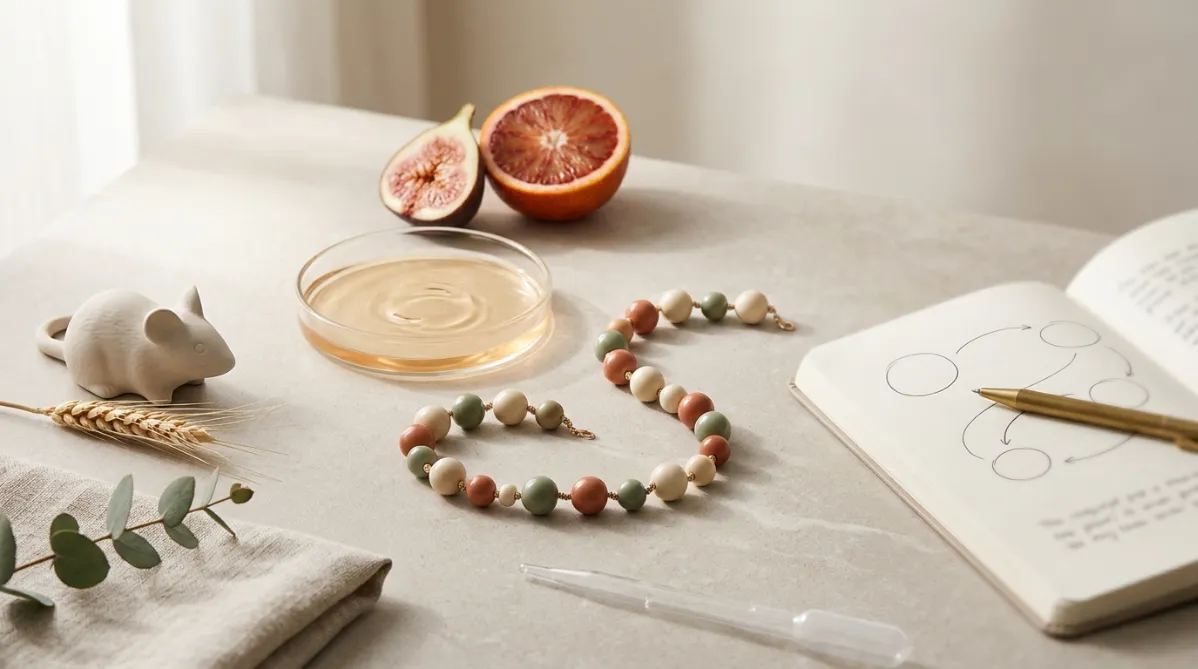
A wide, editorial-style still life photographed from slightly above on a pale warm-gray stone surface, lit by soft diffused morning light from the left. At the center, a delicate chain of 16 small, glossy beads in alternating muted terracotta, sage green, and cream is arranged in a gentle S-curve, each bead slightly different in size, like a hand-strung necklace. It stands for a peptide chain in a tactile, abstract way. Beside the chain, a translucent glass petri dish holds a thin layer of pale amber liquid with a few soft ripples. Behind it, a cross-section of a ripe fig and a halved blood orange show their intricate internal textures, suggesting cellular structure and mitochondria without literal illustration.

On the left side of the frame, a small ceramic mouse figurine in matte off-white sits calmly next to a sprig of dried wheat. It is a subtle nod to the mouse study and is stylized and minimal, not cartoonish. On the right, an open, softly blurred notebook with thin hand-drawn circles and curved lines, like looping pathway diagrams, lies under a brass pen. A few pages are visible but the text is illegible.

Scatter a few elements for texture: a small sprig of eucalyptus, a folded linen napkin in oatmeal tone, and a single clear glass pipette resting diagonally across the lower foreground. The palette is warm neutrals with accents of sage, terracotta, and soft amber, giving a calm, modern wellness-journal look. Shallow depth of field keeps the bead chain crisp while the background gently dissolves into creamy bokeh. Generous negative space across the upper right leaves room for headline overlay. The overall mood is clean, contemporary, and intellectually curious: scientific but warm, like a premium health and science magazine cover, with fine grain, natural shadows, and no text, logos, or futuristic elements.
peptides

MOTS‑c explicat: Peptidul mitocondrial de 16 aminoacizi care activează AMPK și protejează șoarecii de obezitatea indusă de dietă

BY DR. SYNAPSE ·

Un peptid de doar 16 aminoacizi, codificat în ADN‑ul mitocondrial – nu în nucleul celular – a activat AMPK în mușchi și a protejat șoarecii de obezitatea și rezistența la insulină induse de dietă, conform unui studiu din 2015 publicat în *Cell Metabolism*. MOTS‑c este astăzi unul dintre cele mai căutate nume în cercurile de peptide și biohacking. Totuși, articolul descrie o descoperire moleculară la nivel de șoareci, fără date clinice la oameni, iar MOTS‑c nu este un tratament aprobat. În continuare explicăm ce este MOTS‑c, cum pare să funcționeze prin ciclul folatului și AMPK, ce au arătat studiile pe șoareci și ce ar trebui – și ce nu ar trebui – să concluzioneze cititorii.

This page is available in