Biocracked
←

#sirt3

1 article
Approach 4, conceptual metaphor, in palette D, bold color field.

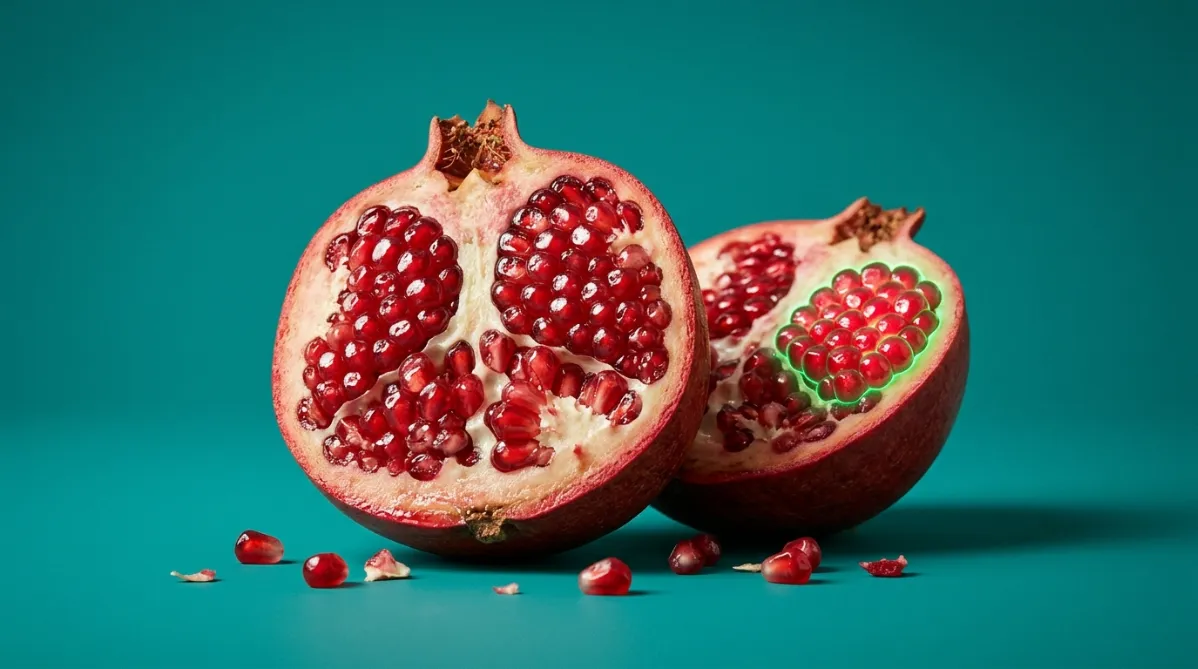
A single pomegranate, split open, sits at the center of a saturated teal backdrop. It is photographed from a slightly high three-quarter angle with a macro lens. One half is pulled slightly forward and the other stays behind it, which hints at two close siblings. The ruby arils are glossy and densely packed. In the smaller half, a few arils glow with a subtle electric green rim light, as if one has been singled out. Pomegranate is a natural source of the precursors that gut bacteria convert into urolithins. Soft, large-source studio light comes from the upper left. It casts crisp, clean shadows on a seamless teal surface and gives the red fruit sharp specular highlights. A few arils are scattered nearby. The mood is curious, vivid and quietly scientific, with a strong red-against-teal contrast and no text.
longevity

Urolithin D vs. A: Das wenig bekannte Geschwisterchen, das das Gedächtnis von Mäusen schützt

BY NOVA CHEN ·

Urolithin A steht im Rampenlicht, doch sein weniger bekanntes Geschwisterchen Urolithin D zeigte in einem D‑Galaktose‑Modell bei alternden Mäusen hirnschützende Effekte. Oral verabreicht verbesserte es Gedächtnis‑Parameter und verringerte die Schädigung des Hippocampus, wobei AMPK, PGC‑1α, SIRT3 und weitere Mitophagie‑Marker beteiligt waren. Zellstudien belegten, dass die Blockade von AMPK oder PGC‑1α den Nutzen zunichte machte. Die Arbeit basiert jedoch auf einem chemisch induzierten Maus‑Modell plus Zellversuchen, es liegen keine Human‑Daten und kein direkter Vergleich mit Urolithin A vor.

This page is available in