Biocracked
Approach: Macro science. Palette: D, bold color field.

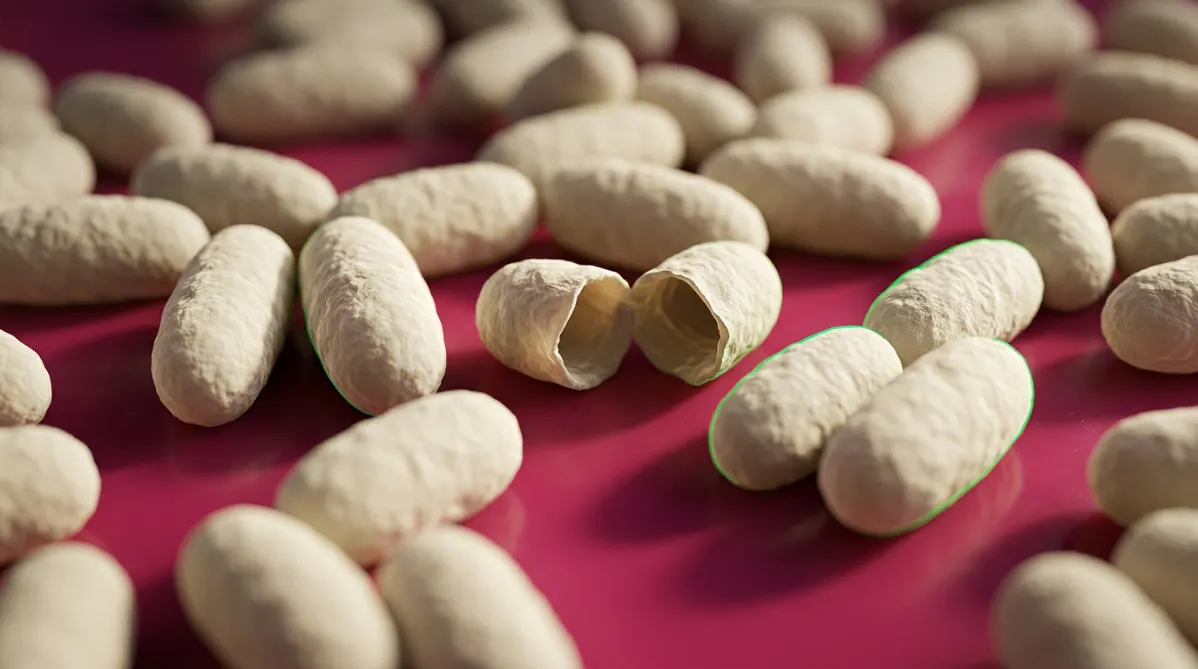
Extreme close-up microscopy-style photograph of a dense cluster of oval, rod-shaped bacterial cells, rendered as slightly wrinkled, matte, pale cream-white forms with visible surface texture. They rest on a smooth, saturated magenta-pink gel surface. Several cells in the foreground are crisp, while the rest fall into soft shallow depth of field. One cell near the center is split open and visibly hollow, to suggest a dead, heat-treated organism. Camera is a low three-quarter angle, as if through a scanning microscope. Lighting is a single hard, warm-white side light that casts short crisp shadows and creates bright rim highlights. A thin electric green (#00e676) line of reflected light traces the edge of one cell. The mood is stark, curious and quietly skeptical. There is no text and no labels.
Metabolism

The Gut Bacterium That Worked Better Dead: Akkermansia's 29% Edge

Helix Ward · · 4 min read

What if the best version of a "probiotic" is the one that's no longer alive? That's the odd twist in one of the most-discussed gut-bacteria trials of recent years, and it matters now that gut health and metabolic health are being discussed together in the GLP-1 era.

The study, published in Nature Medicine in 2019 by Depommier, Everard, Cani, de Vos and colleagues, tested Akkermansia muciniphila in people with overweight or obesity and insulin resistance. The pasteurized form improved insulin sensitivity by about 29% and cut circulating insulin by about 34% compared with placebo. The details deserve a careful read.

What the study did

The paper is titled Supplementation with Akkermansia muciniphila in overweight and obese human volunteers: a proof-of-concept exploratory study (PubMed, DOI: 10.1038/s41591-019-0495-2). It was a single-center, randomized, double-blind, placebo-controlled pilot (NCT02637115).

  • Participants: 40 overweight/obese, insulin-resistant volunteers enrolled; 32 completed.
  • Intervention: 10^10 (10 billion) A. muciniphila bacteria per day, either live or pasteurized, for three months.
  • Comparison: placebo.
  • Primary endpoints: safety, tolerability and metabolic parameters (insulin resistance, circulating lipids, visceral adiposity, body mass).
  • Secondary endpoints: gut barrier function (plasma lipopolysaccharides) and gut microbiota composition.

This was the first time A. muciniphila had been given to humans. Earlier work had only shown that people with obesity, untreated type 2 diabetes or hypertension tend to have less of it.

The key numbers

Compared with placebo, the pasteurized group showed:

  • Insulin sensitivity: +28.62 ± 7.02% (P = 0.002)
  • Insulinemia (circulating insulin): −34.08 ± 7.12% (P = 0.006)
  • Plasma total cholesterol: −8.68 ± 2.38% (P = 0.02)

The authors also report lower blood markers of liver dysfunction and inflammation after three months. The intervention was safe and well tolerated, in both live and pasteurized forms.

The part that didn't make the headline

The changes people hope for most, weight and fat loss, were not statistically significant:

  • Body weight: −2.27 ± 0.92 kg vs placebo (P = 0.091)
  • Fat mass: −1.37 ± 0.82 kg vs baseline (P = 0.092)
  • Hip circumference: −2.63 ± 1.14 cm vs baseline (P = 0.091)

The authors describe these as "slight" decreases. Treat them as hints, not results. This is not a weight-loss supplement on this evidence, and it is certainly not a GLP-1 substitute.

Why dead may beat alive

The pasteurized form carried the clearest benefits, and the live form was less effective. The abstract doesn't explain why, so treat any mechanism as hypothesis. Two points from the paper are worth noting.

First, the overall structure of the gut microbiome was unaffected. Whatever pasteurized Akkermansia did, it apparently didn't work by reshuffling the microbial community. That fits the idea of a "postbiotic" effect, where the bacterial cell, or components of it, signals to the host without needing to colonize anything.

Second, gut barrier function was a pre-specified secondary outcome, reflecting the thinking that Akkermansia supports the gut lining. The abstract doesn't report a barrier result, so check the full text (open access, PMC6699990) before assuming it.

A practical upside of a heat-killed product is that it doesn't depend on keeping an oxygen-sensitive gut bacterium alive on a shelf.

Limitations and conflicts of interest

Be skeptical, in a constructive way:

  • Small and short. Only 32 people finished, over three months. The authors call it a proof-of-concept exploratory study.
  • Single center. Results haven't been replicated within this paper.
  • Non-significant body composition changes. See above.
  • Commercial interests. Several authors (Everard, Druart, Plovier, Cani and de Vos) are inventors on patent applications covering A. muciniphila in obesity and related disorders. Cani and de Vos co-founded A-Mansia Biotech SA. That doesn't invalidate the data, but it's a reason to want independent replication.
  • Surrogate outcomes. Insulin sensitivity and cholesterol are markers, not proof of fewer heart attacks or less diabetes.

What it means for you: practical takeaways

Dose used in the trial: 10^10 cells per day for three months. Timing wasn't part of the key findings, so there's no evidence-based "best time of day."

What to look for:

  • A product that specifies pasteurized Akkermansia muciniphila, since that's the form with the strongest results.
  • A stated cell count per serving. Compare it with the trial's 10^10 cells/day rather than trusting vague "billion CFU" marketing, because live-bacteria CFU and pasteurized cell counts aren't the same thing.
  • Transparency about strain and manufacturing. The trial's product tie-in is to A-Mansia, so expect brand claims to lean on this study. Product-specific evidence may not match what was tested.

Who it's potentially for: overweight or obese adults with insulin resistance, the population studied. Results in lean, metabolically healthy people are unknown.

Who should skip it or talk to a clinician first: anyone on glucose-lowering medication, since an effect on insulin sensitivity could matter for dosing, and anyone who is pregnant, immunocompromised or managing a serious condition. The trial excluded no one from these categories in the abstract, but it also didn't test them, so this is general caution rather than a finding from the paper.

Safety: the trial found daily 10^10 cells, live or pasteurized, safe and well tolerated over three months. Longer-term safety isn't covered.

Bottom line

This is a promising, honest pilot: significant improvements in insulin sensitivity, insulin and cholesterol with a pasteurized bacterium, but no confirmed weight loss, a tiny sample and industry-linked authors. Interesting? Absolutely. A proven metabolic fix? Not yet. Diet, exercise, sleep and medical care remain the foundation. Full study: Depommier et al., Nature Medicine, 2019.
Original study

Read the original research on pubmed.ncbi.nlm.nih.gov →

This article summarizes published research for general information. It is not medical advice.

HW

Written by

Helix Ward

Helix Ward writes for Biocracked: biohacking science, longevity & human performance.

Related Articles

A wide, editorial-style still life photographed from slightly above on a pale warm-gray stone surface, lit by soft diffused morning light from the left. At the center, a delicate chain of 16 small, glossy beads in alternating muted terracotta, sage green, and cream is arranged in a gentle S-curve, each bead slightly different in size, like a hand-strung necklace. It stands for a peptide chain in a tactile, abstract way. Beside the chain, a translucent glass petri dish holds a thin layer of pale amber liquid with a few soft ripples. Behind it, a cross-section of a ripe fig and a halved blood orange show their intricate internal textures, suggesting cellular structure and mitochondria without literal illustration.

On the left side of the frame, a small ceramic mouse figurine in matte off-white sits calmly next to a sprig of dried wheat. It is a subtle nod to the mouse study and is stylized and minimal, not cartoonish. On the right, an open, softly blurred notebook with thin hand-drawn circles and curved lines, like looping pathway diagrams, lies under a brass pen. A few pages are visible but the text is illegible.

Scatter a few elements for texture: a small sprig of eucalyptus, a folded linen napkin in oatmeal tone, and a single clear glass pipette resting diagonally across the lower foreground. The palette is warm neutrals with accents of sage, terracotta, and soft amber, giving a calm, modern wellness-journal look. Shallow depth of field keeps the bead chain crisp while the background gently dissolves into creamy bokeh. Generous negative space across the upper right leaves room for headline overlay. The overall mood is clean, contemporary, and intellectually curious: scientific but warm, like a premium health and science magazine cover, with fine grain, natural shadows, and no text, logos, or futuristic elements.
peptides

MOTS-c Explained: The 16-Amino-Acid Mitochondrial Peptide That Activated AMPK and Shielded Mice From Diet-Induced Obesity

BY DR. SYNAPSE ·

A tiny 16-amino-acid peptide encoded in mitochondrial DNA, not the nucleus, activated AMPK in muscle and protected mice from diet-induced obesity and insulin resistance in a 2015 Cell Metabolism study. MOTS-c is now one of the most talked-about names in peptide and biohacking circles. But this was a mouse and molecular-discovery paper with no human outcome data, and MOTS-c is not an approved therapy. This article explains what MOTS-c is, how it appears to work through the folate cycle and AMPK, what the mice showed, and what readers should and should not conclude.

A softly lit editorial still life on a pale oat-colored linen surface, shot from a slightly elevated three-quarter angle in a wide landscape frame. At center-left, a small matte white ceramic dish holds a modest pile of fine off-white powder, with a tiny brushed-brass measuring spoon resting beside it. Next to the dish stands a minimalist amber glass supplement bottle with a plain cream label and no readable text. A few capsules spill casually across the linen, some translucent and some opaque ivory.

On the right side of the composition, a ripe blood orange cut in half and a handful of raw almonds sit on a light ash-wood board. A sprig of fresh rosemary adds a muted green accent. A sheer glass of water catches the light and throws a soft, rippled caustic pattern across the fabric.

In the background, out of focus, a woman's hand in a soft sage-green knit sleeve rests near a ceramic mug. This suggests a calm morning routine without showing a face. Behind her, a tall window casts diffused, golden-hour light from the upper left, with gentle shadows and a creamy, shallow depth of field.

The palette is warm and restrained: oat, ivory, terracotta, sage, and amber, with a single pop of coral from the blood orange. A thin, abstract line of muted terracotta paint, like a brushed arc, sweeps across the upper right background. It subtly evokes a rising curve without becoming a literal chart.

The mood is calm, trustworthy, and contemporary, like a premium wellness and science journal feature. The image has crisp focus on the powder and bottle, natural film-like grain, soft contrast, and generous negative space in the upper third for headline overlay. It looks like a high-end editorial photograph with no text, logos, or futuristic elements.
metabolism

NMN's First Human Win: 250 mg a Day Lifted Muscle Insulin Sensitivity by About 25% in Prediabetic Women

BY DR. SYNAPSE ·

NMN has long been a darling of the longevity market, but human evidence was thin until a 2021 Washington University trial published in Science. In postmenopausal women with prediabetes who were overweight or obese, 250 mg of NMN daily for 10 weeks improved muscle insulin sensitivity by roughly 25%. Muscle insulin signaling and genes tied to muscle remodeling also improved, while the placebo group saw no change. But the benefit was narrow, and the study did not show NMN lowering blood sugar or reversing prediabetes. Here's what the trial found, who it applies to, and what it didn't change.

A wide, softly lit editorial still life on a pale travertine surface. In the center-left, a halved ruby-red pomegranate sits open, its glossy arils spilling in a loose cluster onto the stone. Beside it are a few cracked walnut halves and a small matte ceramic dish holding a pinch of fine cream-colored powder. A single aril catches a bright highlight near the foreground. In the soft-focus background, a sheer linen curtain filters warm morning sunlight, which casts long, gentle shadows across the scene.

On the right side, an elegant older woman's hand, seen only from the wrist down, rests lightly on the surface next to a minimalist glass of water. Her skin shows natural texture and warmth. A slim sprig of dried olive branch and a folded sage-green napkin add quiet, organic accents.

The palette is restrained and modern: deep garnet red, warm walnut brown, oat beige, soft sage, and creamy off-white. The composition leaves generous negative space on the upper right for title text. The depth of field is shallow, with crisp focus on the pomegranate and a creamy bokeh falloff. The lighting is natural, diffused, and slightly golden, in the style of a high-end wellness magazine or a contemporary science and nutrition journal. The mood is calm, clean, and quietly authoritative. The finish is photographic, with fine grain, subtle matte tones, and a premium editorial feel.
supplements

Urolithin A, the Pomegranate Postbiotic, Triggers a Mitophagy Signature in Older Adults

BY DR. SYNAPSE ·

Urolithin A, a molecule made by gut bacteria from pomegranate and walnut polyphenols, has long rejuvenated muscle in aging animals. The first human trial in older adults found it safe, bioavailable, and able to shift mitochondrial biomarkers at 500 to 1,000 mg a day. The study, backed by the company behind Mitopure, showed a molecular signature of improved mitochondrial health in muscle. But it was small, short, and measured biomarkers rather than strength or longevity. Here is what the data show, who it is aimed at, and where the evidence stops.

Approach: Macro science. Palette: B, warm.

Extreme macro photograph of raw berberine: a small heap of vivid yellow-orange crystalline powder with needle-like crystal clusters, shot at a low 30-degree angle with a shallow depth of field. Beside it, a dry sliver of Berberis root bark shows its bright yellow inner wood and fibrous grain. The surface is a smooth dark walnut board. Low golden-hour side light from the left makes the crystals glint like amber glass and throws long warm copper shadows across the wood. One tiny electric green highlight reflects off a glass spatula edge in the soft background blur. The mood is quiet and investigative, with rich saturated honey and burnt-orange tones and no blue cast. Photorealistic, microscopy-like texture, no text or labels.
metabolism

Berberine vs. Metformin: The Pilot Trial Behind HbA1c 9.5% to 7.5%

BY HELIX WARD ·

A small 2008 pilot trial put berberine head-to-head with metformin in newly diagnosed type 2 diabetes, and the glucose-lowering effect looked similar. In the berberine group, HbA1c fell from 9.5% to 7.5% in three months. A second trial in 48 people already on treatment saw HbA1c drop from 8.1% to 7.3% and HOMA-IR fall 44.7%. But these were small studies in people with diabetes, and about a third of participants had GI side effects. Here is what the data show, what they don't, and what to know before you think about berberine.

This page is available in