Biocracked
←

#mouse study

2 articles
Approach: macro science. Palette: bold color field (violet).

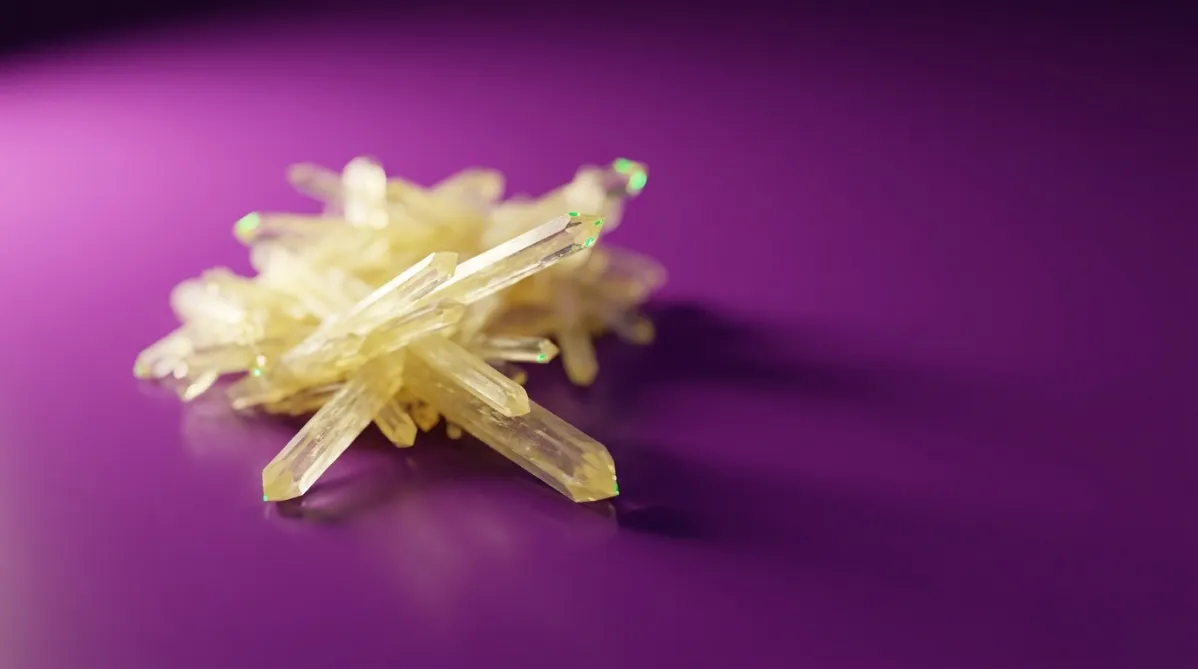
Extreme close-up of fisetin crystals, a small cluster of pale yellow needle-like flavonoid crystals with translucent, faceted edges, resting on a smooth glossy deep violet surface. The camera sits low at a shallow three-quarter angle with a very shallow depth of field, so the front crystals are razor sharp and the rest dissolves into soft magenta-violet blur. Lighting is a single crisp, slightly warm studio key from upper left that makes the crystal edges glow and throws long soft shadows across the violet. A few tiny electric green (#00e676) specks of reflected light catch on the crystal tips. The mood is precise, curious and quietly promising, like a sample under inspection, with plenty of clear violet space on the right side of the frame.
longevity

Fisetin senolytic verlengt muizenleeftijd – human proof ontbreekt nog

BY HELIX WARD ·

Fisetin, een plantaardige flavonoïde, kwam in een vaak geciteerde 2018‑studie in *EBioMedicine* naar voren als de krachtigste senolytic van tien onderzochte stoffen. Bij oude muizen verminderde een late‑leeftijdsbehandeling de senescentie‑markers, verzachtte leeftijdsgerelateerde pathologie en verlengde zowel de mediane als de maximale levensduur. Het punt is echter dat dit uitsluitend muis‑ en laboratoriumdata betreft; er is nog geen afgeronde menselijke proef. In dit artikel wordt uitgelegd wat de onderzoekers ontdekten, wat de doseringscontext werkelijk betekent en wie er aandacht moet besteden zodra er menselijke studies volgen.

A wide landscape editorial photograph of a minimalist laboratory-meets-wellness still life on a pale, warm-gray stone countertop, softly lit by diffused morning window light from the left. In the center foreground, a small amber glass supplement jar with a plain matte white label sits beside a scattering of fine white powder and a few loose white capsules on a ceramic dish. Next to it rests a clean, open notebook with faint hand-drawn line graphs, two diverging curves rising gently, one slightly higher than the other, drawn in muted sage-green and charcoal ink. A slim brass pen lies across the page.

In the soft-focus midground, a delicate glass beaker filled with clear liquid catches a thin streak of light, casting a gentle caustic shimmer across the stone. A sprig of dried eucalyptus and a small sliver of citrus peel add organic texture. Behind them, an out-of-focus wall of pale oat-colored tiles and a floating wooden shelf holds a few blurred ceramic vessels and a small potted fern.

The color palette is calm and editorial: warm creams, sage green, soft amber, muted terracotta accents, and touches of charcoal. Shallow depth of field with a crisp focus on the jar and notebook, creamy bokeh in the background. Subtle film-like grain, natural shadows, and generous negative space on the right third of the frame, suitable for headline overlay. The mood is thoughtful, measured, and trustworthy, like a contemporary science and wellness journal cover: modern, tactile, quietly optimistic, and grounded rather than hyped.
longevity

Calcium‑alpha‑ketoglutaraat verlengt de levensduur van vrouwelijke muizen met tot 16,6 %: wat dat wel en niet betekent voor mensen

BY DR. SYNAPSE ·

Een studie uit 2020 in *Cell Metabolism* toonde aan dat een dieet met 2 % calcium‑alpha‑ketoglutaraat (CaAKG) de mediane levensduur van vrouwelijke muizen met maximaal 16,6 % verlengde en hun frailiteit verminderde. Het effect was kleiner in een tweede cohort (10,5 %) en bij mannetjes was de overlevingswinst niet statistisch significant. De onderzoekers koppelden dit aan minder systemische ontsteking en een vermeende stijging van IL‑10. Het blijft echter een onderzoek dat alleen op muizen is uitgevoerd en bewijst niet dat AKG de menselijke levensduur verlengt. Hieronder lees je wat de data écht laten zien, hoe dit verschilt van supplement‑marketing, en waarom CaAKG op een onderzoeks‑watchlist thuishoort in plaats van in een bewezen protocol.

This page is available in