Biocracked
←

#healthy aging

5 articles
Approach: macro science with a conceptual twist. Palette: bold color field.

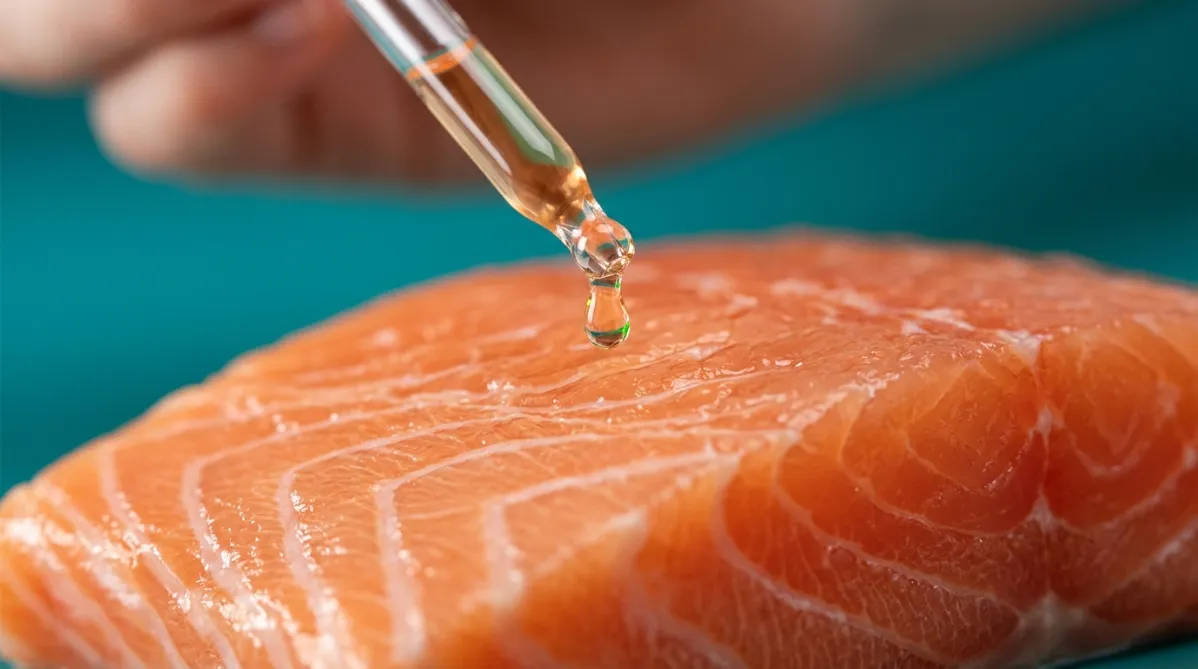
Extreme close-up, slightly high three-quarter angle, of a raw salmon fillet's translucent coral flesh, with a glass pipette releasing a single droplet of pale amber peptide solution onto the muscle fibers. Glistening myotome layers and fine white connective lines are sharp in the foreground, with shallow depth of field melting the rest. The salmon sits on a saturated teal backdrop, so the orange-pink flesh contrasts strongly with it. Soft, large-source studio light from upper left gives crisp specular highlights on the droplet and moist fibers, with gentle neutral shadows. A tiny electric green reflection glints inside the droplet. The mood is precise, fresh and curious, like a food-science lab photograph. Photorealistic, with no text.
peptides

Peptides de saumon vs lactosérum : +13 % de ferritine en 8 semaines (étude pilote de 14 personnes)

BY NOVA CHEN ·

Un petit essai norvégien a montré que 12 g/jour d’hydrolysat de protéine de saumon augmentaient la ferritine d’environ 13 % et le nombre de globules rouges d’environ 7 % comparé au lactosérum sur huit semaines. Les résultats secondaires suggéraient une réduction de l’inflammation, de meilleurs marqueurs glucidiques et une composition corporelle améliorée. L’étude, limitée à 14 participants et financée par l’industrie, constitue davantage un signal qu’une preuve définitive. Voici ce que sont les peptides de saumon, ce que l’essai a trouvé, leurs différences avec le collagène et pourquoi la prudence reste indispensable.
Approach: conceptual metaphor. Palette: bold color field.

A single AA-style cylindrical battery, shown as a real object with a bare metal cap and a plain unlabeled matte sleeve, stands upright on a glossy surface. It is photographed from a low three-quarter angle against a saturated tomato-red seamless backdrop. The battery is half-filled with a translucent amber liquid that visibly rises inside a clear glass cutaway section. A thin ribbon of electric green light (#00e676) wraps around its base like a charging band. Soft large-softbox light comes from the upper left and produces crisp highlights on the metal and a clean, slightly blurred red reflection beneath it. A second, shorter battery sits out of focus behind, nearly drained and empty, to suggest contrast. The mood is energetic, optimistic and precise, with a tactile product-photography look and shallow depth of field.
supplements

NR + pterostilbène fait grimper le NAD+ de ~40 % à 90 % dans une étude humaine

BY NOVA CHEN ·

Une capsule quotidienne de nicotinamide riboside et de pterostilbène peut‑elle augmenter le NAD+ chez les personnes âgées ? Dans le premier essai humain NRPT (Basis), 120 participants âgés de 60 à 80 ans ont suivi le traitement pendant huit semaines. Le taux sanguin de NAD+ a progressé d’environ 40 % à la dose recommandée et d’environ 90 % à la dose doublée, hausse qui s’est maintenue pendant l’étude. Aucun effet indésirable grave n’a été signalé. Voici les données, les enseignements sur les doses, et ce que l’étude ne permet pas de conclure.
A wide, minimalist editorial still life on a soft, warm-gray linen surface lit by gentle diffused morning window light. At center sit two identical small amber glass supplement bottles, one slightly in front of the other, with plain matte cream labels and no readable text. In front of them, two matching shallow ceramic dishes in muted sage green hold identical small ivory capsules. The capsules are nearly indistinguishable, which quietly suggests placebo versus active. Beside the dishes, a few wheat germ grains, a small cluster of aged cheddar-toned cheese shards, and a halved ripe mushroom hint at natural spermidine food sources. They are arranged with careful negative space.

On the left, a delicate balance scale in brushed brass sits perfectly level, its two small pans empty and even, as a subtle visual metaphor for "no difference." On the right, a neat open notebook with soft blurred pencil lines and a single sprig of dried eucalyptus lies beside a pair of thin round tortoiseshell reading glasses, suggesting older adults and memory without showing any people.

The background is a softly blurred pale oat-colored wall with a long gentle shadow cast diagonally across the scene from a window. The color palette is muted and modern: warm cream, sage green, amber, soft brass, and dusty terracotta accents. Shallow depth of field keeps the bottles and scale crisp while the edges melt into a creamy blur. The mood is calm, thoughtful, and quietly skeptical, like a trendy health and science journal feature. Fine film grain, a subtle matte finish, and a balanced asymmetrical composition leave open space in the upper right for headline overlay. Photographed from a slightly elevated three-quarter angle, high-end editorial photography style.
supplements

Spermidine pour la mémoire ? Un essai de 12 mois chez 100 adultes âgés n’a révélé aucun avantage par rapport au placebo

BY DR. SYNAPSE ·

La spermidine a été présentée comme un complément protecteur du cerveau, soutenue par la recherche sur l’autophagie et les études animales. L’essai clinique SmartAge a testé cette promesse chez 100 personnes âgées présentant un déclin cognitif subjectif, en administrant environ 0,9 mg par jour pendant 12 mois. Le critère principal de mémoire n’a pas surpassé le placebo (différence –0,03 ; p = 0,47) et les critères secondaires étaient également négatifs. Les signaux exploratoires sur l’inflammation et la mémoire verbale restent non confirmés. Voici ce que cela implique pour quiconque envisage un supplément de spermidine et les limites de l’étude.

A bright, minimalist editorial still life on a pale warm-white stone surface, shot from a slightly elevated three-quarter angle in soft natural window light. At center, a small amber glass supplement bottle with a matte cream label, unbranded, sits beside a few loose white capsules. A pair of weathered hands in a light oatmeal linen sleeve, belonging to an older adult, rests gently near the bottle, with a ceramic mug of tea just out of focus. To the right, a clean glass vial and a delicate glass beaker filled with clear liquid catch the light, hinting at laboratory research without any futuristic touch. A small paper notebook with a handwritten simple line graph rising in a gentle curve lies open nearby, along with a sharpened pencil. Scattered at the edges are soft sprigs of dried eucalyptus and a few pale sage-green leaves, adding an organic note. A faint, abstract molecular diagram printed in muted teal ink on a card leans against the bottle, subtle and graphic. The palette is calm and modern: warm ivory, sage green, soft teal, muted amber, and touches of dusty peach. Long, gentle shadows fall across the surface, and the shallow depth of field blurs the background into creamy neutral tones. The composition leaves generous negative space on the left third for headline text. The overall feel is a trendy health and science journal: clean, airy, trustworthy, and quietly sophisticated, with fine film-like grain and true-to-life color. Ultra-detailed, 16:9 landscape.
supplements

1 000 mg de nicotinamide riboside quotidien augmentent le NAD+ des cellules sanguines d’environ 60 % chez les personnes âgées : le résultat d’un essai randomisé

BY DR. SYNAPSE ·

Un essai croisé publié en 2018 dans *Nature Communications* a testé la nicotinamide riboside à raison de 500 mg deux fois par jour (1 000 mg/jour) pendant six semaines chez des adultes en bonne santé d’âge moyen et avancé. Le supplément a été bien toléré et a augmenté le NAD+ dans les cellules immunitaires sanguines d’environ 60 % par rapport au placebo. Les chercheurs ont également observé des signaux précoces d’une pression artérielle plus basse et d’une rigidité artérielle réduite, qu’ils ont présentés comme des pistes pour de plus grands essais, et non comme des bénéfices prouvés. Cet article explique pourquoi le NAD+ est censé diminuer avec l’âge, ce que l’étude a fait, et ce qu’elle ne peut pas nous dire sur les issues de maladie ou la longévité.
A wide, softly lit editorial still life on a pale travertine surface. In the center-left, a halved ruby-red pomegranate sits open, its glossy arils spilling in a loose cluster onto the stone. Beside it are a few cracked walnut halves and a small matte ceramic dish holding a pinch of fine cream-colored powder. A single aril catches a bright highlight near the foreground. In the soft-focus background, a sheer linen curtain filters warm morning sunlight, which casts long, gentle shadows across the scene.

On the right side, an elegant older woman's hand, seen only from the wrist down, rests lightly on the surface next to a minimalist glass of water. Her skin shows natural texture and warmth. A slim sprig of dried olive branch and a folded sage-green napkin add quiet, organic accents.

The palette is restrained and modern: deep garnet red, warm walnut brown, oat beige, soft sage, and creamy off-white. The composition leaves generous negative space on the upper right for title text. The depth of field is shallow, with crisp focus on the pomegranate and a creamy bokeh falloff. The lighting is natural, diffused, and slightly golden, in the style of a high-end wellness magazine or a contemporary science and nutrition journal. The mood is calm, clean, and quietly authoritative. The finish is photographic, with fine grain, subtle matte tones, and a premium editorial feel.
supplements

Urolithine A, le postbiotique de la grenade, déclenche une signature de mitophagie chez les personnes âgées

BY DR. SYNAPSE ·

L’urolithine A, molécule produite par le microbiote intestinal à partir des polyphénols de la grenade et des noix, a longtemps montré des effets rajeunissants sur le muscle des animaux âgés. Le premier essai clinique réalisé chez des seniors a démontré qu’elle était sûre, biodisponible et capable de moduler les biomarqueurs mitochondriaux à des doses de 500 à 1 000 mg par jour. Financé par l’entreprise à l’origine de Mitopure, l’étude a mis en évidence une signature moléculaire d’amélioration de la santé mitochondriale dans le muscle, même si elle était de petite taille, de courte durée et s’appuyait sur des biomarqueurs plutôt que sur la force ou la longévité. Voici ce que révèlent les données, à qui elles s’adressent et quelles en sont les limites.

This page is available in