Biocracked
Approach: The human outcome. Palette: C, Natural.

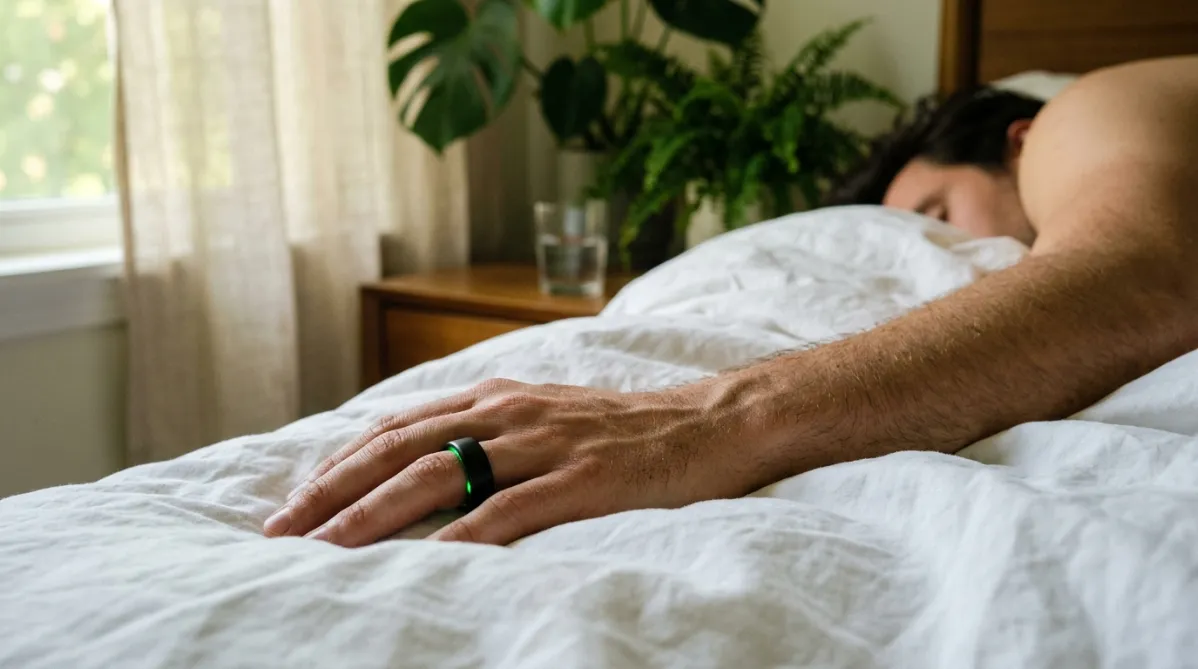
A close, low-angle shot of a sleeping person's bare forearm and hand resting on a rumpled white cotton duvet, a matte black smart ring on the index finger, with a small electric green LED glint on the ring's inner edge. Early morning daylight comes through a sheer curtain at the left and casts soft golden-green light across the skin, showing fine arm hair and natural skin texture. In the background, out of focus, are a wooden nightstand with a glass of water and the blurred green leaves of a houseplant by the window. The face is not shown. Shot at a 35mm equivalent with shallow depth of field, focused on the ring and knuckles. The mood is calm, restorative and quietly observational, as if the night's data were about to be checked.
Supplements

Magnesium L-Threonate Lifted Oura Deep and REM Scores in 3 Weeks

Nova Chen · · 5 min read

You can buy magnesium in a dozen forms, and almost every label promises better sleep. A 2024 randomized trial in Sleep Medicine: X tested one of them, magnesium L-threonate (MgT, sold under the brand name Magtein). After just 21 days, adults taking it had better deep and REM sleep scores on their Oura rings than those taking placebo. The result is interesting, but the details matter, and so do the caveats.

Why the magnesium form matters

Magnesium is a mineral, but supplements deliver it attached to a carrier molecule: citrate, glycinate, oxide, threonate and others. The carrier can influence absorption, digestive tolerance and, possibly, where the magnesium ends up.

MgT was designed around that last idea. It grew out of rodent research (Slutsky et al., Neuron, 2010) suggesting that threonate could help raise magnesium levels in the brain. The new trial's authors describe MgT as promising because of its brain bioavailability and its links to cognition, memory and mood. That is the rationale. It is not proof that the same effect translates into better sleep in people, which is what this study tried to examine.

The trial: who, what and how long

The study was randomized, double-blind, placebo-controlled and run in parallel groups.

  • Participants: 80 adults aged 35 to 55 with self-reported sleep problems
  • Intervention: 1 g/day of MgT (Magtein) or placebo
  • Duration: 21 days
  • Subjective measures: Insomnia Severity Index, Leeds Sleep Evaluation Questionnaire, Restorative Sleep Questionnaire, Profile of Mood States, and a daily diary
  • Objective measure: an Oura ring

Pairing questionnaires with a wearable is a sensible design. People's sense of how they slept and what a device records don't always agree, so seeing both move in the same direction is more persuasive than either alone.

The Oura results

Compared with placebo, the MgT group showed statistically significant improvements (p < 0.05) in:

  • Deep sleep score
  • REM sleep score
  • Light sleep time
  • Activity score and daily movement score
  • Readiness score, readiness activity balance and readiness sleep balance

The authors summarized this as improved sleep quality, especially in the deep and REM stages. Note that these are Oura's composite scores, not necessarily extra minutes in each stage, so avoid reading them as "X more minutes of deep sleep." Also, the abstract says the MgT group maintained good sleep quality and daytime functioning while the placebo group declined. Part of the headline gap therefore comes from the placebo group getting worse, not only from the MgT group improving.

Mood, energy and daytime function

The questionnaires pointed the same way. Versus placebo, MgT significantly improved behavior upon awakening, energy and daytime productivity, grouchiness, mood and mental alertness. Sleep supplements are often judged on how you feel the next day, and that is where this trial reported some of its clearer signals.

The authors say the findings fit what is known about MgT in neurons and animal models, and they suggest broader brain-health benefits. That is a hypothesis for future work, not something this study established.

Magnesium threonate vs glycinate vs citrate

This is the question most people searching "best magnesium for sleep" want answered, and this trial cannot answer it. It compared MgT to placebo, not to glycinate, citrate or any other form. Any ranking would be speculation.

What can be said, with hedging:

  • Threonate: the form with a brain-delivery rationale and now a small positive sleep trial, though much of the supporting mechanistic work is in animals and the form is typically branded and more expensive.
  • Glycinate: widely used for sleep and generally considered gentle on the stomach, with a plausible calming role for the glycine component. Head-to-head evidence against threonate is lacking.
  • Citrate: well absorbed and common, but better known for its laxative effect at higher doses.

The authors themselves note that clinical evidence for magnesium and sleep has varied depending on the magnesium source. That is a reason to be cautious about assuming all forms behave alike, and equally cautious about assuming threonate is superior.

Practical takeaways

Dose. The trial used 1 g/day of MgT. That is the compound, not the elemental magnesium. At roughly 7 to 8 percent magnesium by weight, 1 g provides about 72 to 80 mg of elemental magnesium, which is modest next to the 300 to 400 mg many people associate with magnesium supplements. Check the label: some products list a different serving size, and the dose tested here may not match what's on the bottle.

Timing. The abstract doesn't specify when participants took it. Since the target is sleep, many people take MgT in the evening, but that is a practical convention, not a finding from this trial.

Who it might suit. Adults in roughly the 35 to 55 range who have self-described sleep complaints and are curious about a supplement trial. It isn't evidence for treating diagnosed insomnia, sleep apnea or other sleep disorders.

Side effects. The authors reported MgT was safe and well tolerated. Magnesium supplements in general can cause loose stools or stomach upset, and people with kidney disease or those taking medications that interact with magnesium (certain antibiotics and bisphosphonates, for example) should talk to a clinician or pharmacist first.

Honest limitations

  • Short duration. Three weeks says nothing about long-term effects or whether benefits persist.
  • Wearable sleep staging. Oura rings estimate sleep stages and are not polysomnography, the lab standard. Consumer devices can be useful for tracking trends but are less reliable at assigning specific stages.
  • Self-reported sleep problems. Participants weren't necessarily clinically diagnosed, which limits how far the results generalize.
  • Small sample. Eighty people is enough for a signal, not for firm conclusions.
  • Branded ingredient. Magtein is a proprietary ingredient. Readers should check the paper's disclosures for industry ties or funding, and independent replication is still limited.
  • Many outcomes. With numerous measures tested, some p < 0.05 results can arise by chance, which is another reason to want replication.

The bottom line

This trial is a promising, well-structured early signal that MgT may support deep and REM sleep scores, mood and daytime energy over three weeks. It doesn't show that threonate beats glycinate or citrate, and it doesn't settle the dose, timing or long-term question. Treat it as a reason for larger, independent, longer trials, and as a conversation starter with your clinician if you're considering it.

Original study

Read the original research on pubmed.ncbi.nlm.nih.gov →

This article summarizes published research for general information. It is not medical advice.

NC

Written by

Nova Chen

Nova Chen writes for Biocracked: biohacking science, longevity & human performance.

Related Articles

Approach: Macro science. Palette: B, warm.

Extreme macro photograph of raw berberine: a small heap of vivid yellow-orange crystalline powder with needle-like crystal clusters, shot at a low 30-degree angle with a shallow depth of field. Beside it, a dry sliver of Berberis root bark shows its bright yellow inner wood and fibrous grain. The surface is a smooth dark walnut board. Low golden-hour side light from the left makes the crystals glint like amber glass and throws long warm copper shadows across the wood. One tiny electric green highlight reflects off a glass spatula edge in the soft background blur. The mood is quiet and investigative, with rich saturated honey and burnt-orange tones and no blue cast. Photorealistic, microscopy-like texture, no text or labels.
metabolism

Berberine vs. Metformin: The Pilot Trial Behind HbA1c 9.5% to 7.5%

BY HELIX WARD ·

A small 2008 pilot trial put berberine head-to-head with metformin in newly diagnosed type 2 diabetes, and the glucose-lowering effect looked similar. In the berberine group, HbA1c fell from 9.5% to 7.5% in three months. A second trial in 48 people already on treatment saw HbA1c drop from 8.1% to 7.3% and HOMA-IR fall 44.7%. But these were small studies in people with diabetes, and about a third of participants had GI side effects. Here is what the data show, what they don't, and what to know before you think about berberine.

**Approach: Conceptual metaphor. Palette: B, Warm.**

A close, slightly high three-quarter view of a single weathered hemp rope stretched horizontally across the frame, shot at a shallow depth of field. On the left the rope is thick and tightly twisted. On the right it has frayed down to a few thin strands, with a short, neat whipping of bright electric green thread binding the rope just where the fraying stops. Golden-hour sunlight enters low from the left and picks out each individual fiber in honey and copper tones. Soft amber shadows fall across a blurred, sun-warmed wooden dock in the background. The mood is quiet and cautiously hopeful, suggesting something worn down slowly but partly held in place. The image is photorealistic and has no text.
longevity

Vitamin D3 Preserved 140 Base Pairs of Telomere in a 4-Year RCT

BY DR. SYNAPSE ·

A large, randomized, placebo-controlled trial found that four years of vitamin D3 slowed telomere shortening by about 140 base pairs. The data come from the VITAL study of older U.S. adults taking 2,000 IU/day. The effect was modest and borderline significant (p=0.039), and telomere length is a surrogate marker, not proof of a longer life. Omega-3s, meanwhile, did nothing for telomeres in this trial. Here is what the numbers show, what the limits are, and how to use the finding sensibly.

Approach: the human outcome. Palette: natural.

Extreme close-up of a woman's eye and the delicate skin around it, shot from a slight three-quarter angle with a 100mm macro lens and a shallow depth of field. Her skin is a mature 50s complexion with fine crow's feet that are sharp and tactile, with visible pores and soft vellus hairs. Her gaze is relaxed and not at the camera, and the face is cropped so identity isn't the focus. Soft, directional window daylight rakes across the skin from the left to bring out the wrinkle texture, with gentle warm skin tones and a blurred leafy green background outdoors. A single glass of water with a faint dissolving powder swirl sits out of focus in the foreground, with a tiny electric green leaf highlight at the edge. The mood is calm, honest and quietly scientific.
peptides

2.5 g of Collagen Peptides Cut Eye Wrinkles 20% in 8 Weeks

BY NOVA CHEN ·

Collagen is one of the most searched beauty and longevity supplements, but few products have placebo-controlled human data. In this trial of 114 women aged 45-65, 2.5 g a day of the specific bioactive peptide Verisol cut eye wrinkle volume by 20% versus placebo after 8 weeks. Biopsies showed 65% more procollagen type I and 18% more elastin, while a 6% fibrillin bump wasn't significant. The effect was still detectable 4 weeks after the last dose. But the results apply to one branded peptide in one population, not every collagen powder, so here's what the paper does and doesn't prove.

A wide landscape editorial photograph of a minimalist laboratory-meets-wellness still life on a pale, warm-gray stone countertop, softly lit by diffused morning window light from the left. In the center foreground, a small amber glass supplement jar with a plain matte white label sits beside a scattering of fine white powder and a few loose white capsules on a ceramic dish. Next to it rests a clean, open notebook with faint hand-drawn line graphs, two diverging curves rising gently, one slightly higher than the other, drawn in muted sage-green and charcoal ink. A slim brass pen lies across the page.

In the soft-focus midground, a delicate glass beaker filled with clear liquid catches a thin streak of light, casting a gentle caustic shimmer across the stone. A sprig of dried eucalyptus and a small sliver of citrus peel add organic texture. Behind them, an out-of-focus wall of pale oat-colored tiles and a floating wooden shelf holds a few blurred ceramic vessels and a small potted fern.

The color palette is calm and editorial: warm creams, sage green, soft amber, muted terracotta accents, and touches of charcoal. Shallow depth of field with a crisp focus on the jar and notebook, creamy bokeh in the background. Subtle film-like grain, natural shadows, and generous negative space on the right third of the frame, suitable for headline overlay. The mood is thoughtful, measured, and trustworthy, like a contemporary science and wellness journal cover: modern, tactile, quietly optimistic, and grounded rather than hyped.
longevity

Calcium Alpha-Ketoglutarate Extended Female Mouse Lifespan by Up to 16.6%. Here's What That Does (and Doesn't) Mean for Humans

BY DR. SYNAPSE ·

A 2020 Cell Metabolism study found that feeding middle-aged mice a 2% calcium alpha-ketoglutarate diet extended female median lifespan by up to 16.6% and reduced frailty. The effect was smaller in the second cohort (10.5%), and male survival gains were not statistically significant. Researchers link the benefit to lower systemic inflammation and a proposed rise in IL-10. But this was a mouse-only study, and it does not establish that AKG extends human lifespan. Here is what the data show, how they differ from supplement marketing, and why CaAKG belongs on a research watchlist rather than in a proven protocol.

This page is available in