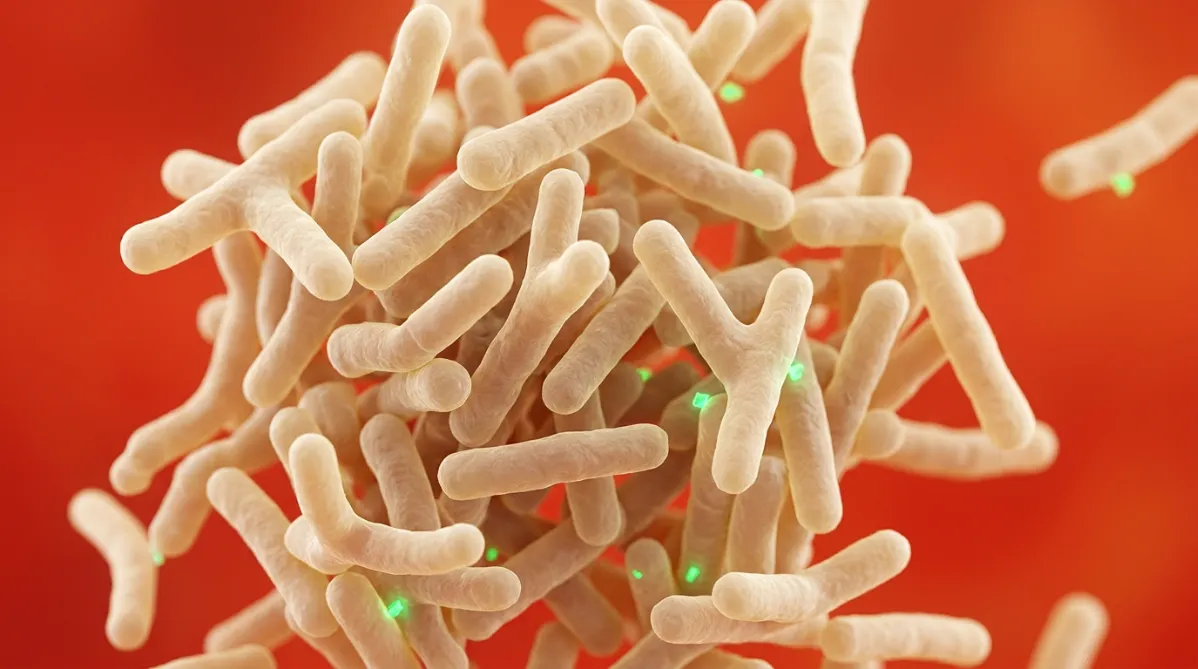
What if one of the gut's quietest residents was also one of its best defenders against aging, and it disappears as we get older? A new paper in Nature Aging points at exactly that. The microbe is Bifidobacterium pseudocatenulatum, and the molecule it makes is 5-aminovaleric acid betaine (5-AVAB).
Here is what the study found, what it didn't, and what you can responsibly do with the information today.
The Big Finding: A Missing Microbe in Older Guts
The study, by Lu and colleagues, starts from a familiar problem. The gut microbiome clearly shapes how we age, but it has been hard to say which microbes matter and how. The team first mapped how gut communities remodel with age in an enterotype-specific way, meaning the pattern differs depending on the broad microbial community type a person carries. They then built a microbiome-based aging clock, called MicroAge, to track biological aging trajectories.
From that work, one species stood out. B. pseudocatenulatum was consistently depleted during aging across both sexes and multiple Chinese cohorts. Its consistency across groups is why the authors flagged it as a candidate "geroprotective" species, one that may help protect against the aging process.
The depletion pattern is human data, but it is an association. It shows the microbe declines with age, not that restoring it slows aging in people.
What Happened in Mice
The functional testing was done in naturally aged mice, not in humans. Mice that received oral B. pseudocatenulatum as a single-strain (monotherapy) treatment showed several changes, according to the abstract:
- Restored intestinal homeostasis
- Reduced multiorgan inflammaging, the chronic low-grade inflammation that builds with age and is tied to many age-related conditions
- Better cognitive-motor performance
- Extended healthspan
The abstract reports healthspan extension, which is not the same as a proven lifespan extension. It also does not give quantitative effect sizes, so the magnitude of these benefits can't be judged from the summary alone.
The Metabolite Twist: Meet 5-AVAB
The more intriguing part is the mechanism. The researchers identified 5-AVAB as a key metabolite produced by B. pseudocatenulatum. Its levels decline physiologically in aging humans, which mirrors the microbe's own decline.
When the team supplemented 5-AVAB directly, it partially recapitulated the broad systemic benefits seen with the live bacterium. That included improved cognitive and motor function and suppressed multiorgan inflammaging.
The word "partially" matters. 5-AVAB reproduced some of the effect, not all of it. The live microbe likely does more than make one molecule, or it delivers the molecule in a way a simple supplement doesn't match. The authors frame the B. pseudocatenulatum–5-AVAB axis as a "promising target" for microbiome-based interventions, which is a research direction, not a finished therapy.
Why This Matters for Inflammaging
Inflammaging is a major thread in aging biology. Persistent, low-level inflammation across organs is associated with cognitive decline, frailty, and metabolic problems. Most anti-inflammaging strategies target the immune system directly. This work takes a different route and asks whether a missing gut symbiont, and the small molecule it produces, could be an upstream lever.
The microbe-to-metabolite framing also has a practical appeal. A defined metabolite is easier to standardize, dose, and test than a living organism, so 5-AVAB could in principle become a more tractable intervention than a probiotic. That is speculation beyond the paper, and the abstract doesn't claim it.
Practical Takeaways (With Honest Caveats)
Dose and timing: The abstract gives no human dose, schedule, or formulation for either B. pseudocatenulatum or 5-AVAB. There is no evidence-based human protocol from this paper, so any specific dose recommendation would be invented. Mouse doses also don't translate directly to people.
Who it's potentially relevant for: In the long run, older adults whose microbiomes have lost Bifidobacterium species may be the natural target. The depletion was observed in Chinese cohorts, so whether the pattern holds in other populations needs to be tested.
Who should be cautious or skip it for now:
- Anyone looking for a proven, ready-to-buy anti-aging product. No human intervention data are reported in the abstract.
- People who are immunocompromised, critically ill, or on immunosuppressants should talk to a clinician before taking any probiotic. This is general caution, not a finding from the paper.
- Anyone tempted by products that claim to contain 5-AVAB or this exact strain. Check that the claims are backed by human trials.
What you can do now: Nothing in this study suggests a specific supplement purchase. The sensible move is to follow the research, since human trials of this strain or metabolite would be the real test, and to keep up the general habits associated with a healthy gut, such as a fiber-rich diet.
The Bottom Line
This paper builds a coherent story from human cohort data (a microbe and metabolite that fall with age) to animal experiments (restoring them improved inflammaging, function, and healthspan in aged mice). The key limits are clear: the causal evidence is from mice, 5-AVAB reproduced the benefits only partially, and no human dosing or efficacy data are given in the abstract.
The next questions are whether B. pseudocatenulatum or 5-AVAB can shift inflammaging markers in older people, and at what dose. Until trials answer them, treat this as a promising lead rather than a recommendation.
Source: Lu et al. "A geroprotective probiotic and its functional metabolite counteract inflammaging to extend healthspan." Nature Aging. DOI: 10.1038/s43587-026-01181-4. PubMed: https://pubmed.ncbi.nlm.nih.gov/42642521/