The Ancient Quest Meets Modern Photomedicine
The pursuit of youthful skin has captivated humanity since ancient times, driving everything from Cleopatra's milk baths to modern cosmetic surgery. Yet a groundbreaking 2009 study published in Photomedicine and Laser Surgery revealed that the fountain of youth might not be found in synthetic compounds or invasive procedures, but in a surprisingly simple combination of botanical chemistry and targeted light therapy. Researchers Andrei P. Sommer and Dan Zhu demonstrated that when green tea polyphenols meet 670-nanometer red light, the result is nothing short of remarkable—a synergistic effect that rejuvenates skin, dramatically reduces wrinkle levels, and restores what the researchers termed a "juvenile complexion."
Decoding the Synergy: Polyphenols Meet Photons
To understand why this combination proves so potent, we must examine the individual components through the lens of cellular biology. Green tea (Camellia sinensis) has long been celebrated for its high concentration of catechins, particularly epigallocatechin gallate (EGCG), one of nature's most powerful antioxidants. These polyphenols neutralize free radicals and mitigate oxidative stress—the cellular damage that accelerates aging, degrades collagen, and manifests as wrinkles and photodamage.
Red light therapy, specifically photobiomodulation at 670 nanometers, operates through a different mechanism entirely. When delivered at a dermal dose of 4 J/cm², this wavelength penetrates the skin to stimulate mitochondrial activity, enhancing cellular energy production (ATP synthesis) and upregulating fibroblast function. These light-stimulated cells increase collagen and elastin production—the structural proteins responsible for skin firmness and elasticity.
"The genius of this approach lies not in using either modality alone, but in exploiting their complementary biological actions," explains Dr. Synapse, a photomedicine researcher. "While green tea provides antioxidant protection and anti-inflammatory benefits, red light energizes the cellular machinery needed for tissue repair. Together, they create an environment where aged skin can essentially reprogram itself toward youthfulness."
The Experimental Protocol: Extreme Stress, Remarkable Recovery
The study's methodology underscores the robustness of its findings. Rather than testing on pristine skin, the researchers subjected their model to two months of extreme oxidative stress—simulating the cumulative damage of years of UV exposure and environmental pollution. This created a baseline representative of severely aged, photodamaged tissue rather than minor cosmetic concerns.
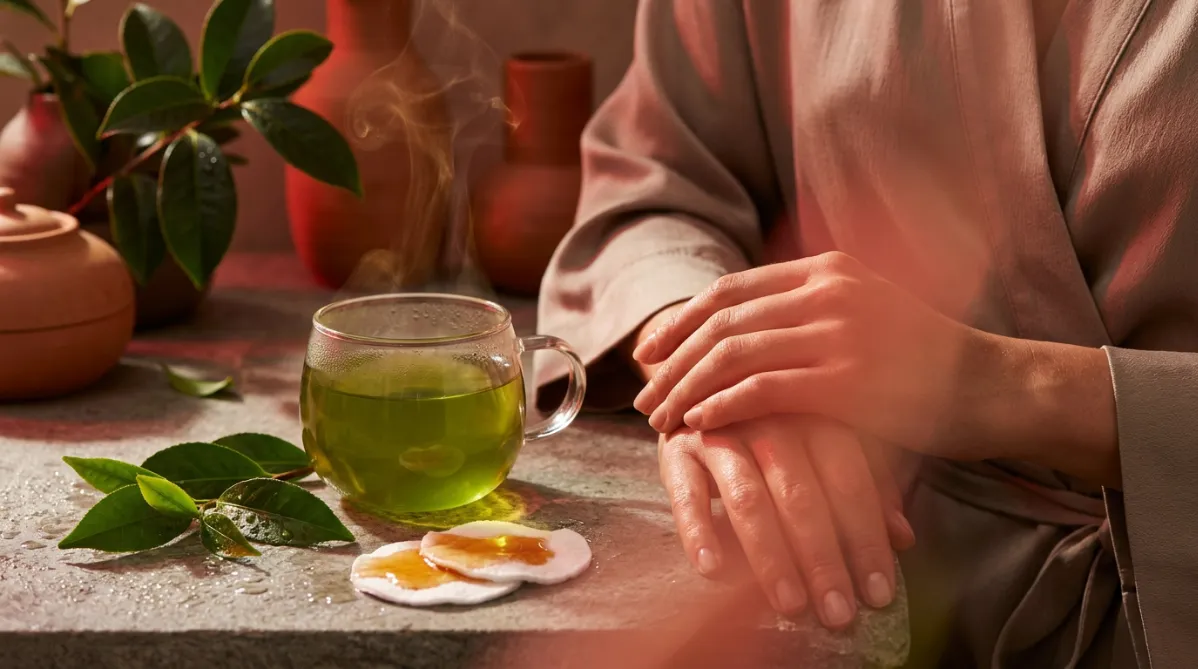
The treatment protocol itself was elegantly simple yet scientifically precise: cotton pads saturated with green tea were applied to the skin for 20 minutes prior to LED exposure. This pre-treatment window allowed for optimal cutaneous absorption of catechins, saturating the tissue with antioxidant protection before the 670 nm light array was activated.
This sequencing proved critical. By neutralizing reactive oxygen species before photostimulation, the green tea prevented the oxidative byproducts that sometimes accompany light-based therapies, while simultaneously enhancing the cellular receptivity to photobiomodulation. The result was a controlled, high-efficiency cellular rejuvenation process that worked with the body's own repair mechanisms rather than against them.
From Oxidative Stress to Juvenile Complexion
The results reported in the study bordered on the dramatic—what modern wellness advocates might describe as "insane results" in an era of modest cosmetic claims. Following the green tea-assisted facial rejuvenation program, researchers documented not merely incremental improvements but fundamental reversal of aged skin characteristics. Wrinkle levels showed significant reduction, with deeper furrows softening and fine lines diminishing markedly. More strikingly, the skin achieved what the researchers characterized as a "juvenile complexion"—suggesting restoration of the dermal density, texture, and luminosity typically associated with significantly younger tissue.
These outcomes challenge conventional dermatological timelines. While most topical treatments require months to show subtle improvements, and invasive procedures carry risks of inflammation and downtime, this non-invasive duo delivered measurable structural changes in skin that had been subjected to extreme aging stressors.
Mechanisms of Action: Why 1+1 Equals Anti-Aging
The synergistic mechanism transcends simple addition. Green tea catechins, when absorbed through the stratum corneum, create a reduced environment within the dermal layers—effectively clearing the path for optimal cellular function. When 670 nm light then penetrates to the fibroblast level, it encounters cells protected from oxidative interference, allowing for unimpeded mitochondrial stimulation.
Furthermore, emerging research suggests that specific wavelengths of red light may enhance the bioavailability of polyphenols, while the antioxidant status provided by green tea prevents the formation of reactive oxygen species that can sometimes result from light exposure. This creates a positive feedback loop: protection enables repair, and repair reinforces resilience.
"We're looking at a model where the whole exceeds the sum of its parts," notes Dr. Synapse. "The green tea doesn't just protect; it potentiates. The red light doesn't just stimulate; it optimizes. In combination, they're addressing aging at the cellular level—mitochondrial health, collagen synthesis, inflammatory cascades—simultaneously."
Implications for At-Home Therapeutics
Beyond the laboratory, this research established a blueprint accessible to consumers. The use of simple cotton pads for green tea delivery and LED arrays emitting 670 nm light means this protocol doesn't require clinical administration. While professional treatments offer precision dosing, the fundamental elements—high-quality green tea extracts and appropriate red light wavelength—have become staples of the modern anti-aging arsenal.
For an industry often criticized for marketing complexity over efficacy, the Sommer and Zhu study offers something radical: transparency in mechanism, simplicity in application, and results that speak to genuine cellular rejuvenation rather than superficial cosmetic camouflage.
As photomedicine continues to evolve, this 2009 discovery stands as a testament to the power of convergent therapies—where ancient botanical wisdom meets precise wavelength medicine to turn back the cellular clock on human skin.