Biocracked
←

#bifidobacterium

1 article
Approach 1, macro science, in palette D, bold color field.

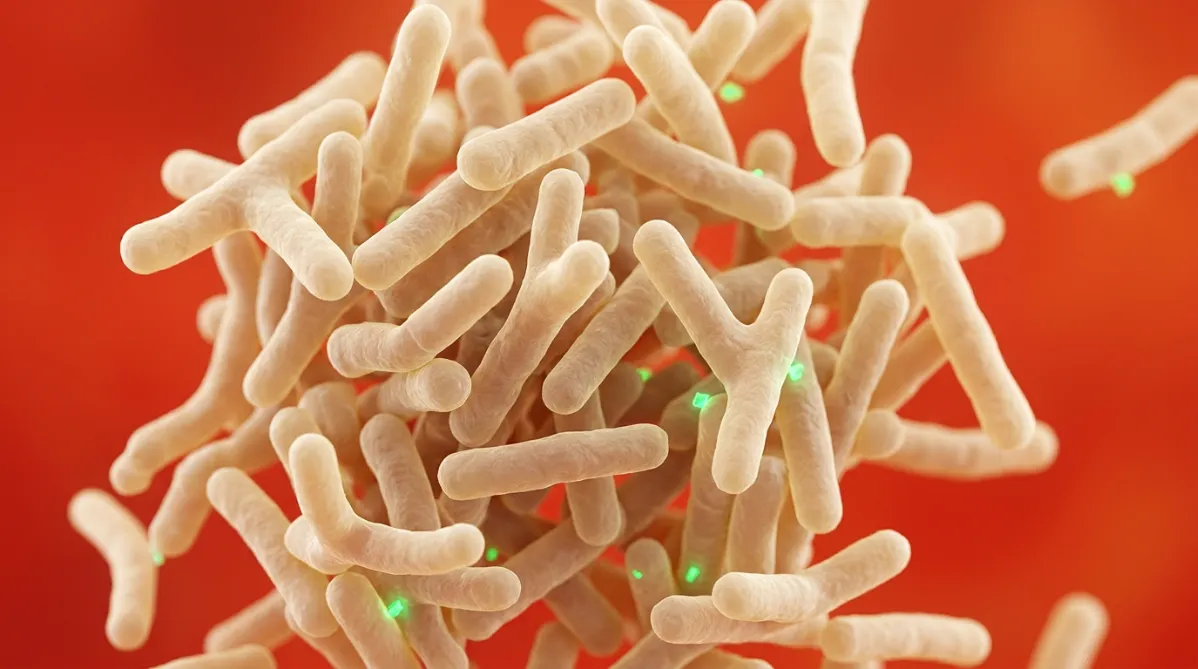
Extreme close-up microscopy-style photograph of a dense colony of rod-shaped, slightly branched Bifidobacterium cells, rendered as real textured organic forms with soft translucent walls and subtle surface detail. The cells are warm cream and ivory, clustered in the center and thinning toward the edges. The whole backdrop is a saturated tomato-red to orange field, smooth and out of focus, so the bacteria stand out in sharp contrast. A few scattered tiny crystalline metabolite specks glow faintly electric green (#00e676) near the colony. Camera angle is straight-on, slightly oblique, with a very shallow depth of field. Lighting is soft, diffuse backlight with gentle rim highlights on the cell edges and no harsh shadows. The mood is vivid, curious and hopeful, scientific but warm, with no blue cast anywhere. No text.
longevity

This Gut Microbe Makes 5-AVAB, a Molecule That Tamed Inflammaging

BY NOVA CHEN ·

A gut microbe that quietly vanishes as we age may be doing more than anyone realized. A new Nature Aging study identifies Bifidobacterium pseudocatenulatum as consistently depleted across older adults in multiple Chinese cohorts. In naturally aged mice, giving it orally eased multiorgan inflammaging and extended healthspan. The team traced part of the effect to a metabolite called 5-AVAB, which also declines with age in humans. Here is what the study showed, what remains unproven in people, and how to read the hype responsibly.

This page is available in