Biocracked
←

#bifidobacterium

1 article
Approach 1, macro science, in palette D, bold color field.

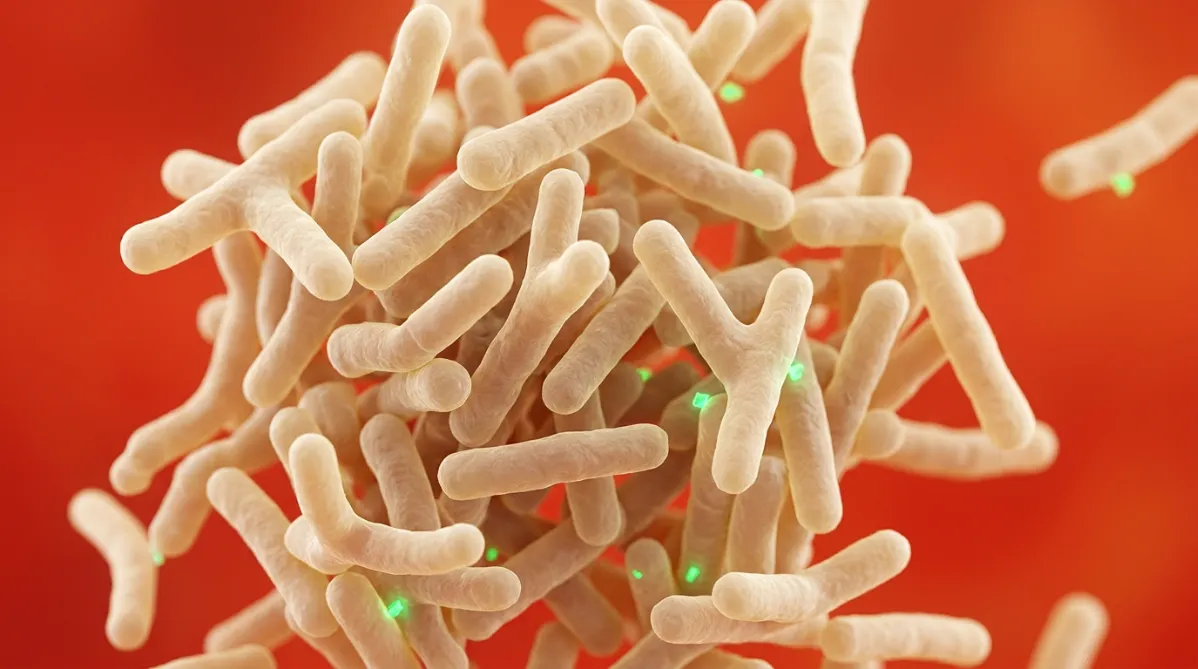
Extreme close-up microscopy-style photograph of a dense colony of rod-shaped, slightly branched Bifidobacterium cells, rendered as real textured organic forms with soft translucent walls and subtle surface detail. The cells are warm cream and ivory, clustered in the center and thinning toward the edges. The whole backdrop is a saturated tomato-red to orange field, smooth and out of focus, so the bacteria stand out in sharp contrast. A few scattered tiny crystalline metabolite specks glow faintly electric green (#00e676) near the colony. Camera angle is straight-on, slightly oblique, with a very shallow depth of field. Lighting is soft, diffuse backlight with gentle rim highlights on the cell edges and no harsh shadows. The mood is vivid, curious and hopeful, scientific but warm, with no blue cast anywhere. No text.
longevity

Deze darmbacterie maakt 5‑AVAB, een molecuul dat inflammaging temt

BY NOVA CHEN ·

Een darmbacterie die stilletjes verdwijnt naarmate we ouder worden, kan meer doen dan men zich realiseert. Een nieuwe studie in *Nature Aging* toont aan dat *Bifidobacterium pseudocatenulatum* consequent minder voorkomt bij oudere volwassenen in verschillende Chinese cohorten. Bij natuurlijk verouderde muizen verminderde orale toediening van deze bacterie inflammaging en verlengde de healthspan. Het team koppelde een deel van dit effect aan een metaboliet genaamd 5‑AVAB, die ook met de leeftijd afneemt bij mensen. Hieronder lees je wat de studie heeft aangetoond, wat nog niet in mensen is bewezen, en hoe je de hype verantwoord kunt interpreteren.

This page is available in