
Biocracked
←

#semaglutide

4 articles
Approach: 3, the human outcome, here as an animal-science moment. Palette: C, natural.

An old female lab mouse with slightly greying, ruffled fur sits upright on a researcher's open gloved palm, photographed at eye level in a close side-on view with a shallow depth of field. Behind it, a softly blurred animal facility window pours in real morning daylight, giving the scene a pale green-grey and warm-wood setting. The nitrile glove is a vivid electric green (#00e676), the single saturated accent. The mouse's whiskers and pink ears catch the light, and the researcher's white coat sleeve is just visible. Tones are natural: skin, soft cream bedding, sage walls. The mood is calm, careful and quietly hopeful, and it conveys age and care rather than drama. The image has no text, no labels and no readable writing.
longevity

El ingrediente activo de Ozempic prolongó la vida de ratonas ancianas. Así es

BY DR. SYNAPSE ·

La semaglutida, principio activo de Ozempic y Wegovy, alargó la esperanza de vida de ratonas mayores en un estudio publicado en *Nature* por la UC Berkeley. El tratamiento se inició a los 20 meses de edad y reprodujo gran parte de los beneficios de la restricción calórica. En comparación directa, el fármaco mostró ventajas sobre la restricción calórica en curiosidad, memoria espacial y control glucémico. Es investigación en ratones; no existen indicaciones de dosis para humanos. A continuación, qué sugiere el hallazgo y qué no.
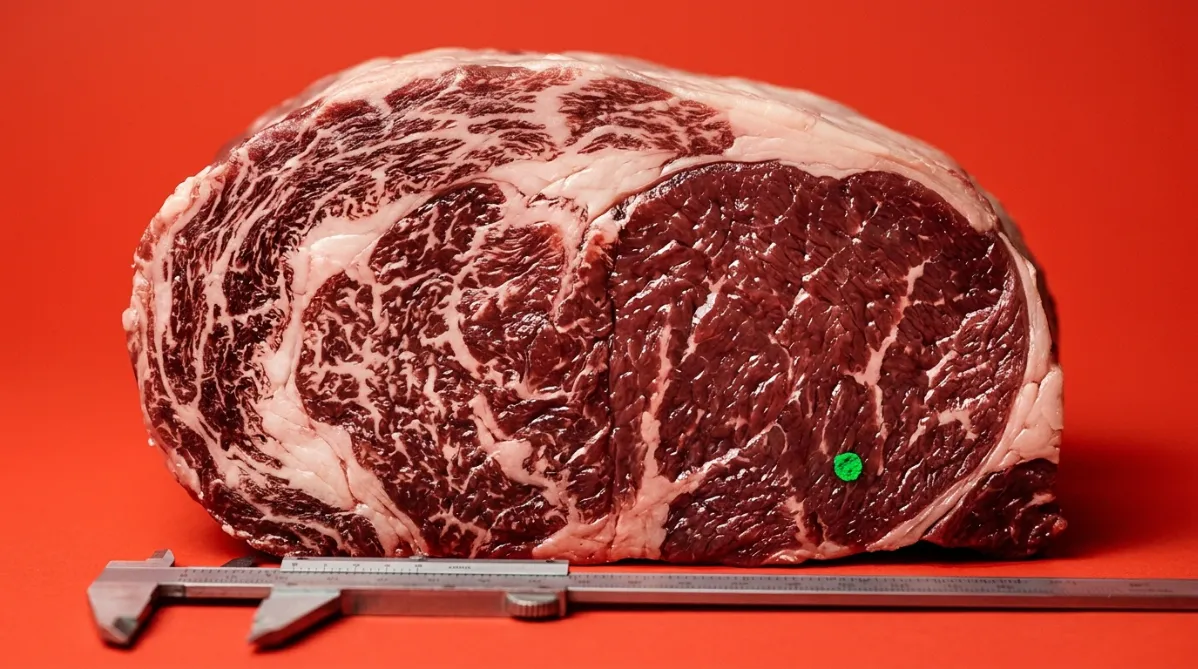
Approach: Macro science, the human outcome angle through tissue. Palette: D, bold color field.

Extreme close-up of a cross-section of raw beef thigh muscle, used as a stand-in for human thigh tissue. It is shot straight on and slightly from above, on a saturated tomato-red seamless backdrop. Fine white fat marbling threads run through the dark red muscle fibers. On one half the marbling is dense and lacy, and on the other it is sparse and clean, so the contrast reads as a before and after. A thin, translucent calipers-style steel ruler lies along the edge, with no markings readable. Lighting is soft, directional studio light from the upper left, with crisp highlights on the glistening fibers and gentle warm shadows. A single small electric green surgical marker dot sits on the tissue. The mood is analytical, tense and uncertain, with shallow depth of field and sharp detail on the fat texture.
longevity

Semaglutida de alta dosis y músculo del muslo: lo que muestra la resonancia magnética

BY HELIX WARD ·

Un nuevo sub‑análisis por resonancia magnética del ensayo STEP UP evaluó los efectos de 72 semanas de semaglutida a 7,2 mg sobre la composición corporal, incluido el músculo del muslo. La pérdida de grasa fue notable, alrededor de 11 litros frente a placebo, y la infiltración grasa en el músculo del muslo disminuyó significativamente. El volumen del músculo del muslo cayó aproximadamente 1,1 L, un cambio que no alcanzó significación estadística (p = 0.07) pero cuyo intervalo de confianza se inclina hacia una pérdida. Con solo 55 participantes escaneados, seis en el grupo placebo, y la participación de Novo Nordisk, los hallazgos son más sugestivos que concluyentes. A continuación, lo que los datos demuestran, lo que no pueden probar y cómo proteger tu músculo al usar un agonista GLP‑1.

**Approach:** Lab in action. **Palette:** Bold color field, mustard yellow.

A close, slightly high three-quarter view of a hand in a magenta-purple nitrile glove holding a clear 12-well cell culture plate. Each well is filled with salmon-pink culture medium. A multichannel pipette hovers over one well, with a single droplet caught just before it falls. The background is a seamless, saturated mustard-yellow surface and wall, with a soft shadow under the plate. Bright, even studio light comes from the upper left, giving crisp highlights on the plastic rims and a soft glow through the liquid. The depth of field is shallow, so the far wells blur gently. A tiny electric-green cap on a tube sits in the corner of the frame. The mood is calm, precise and curious, with a clean, graphic, editorial feel. No text or labels.
peptides

Semaglutida no provocó atrofia de células musculares humanas. Entonces, ¿por qué se pierde músculo?

BY DR. SYNAPSE ·

¿Realmente la semaglutida consume tu músculo? Un nuevo estudio en GeroScience aplicó el fármaco directamente a células musculares humanas primarias de adultos mayores con obesidad, y las células no se atrofiaron. No se activaron genes de atrofia ni se detectaron alarmas en el secretoma, y el GIP incluso aumentó el grosor de los miotubos tras ocho días. La semaglutida redujo modestamente la producción de ATP glicolítica, y los receptores GLP‑1 apenas se detectaron. Los hallazgos apuntan a causas indirectas de la pérdida de masa magra, como el déficit calórico y la disminución de la carga mecánica, aunque una placa de cultivo no es un cuerpo.

**Approach: Conceptual metaphor. Palette: D, bold color field.**

A single clear glass of water sits on a saturated mustard-yellow backdrop, shot at a slight low three-quarter angle. A hand-held pen injector rests beside it, its body a matte white with a small electric green dial ring as the only green accent. Hard but clean studio light from the upper left throws a crisp, defined shadow across the yellow surface. Through the glass, the injector is refracted into two slightly offset images, suggesting a signal that is split and hard to read. The mood is calm, questioning and balanced, with no drama. The background is fully warm and bright, with no blue cast. The surface has a subtle paper-like texture. There is no text, no label and no face.
metabolism

¿Ozempic y Mounjaro causan depresión? Lo que 20 estudios encontraron

BY DR. SYNAPSE ·

¿Ozempic y Mounjaro provocan depresión o ideas suicidas? Una revisión sistemática de 20 estudios, junto con evaluaciones de la EMA y la FDA, muestra que la mejor evidencia no respalda esa asociación. Los ensayos aleatorizados, incluidos dos meta‑análisis de 2025, no hallaron aumento de suicidio, depresión ni ansiedad con semaglutida o tirzepatida. Las señales más alarmantes provienen de diseños que no pueden separar los efectos del fármaco del malestar ligado a la obesidad, del riesgo psiquiátrico basal y del sesgo de notificación. Como los ensayos excluyeron a muchos pacientes psiquiátricos, sigue siendo importante vigilar a grupos de alto riesgo y a resultados raros a largo plazo.

This page is available in