
Biocracked
←

#semaglutide

4 articles
Approach: 3, the human outcome, here as an animal-science moment. Palette: C, natural.

An old female lab mouse with slightly greying, ruffled fur sits upright on a researcher's open gloved palm, photographed at eye level in a close side-on view with a shallow depth of field. Behind it, a softly blurred animal facility window pours in real morning daylight, giving the scene a pale green-grey and warm-wood setting. The nitrile glove is a vivid electric green (#00e676), the single saturated accent. The mouse's whiskers and pink ears catch the light, and the researcher's white coat sleeve is just visible. Tones are natural: skin, soft cream bedding, sage walls. The mood is calm, careful and quietly hopeful, and it conveys age and care rather than drama. The image has no text, no labels and no readable writing.
longevity

Der Wirkstoff von Ozempic verlängert das Leben alter Mäuse – das steckt dahinter

BY DR. SYNAPSE ·

Semaglutid, der Wirkstoff in Ozempic und Wegovy, hat bei alten Mäusen die Biologie des Alterns verlangsamt und die Lebensdauer verlängert – allerdings nur teilweise durch verminderte Nahrungsaufnahme. Die Ergebnisse stammen aus einer neuen Nature‑Studie (2026), an 20‑Monat‑alten Weibchen der Rasse C57BL/6. Im Vergleich zur reinen Kalorienrestriktion zeigte Semaglutid zusätzliche Vorteile bei Erkundungsdrang, räumlichem Gedächtnis und Glukosekontrolle. Dennoch handelt es sich um Tierforschung, die nicht automatisch auf Menschen übertragbar ist.
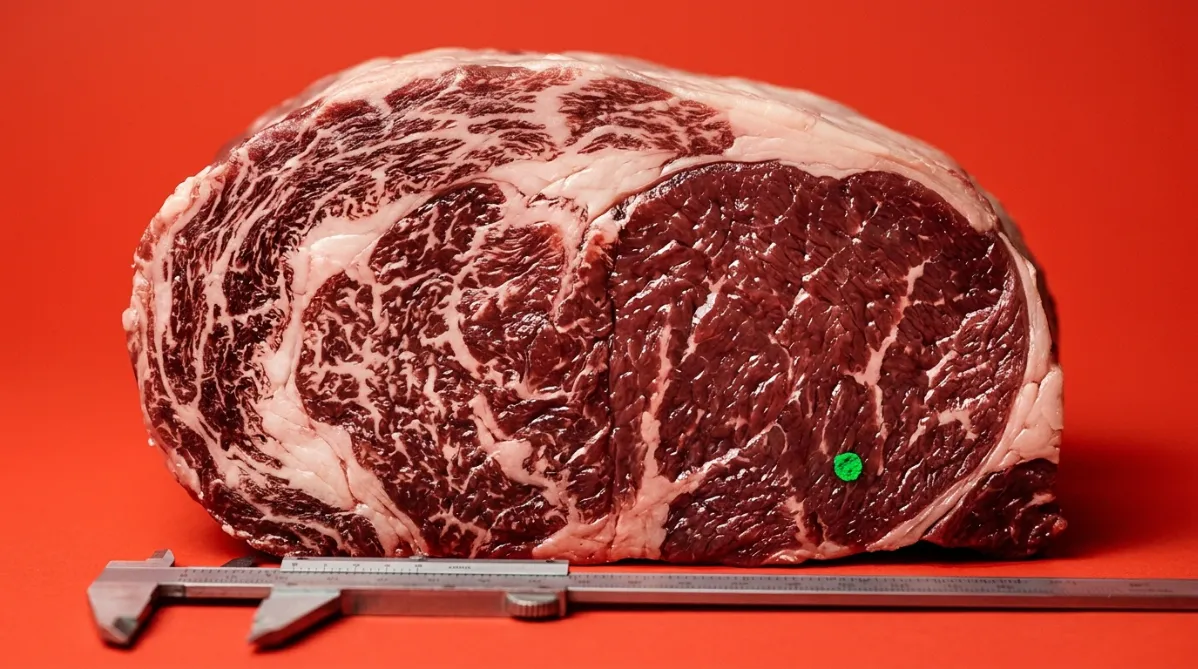
Approach: Macro science, the human outcome angle through tissue. Palette: D, bold color field.

Extreme close-up of a cross-section of raw beef thigh muscle, used as a stand-in for human thigh tissue. It is shot straight on and slightly from above, on a saturated tomato-red seamless backdrop. Fine white fat marbling threads run through the dark red muscle fibers. On one half the marbling is dense and lacy, and on the other it is sparse and clean, so the contrast reads as a before and after. A thin, translucent calipers-style steel ruler lies along the edge, with no markings readable. Lighting is soft, directional studio light from the upper left, with crisp highlights on the glistening fibers and gentle warm shadows. A single small electric green surgical marker dot sits on the tissue. The mood is analytical, tense and uncertain, with shallow depth of field and sharp detail on the fat texture.
longevity

High‑Dose‑Semaglutid und Oberschenkelmuskel: Was das MRT zeigt

BY HELIX WARD ·

Eine neue MRT‑Subanalyse der STEP UP‑Studie untersuchte, was 72 Wochen hochdosiertes Semaglutid (7,2 mg) mit der Körperzusammensetzung machen, insbesondere mit den Oberschenkelmuskeln. Der Fettverlust war groß, etwa 11 Liter gegenüber Placebo, und die Fetteinlagerung im Oberschenkelmuskel nahm deutlich ab. Das Volumen des Oberschenkelmuskels sank um etwa 1,1 L – ein Unterschied, der statistisch nicht signifikant war (p = 0,07), aber dessen Konfidenzintervall eher auf einen Verlust hindeutet. Da nur 55 Teilnehmende gescannt wurden, davon lediglich sechs im Placebo‑Arm, und Novo Nordisk beteiligt war, sind die Ergebnisse eher suggestiv als beweiskräftig. Im Folgenden sehen Sie, was die Daten zeigen, was sie nicht zeigen können und wie Sie Ihre Muskulatur bei einer GLP‑1‑Therapie schützen können.

**Approach:** Lab in action. **Palette:** Bold color field, mustard yellow.

A close, slightly high three-quarter view of a hand in a magenta-purple nitrile glove holding a clear 12-well cell culture plate. Each well is filled with salmon-pink culture medium. A multichannel pipette hovers over one well, with a single droplet caught just before it falls. The background is a seamless, saturated mustard-yellow surface and wall, with a soft shadow under the plate. Bright, even studio light comes from the upper left, giving crisp highlights on the plastic rims and a soft glow through the liquid. The depth of field is shallow, so the far wells blur gently. A tiny electric-green cap on a tube sits in the corner of the frame. The mood is calm, precise and curious, with a clean, graphic, editorial feel. No text or labels.
peptides

Semaglutid hat menschliche Muskelzellen nicht verkleinert – warum also der Muskelverlust?

BY DR. SYNAPSE ·

Zerstört Semaglutid wirklich Ihre Muskeln? Eine neue Studie in *GeroScience* setzte das Medikament direkt auf primäre menschliche Muskelzellen von älteren, adipösen Probanden – und die Zellen zeigten keinerlei Atrophie. Weder atrophie‑induzierende Gene wurden aktiviert, noch ein besorgniserregender Secretom‑Stoffwechsel beobachtet; sogar GIP ließ die Myotuben nach acht Tagen dicker werden. Semaglutid reduzierte leicht die glycolytische ATP‑Produktion, während GLP‑1‑Rezeptoren kaum nachweisbar waren. Die Ergebnisse deuten eher auf indirekte Ursachen des Muskelverlusts hin – Kaloriendefizit und verminderte Belastung – als auf einen direkten zellulären Effekt.

**Approach: Conceptual metaphor. Palette: D, bold color field.**

A single clear glass of water sits on a saturated mustard-yellow backdrop, shot at a slight low three-quarter angle. A hand-held pen injector rests beside it, its body a matte white with a small electric green dial ring as the only green accent. Hard but clean studio light from the upper left throws a crisp, defined shadow across the yellow surface. Through the glass, the injector is refracted into two slightly offset images, suggesting a signal that is split and hard to read. The mood is calm, questioning and balanced, with no drama. The background is fully warm and bright, with no blue cast. The surface has a subtle paper-like texture. There is no text, no label and no face.
metabolism

Verursachen Ozempic und Mounjaro Depression? Was 20 Studien zeigen

BY DR. SYNAPSE ·

Verursachen Ozempic und Mounjaro Depressionen oder Suizidgedanken? Ein neuer systematischer Review von 20 Studien sowie Bewertungen der EMA und FDA zeigt, dass die vorliegenden Daten keinen Zusammenhang belegen. Randomisierte Studien, darunter zwei große Metaanalysen aus dem Jahr 2025, fanden keine erhöhte Suizidalität, Depression oder Angst bei Semaglutid oder Tirzepatide. Die beunruhigenderen Signale kamen aus Studien, die die Wirkung des Medikaments nicht von adipositätsbedingtem Stress, einem bestehenden psychiatrischen Risiko und Meldeverzerrungen trennen konnten. Da klinische Studien jedoch häufig Patient*innen mit psychiatrischen Vorerkrankungen ausschlossen, bleibt eine Beobachtung von Hochrisikogruppen und seltenen Langzeitfolgen wichtig.

This page is available in