Biocracked
←

#tendon healing

1 article
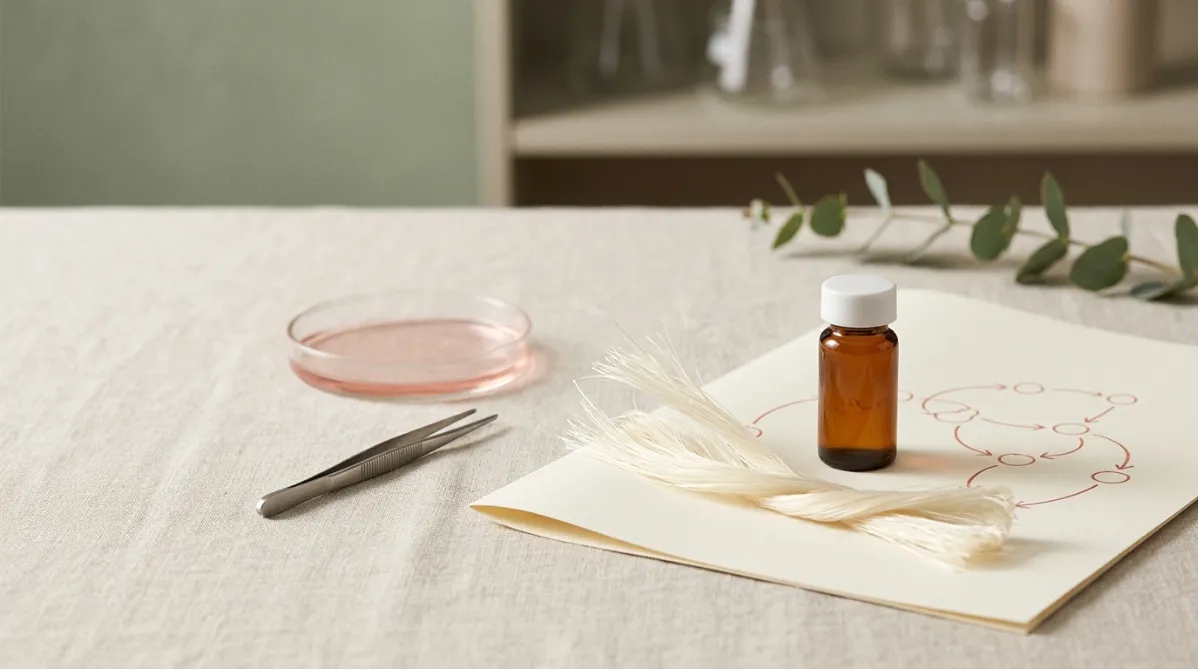
A wide, editorial-style still life photographed in soft natural window light on a pale oatmeal-colored linen surface. In the center foreground, a single small amber glass vial with a matte white cap sits slightly off-center to the right, unlabeled and minimal. Beside it lies a delicate, translucent skein of tendon-like fibers, rendered as fine pale ivory threads gently fanning out and twisting together, resting on a folded sheet of cream paper. To the left, a glass petri dish with a thin layer of soft blush-pink liquid, catching a subtle highlight, and a slim pair of stainless steel tweezers laid diagonally across the surface.

Behind the objects, a softly blurred background in muted sage green and warm taupe suggests a quiet laboratory shelf, with out-of-focus glassware shapes and a single trailing sprig of eucalyptus adding an organic note. A thin, hand-drawn style line diagram of interconnected nodes and curved arrows, in faint terracotta ink, is printed on the paper beneath the fibers. It hints at a cellular signaling pathway without any text or readable labels.

The composition uses generous negative space on the left third for potential title overlay, with a shallow depth of field and a gentle diagonal flow from the petri dish to the vial. The color palette is restrained and warm: cream, sage, blush, amber, and terracotta accents, with soft shadows and a faint film-grain texture. The mood is calm, thoughtful, and scientific but approachable, like a contemporary health and science magazine cover. Shot as if with a 50mm lens at f/2.8, top-down at a slight 30-degree angle, with crisp focus on the vial and fibers. No people, no text, no futuristic elements.
peptides

BPC‑157 và Sửa Chữa Gân: Những gì Nghiên cứu về đường truyền FAK‑Paxillin cho thấy và những gì không

BY DR. SYNAPSE ·

BPC‑157, một peptide gồm 15 axit amin, được ưa chuộng trong các cộng đồng “chữa lành” trực tuyến nhờ một nghiên cứu 2011 rộng rãi trích dẫn về khả năng phục hồi gân. Nghiên cứu cho thấy peptide này tăng tốc độ phát triển của fibroblast gân, cải thiện khả năng sống sót dưới stress oxy hoá và tăng cường di chuyển, có vẻ thông qua việc kích hoạt đường truyền FAK‑Paxillin. Tuy nhiên nó không kích thích sinh sản tế bào và mọi kết quả đều dựa trên mô và tế bào chuột trong phòng thí nghiệm. Bài viết sẽ giải thích cơ chế, chỉ ra tại sao chúng chưa đủ làm chứng cứ cho con người và xem xét tình trạng pháp lý của peptide này.

This page is available in