Biocracked
←

#fibroblasts

1 article
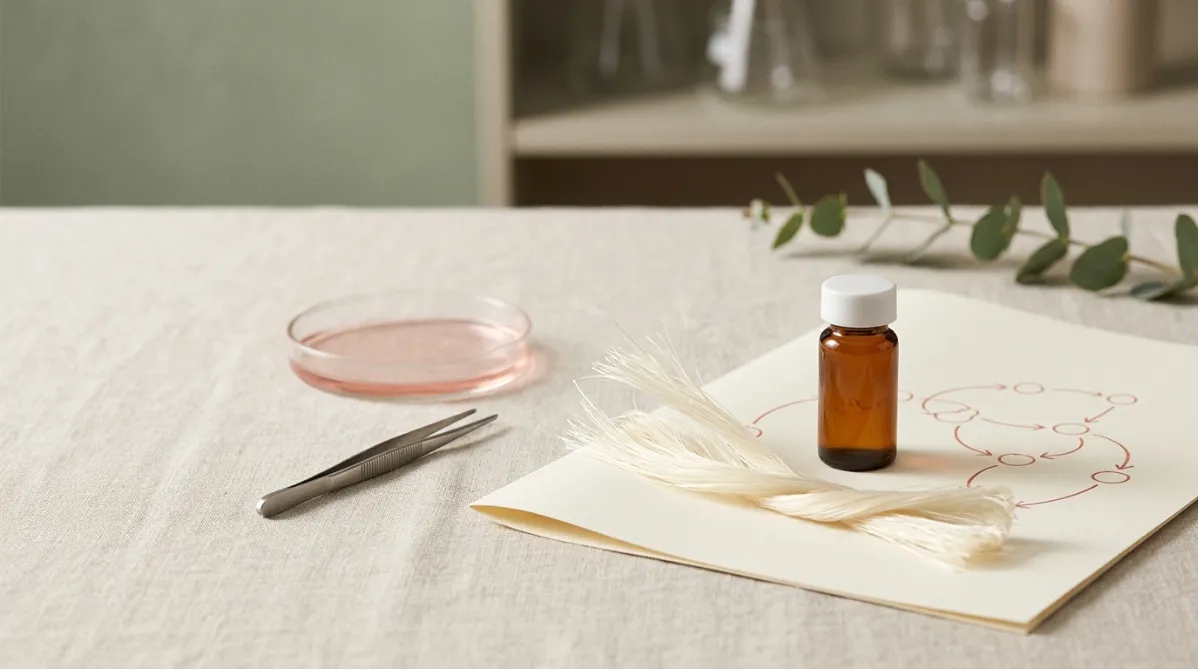
A wide, editorial-style still life photographed in soft natural window light on a pale oatmeal-colored linen surface. In the center foreground, a single small amber glass vial with a matte white cap sits slightly off-center to the right, unlabeled and minimal. Beside it lies a delicate, translucent skein of tendon-like fibers, rendered as fine pale ivory threads gently fanning out and twisting together, resting on a folded sheet of cream paper. To the left, a glass petri dish with a thin layer of soft blush-pink liquid, catching a subtle highlight, and a slim pair of stainless steel tweezers laid diagonally across the surface.

Behind the objects, a softly blurred background in muted sage green and warm taupe suggests a quiet laboratory shelf, with out-of-focus glassware shapes and a single trailing sprig of eucalyptus adding an organic note. A thin, hand-drawn style line diagram of interconnected nodes and curved arrows, in faint terracotta ink, is printed on the paper beneath the fibers. It hints at a cellular signaling pathway without any text or readable labels.

The composition uses generous negative space on the left third for potential title overlay, with a shallow depth of field and a gentle diagonal flow from the petri dish to the vial. The color palette is restrained and warm: cream, sage, blush, amber, and terracotta accents, with soft shadows and a faint film-grain texture. The mood is calm, thoughtful, and scientific but approachable, like a contemporary health and science magazine cover. Shot as if with a 50mm lens at f/2.8, top-down at a slight 30-degree angle, with crisp focus on the vial and fibers. No people, no text, no futuristic elements.
peptides

BPC‑157 і відновлення сухожиль: що показують дослідження FAK‑paxillin, а що ні

BY DR. SYNAPSE ·

BPC‑157 — 15‑амінокислотний пептид, який активно обговорюють у інтернет‑спільнотах про «зцілення». У його підґрунті лежить широко цитоване дослідження 2011 р., у якому вчені виявили пришвидшення вивільнення фібробластів з сухожильних тканин, підвищення їх виживаності під окислювальним стресом та стимуляцію міграції, ймовірно, через активацію шляху FAK‑paxillin. Пептид не підвищував пряму проліферацію клітин, а всі результати отримані лише на тканинах і клітинах щурів у лабораторії. У статті розбирається механізм дії, пояснюється, чому це не є доказом для людей, і розглядається нерегульований статус пептиду.

This page is available in