Дослідження лише на гризунах. Все нижче – результати експериментів на щурах і мишах. Жоден із них не доводить, що золотий вушний гриб знижує жир у печінці, холестерин чи ризик захворювань у людей.
Ergothioneine has become one of the most talked‑about compounds in the longevity world, and mushrooms are its best‑known dietary source. So a new rodent study has a plot twist for supplement shoppers. The mushroom lowered liver fat in the animals. The purified ergothioneine, given on its own, did not.
Переклад: Ерготіонін став одним із найактивніше обговорюваних сполук у світі довголіття, а гриби – його найвідоміше джерело у раціоні. Тож нове дослідження на гризунах внесло несподіваний поворот для покупців добавок: гриб знизив жир у печінці у тварин, а ізольований ерготіонін у такій же дозі цього не зробив.
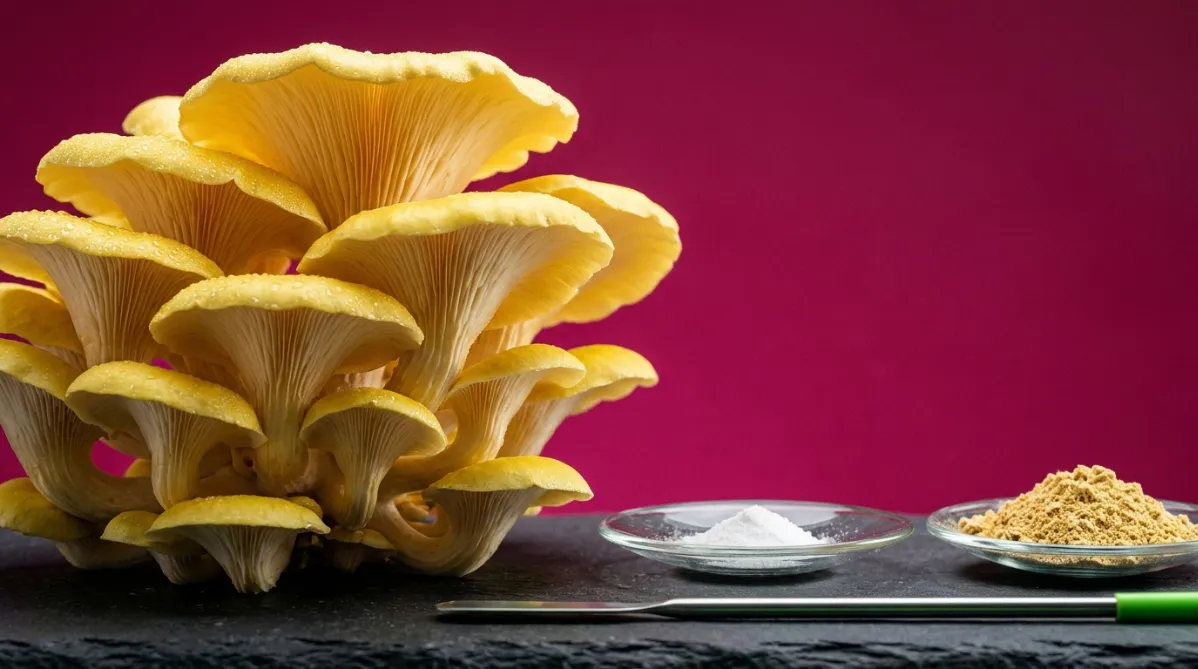
The paper, published in Food, Nutrition and Health (DOI: 10.1007/s44403-026-00089-6), tested Tamogitake, also sold as golden oyster mushroom (Pleurotus cornucopiae var. citrinopileatus). It compared the whole mushroom with isolated ergothioneine, and the results suggest the mushroom does something the single compound can't account for.
Переклад: Роботу, опубліковану у журналі Food, Nutrition and Health (DOI: 10.1007/s44403-026-00089-6), протестовано Tamogitake, також відомий як золотий вушний гриб (Pleurotus cornucopiae var. citrinopileatus). Порівнювали цілий гриб із ізольованим ерготіоніном, і результати свідчать, що гриб виконує дію, яку не можна пояснити лише однією сполукою.
The Setup: A Mushroom Famous for One Molecule
Tamogitake is an edible mushroom rich in ergothioneine, a sulfur‑containing amino acid. Ergothioneine has been linked in earlier research to anti‑inflammatory effects and improved cognitive function, largely through its antioxidant activity. The authors point out that the benefits of eating Tamogitake itself were still unclear. They wanted to know what the mushroom does to lipid metabolism, meaning how the body handles cholesterol and triglycerides (triacylglycerol).
Переклад: Налаштування експерименту: гриб, відомий однією молекулою
Tamogitake – це їстівний гриб, багатий ерготіоніном, амінокислотою, що містить сірку. У попередніх дослідженнях ерготіонін пов’язували з протизапальними ефектами та покращенням когнітивних функцій, головним чином завдяки його антиоксидантній активності. Автори зазначають, що користь споживання саме Tamogitake залишалась незрозумілою. Вони хотіли з’ясувати, як гриб впливає на ліпідний обмін, тобто на те, як організм переробляє холестерин і тригліцериди (тригліцериди).
Experiment 1: Rats and a 5% Mushroom Diet
The team fed four‑week‑old male Sprague‑Dawley rats an AIN‑76‑based diet containing 5% dried Tamogitake powder. Some diets also contained 0.5% added cholesterol, and the feeding lasted four weeks.
The rats eating Tamogitake showed:
- Significantly lower liver weight
- Significantly lower hepatic cholesterol
- Significantly lower hepatic triacylglycerol
These effects appeared with or without the added dietary cholesterol. The researchers also checked hepatic mRNA expression of HMG‑CoA reductase, the rate‑limiting enzyme in cholesterol synthesis (and the statin target), and CYP7A1, a key enzyme in converting cholesterol to bile acids. Neither changed. The mushroom's effect therefore doesn't seem to come from the most obvious gene‑level switches in liver cholesterol metabolism, and the mechanism remains open.
Переклад: ## Експеримент 1: Щури та дієта з 5 % грибом
Команда годувала чотиритижневих самців щурів породи Спраг‑Доулі сухим порошком Tamogitake, що складав 5 % дієти на основі AIN‑76. У деяких раціонах додавали 0,5 % холестерину, а годування тривало чотири тижні.
У щурів, які споживали Tamogitake, спостерігалися:
- Помітно зменшена вага печінки
- Помітно знижений рівень печінкового холестерину
- Помітно знижений рівень печінкових тригліцеридів
Ці ефекти виявлялися як у разі додавання дієтичного холестерину, так і без нього. Дослідники також виміряли експресію печінкових мРНК HMG‑CoA редуктази (ключовий фермент синтезу холестерину, мішень статинів) та CYP7A1 (фермент, що перетворює холестерин у жовчні кислоти). Жодних змін не зафіксовано. Тому вплив гриба, схоже, не пов’язаний із найочевиднішими генетичними регуляторами печінкового обміну холестерину, і механізм залишився нез'ясованим.
Experiment 2: The Plot Twist in Obese Mice
The second experiment was harder on the mushroom. The researchers used three‑week‑old male KK‑Ay mice, a model of obesity and hyperglycemia whose livers accumulate excess lipids. For 52 days, the mice ate diets with 0.5% cholesterol plus one of two additions:
- 5% Tamogitake powder, or
- 0.05% pure ergothioneine.
The mushroom's liver‑lowering effect on cholesterol and triacylglycerol reproduced in these mice, even though their livers were prone to fat buildup. The ergothioneine diet did not produce that effect.
The abstract doesn't say how the ergothioneine dose compared with the amount in the mushroom powder, so it would be wrong to read this as proof that ergothioneine does nothing in the liver. The authors' own conclusion is more measured: the benefits of Tamogitake "cannot be attributed to ergothioneine alone."
Переклад: ## Експеримент 2: Неочікуваний результат у ожирілих мишей
У другому експерименті тиск на гриб був вищим. Дослідники використали тритижневих самців мишей KK‑Ay – модель ожиріння та гіперглікемії, у яких печінка схильна до надмірного накопичення жиру. Протягом 52 днів миші отримували дієту з 0,5 % холестерину та одним із двох додатків:
- 5 % порошку Tamogitake, або
- 0,05 % чистого ерготіоніну.
Ефект зниження печінкових рівнів холестерину та тригліцеридів, спостережений у щурів, повторився й у цих мишей, хоча їх печінки схильні до жирових відкладень. Дієта з ерготіоніном цього ефекту не дала.
Анотація не вказує, якою була доза ерготіоніну у порівнянні з його вмістом у порошку гриба, тому неправильно трактувати результати як доказ того, що ерготіонін не діє в печінці. Висновок авторів більш збалансований: користь Tamogitake «не можна пояснити лише ерготіоніном».
A Clue From the Fecal Data
The researchers also measured what the animals excreted. Fecal excretion of apparent total cholesterol and free fatty acids tended to be higher with Tamogitake feeding, but not with ergothioneine feeding. Bile acid excretion was not increased.
The word "tended" matters here, because it signals a trend rather than a firm effect. Still, it hints that something in the whole mushroom may reduce how much fat and cholesterol the body keeps, perhaps by affecting absorption or handling in the gut. This is speculation, since the paper doesn't establish the mechanism. Mushrooms contain fibers and many other compounds besides ergothioneine, and the study doesn't pin down which one is responsible.
Blood glucose and serum insulin did not differ significantly among groups. The mushroom's effect was on liver lipids, not on glycemic measures, at least in this experiment.
Переклад: ## Підказка з фекальних даних
Дослідники також вимірювали, що виводять тварини. Виділення в калі загального холестерину та вільних жирних кислот, здається, було вищим у групі, що отримувала Tamogitake, але не у групі з ерготіоніном. Виділення жовчних кислот не збільшувалося.
Слово «здається» має значення, бо вказує на тенденцію, а не на впевнений ефект. Проте це натякає, що щось у цілому грибі може зменшувати кількість жиру та холестерину, що утримується в організмі, можливо, впливаючи на їх всмоктування чи обробку в кишечнику. Це лише припущення, оскільки стаття не встановлює механізм. Гриби містять клітковину та багато інших сполук, окрім ерготіоніну, і дослідження не визначило, яка саме з них відповідає за ефект.
Рівень глюкози в крові та сироватковий інсулін не відрізнялися суттєво між групами. Вплив гриба спостерігався лише на ліпіди печінки, а не на глікемічні параметри, принаймні у цьому експерименті.
Why This Matters for the Supplement Conversation
The broader lesson is familiar in nutrition science. A food is not just its most famous molecule. When a headline compound gets isolated and sold in capsules, there's an implicit assumption that the capsule delivers the food's benefits. This study is a small, animal‑based counterexample. In these rodents, the whole mushroom did something the purified compound did not.
The finding doesn't make ergothioneine supplements useless, and it doesn't test the cognitive or anti‑inflammatory effects reported elsewhere. It says that, for liver fat in these models, ergothioneine wasn't the active ingredient, or at least not the only one.
Переклад: ## Чому це важливо в дискусії про добавки
Загальний висновок добре відомий у харчовій науці: їжа – це не лише її найвідоміша молекула. Коли «зіркова» сполука ізолюється й продається у капсулах, передбачається, що капсула передасть користь цілого продукту. Це дослідження – невеликий приклад, що спростовує таке припущення: у гризунів цілий гриб робив те, чого не змогла ізольована сполука.
Отриманий результат не робить добавки з ерготіоніном безкорисними і не стосується когнітивних чи протизапальних ефектів, описаних в інших роботах. Він лише говорить, що у випадку жирових відкладень у печінці цих моделей ерготіонін не був головним активним інгредієнтом, або, принаймні, не був єдиним.
Practical Takeaways
Whole food vs. isolated ergothioneine
If the goal is to get what the mushroom offers, this study favors the mushroom over the isolate. Whole foods contain many compounds that may work together, and this experiment supports that idea, but only in animals.
How to eat golden oyster mushrooms
The paper used dried powder, not cooked dishes, so it offers no guidance on preparation. As general culinary practice, golden oyster mushrooms are typically cooked, for example sautéed, roasted, or added to soups and stir‑fries, and cooking mushrooms thoroughly is standard food‑safety advice. Don't expect a stir‑fry to replicate the experiment.
Why 5% of the diet is a lot
In the rodent diets, the mushroom powder made up 5% of the feed. That is a constant, substantial share of everything the animals ate, every day, for four weeks in rats and 52 days in mice. It is not a garnish or a weekly side dish. Rodent diets are also formulated differently from human diets, so there is no simple conversion to a human portion, and this article doesn't offer one. The study doesn't establish a human dose.
Who might care
People worried about fatty liver or high cholesterol will find this topic interesting, but it is not a treatment. Fatty liver disease and lipid disorders need proper evaluation. If you have risk factors, such as obesity, high blood sugar, or abnormal liver tests, see a doctor rather than relying on a mushroom powder or a supplement.
The Bottom Line
This study shows that, in rats and obese mice, golden oyster mushroom powder lowered liver cholesterol and triglycerides, and pure ergothioneine at 0.05% did not. The fecal data hint at a gut‑level mechanism, and the lack of change in HMG‑CoA reductase and CYP7A1 expression suggests the mushroom isn't acting through those obvious routes. Whether any of this applies to people, at realistic portions, is an open question that only human trials can answer.
Переклад: ## Підсумок
Дослідження показало, що у щурів і ожирілих мишей порошок золотого вушного гриба знижував рівень печінкового холестерину та тригліцеридів, тоді як чистий ерготіонін у концентрації 0,05 % цього не робив. Фекальні дані натякають на можливий кишечний механізм, а відсутність змін у експресії HMG‑CoA редуктази та CYP7A1 свідчить про те, що гриб не діє через ці типові шляхи. Чи застосовні ці результати до людей при реалістичних порціях, залишиться питанням, яке зможуть відповісти лише клінічні випробування.