Biocracked
←

#urolithin d

1 article
Approach 4, conceptual metaphor, in palette D, bold color field.

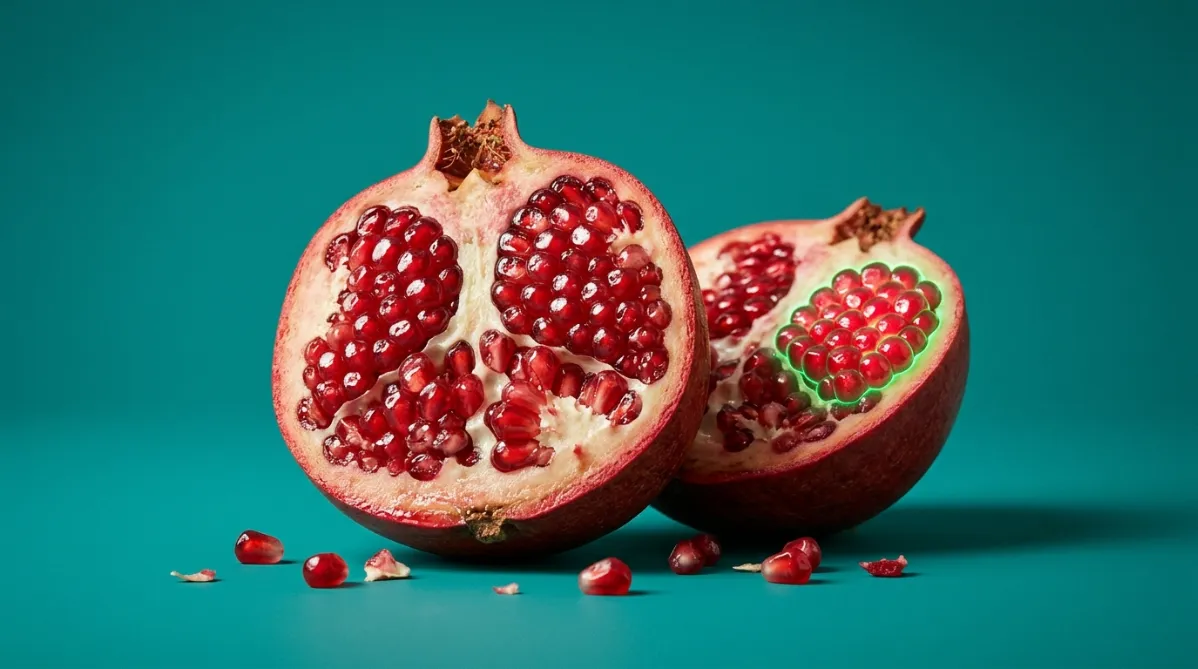
A single pomegranate, split open, sits at the center of a saturated teal backdrop. It is photographed from a slightly high three-quarter angle with a macro lens. One half is pulled slightly forward and the other stays behind it, which hints at two close siblings. The ruby arils are glossy and densely packed. In the smaller half, a few arils glow with a subtle electric green rim light, as if one has been singled out. Pomegranate is a natural source of the precursors that gut bacteria convert into urolithins. Soft, large-source studio light comes from the upper left. It casts crisp, clean shadows on a seamless teal surface and gives the red fruit sharp specular highlights. A few arils are scattered nearby. The mood is curious, vivid and quietly scientific, with a strong red-against-teal contrast and no text.
longevity

Urolithine D vs A : le frère méconnu qui protège la mémoire des souris

BY NOVA CHEN ·

Urolithine A fait toute la une, mais son frère moins connu, l’urolithine D, montre des effets protecteurs sur le cerveau de souris vieillissantes. Dans un modèle de vieillissement induit par le D‑galactose, l’urolithine D administrée par voie orale améliore les performances cognitives et limite les lésions hippocampiques, via les voies AMPK, PGC‑1α et SIRT3 ainsi que les marqueurs de mitophagie. Les expériences cellulaires indiquent que le blocage d’AMPK ou de PGC‑1α annule le bénéfice. Il s’agit toutefois d’un modèle murin chimique, sans données humaines, et aucune comparaison avec l’urolithine A n’a été faite. Voici ce que cela signifie, d’où proviennent les urolithines et quels comportements adopter (ou éviter) en attendant.

This page is available in