Biocracked
**Approach: Lab in action. Palette: D, bold color field (teal).**

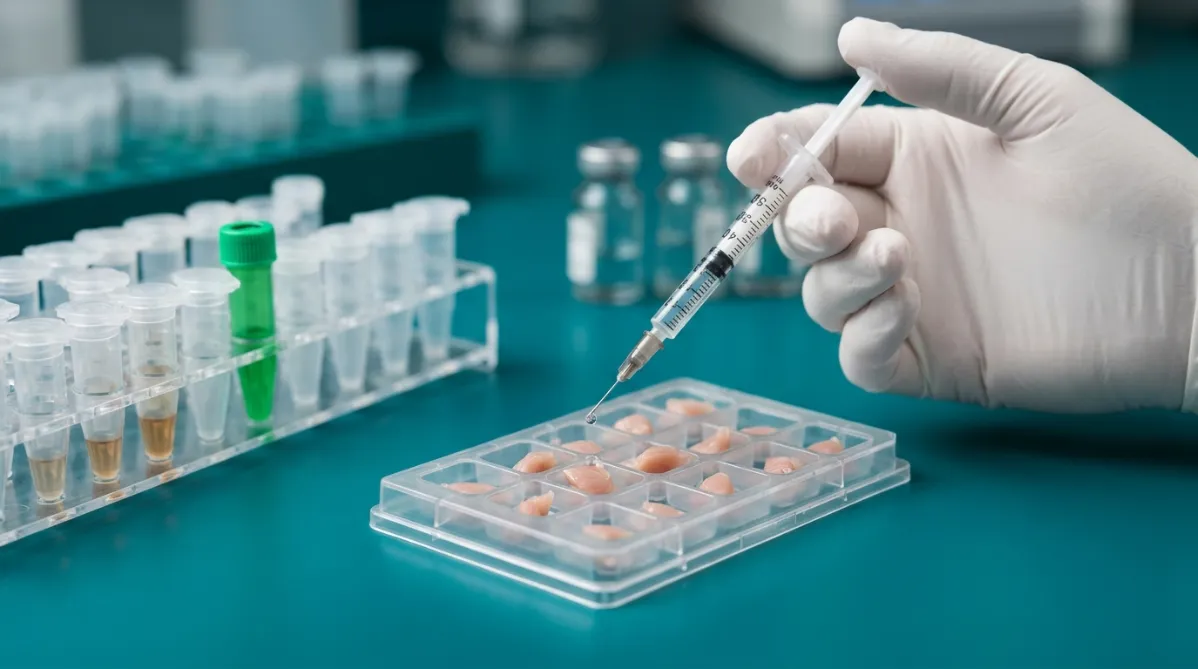
Overhead three-quarter angle on a gloved hand holding a small insulin-style syringe over a tray of mouse-muscle tissue samples. The nitrile glove is bright white, and the backdrop is a saturated teal lab bench surface with a soft sheen. Tiny clear microtubes sit in a rack, and a few contain a faint amber liquid. One thin electric green cap on a tube is the only green accent. The lighting is bright, even studio-like lab light with crisp, soft-edged shadows and a gentle highlight on the syringe barrel and a single hanging droplet at the needle tip. The depth of field is shallow, so the background tubes blur into teal. The mood is precise, focused and quietly hopeful, with no readable text or labels anywhere.
Peptides

One Shot Made Old Mouse Muscle Mitochondria Act Young in 1 Hour

Helix Ward · · 4 min read

One injection. Sixty minutes. Muscle mitochondria in very old mice were producing energy like those of young animals.

That is the headline from a 2013 Aging Cell paper on SS-31, also known as elamipretide, a mitochondria-targeted peptide. Before anyone starts shopping for vials: this was a mouse study. Everything below describes what happened in rodents, and what has (and hasn't) happened in humans since.

What the Study Did

A team led by researchers at the University of Washington, with collaborators including SS-31's co-developer Hazel Szeto, tested a simple question. Can a drug rapidly reverse the mitochondrial decline seen in aged skeletal muscle?

The design was clean:

  • Young mice: 5 months old.
  • Old mice: 27 months old, which is very old for a mouse.
  • Treatment: a single intraperitoneal injection of either saline or SS-31 at 3 mg/kg.
  • Readout: one hour later, the team measured mitochondrial energetics in vivo. They combined optical spectroscopy with ³¹P magnetic resonance spectroscopy, which let them look at living muscle without removing it.
  • Follow-up: a separate experiment used eight days of SS-31 treatment to test whole-animal endurance.

The in vivo measurement matters. Many mitochondrial findings come from isolated organelles in a dish. Here the muscle was working inside a living animal.

What It Found

The paper reports no effect sizes in its abstract, so we'll stick to the direction of the results, which were striking on their own.

In old mice, one hour after a single dose, SS-31 reversed age-related declines in:

  • Resting mitochondrial ATP production
  • Maximal mitochondrial ATP production
  • P/O, a measure of how efficiently oxidative phosphorylation couples oxygen use to ATP synthesis
  • PCr/ATP, an indicator of the muscle cell's energy state

The authors describe these as restored to young levels. In young muscle, SS-31 had no observable effect. That suggests it wasn't acting as a stimulant. It appeared to fix something specifically broken in aged tissue.

The redox data pointed the same way. Treated old muscle showed a more reduced glutathione redox status and lower mitochondrial H₂O₂ emission. In plain terms, the mitochondria looked less oxidatively stressed.

Two functional results followed:

  1. Fatigue resistance: aged muscle tested in situ one hour after treatment was more fatigue resistant.
  2. Endurance: after eight days of SS-31, whole-animal endurance capacity increased.

Why It Works (As Far As We Know)

SS-31 is a small cardiolipin-binding tetrapeptide. Cardiolipin is a lipid found in the inner mitochondrial membrane, where the electron transport chain operates. The working idea is that the peptide associates with cardiolipin and helps stabilize the machinery that produces ATP. That could explain why the effect showed up within an hour and why it appeared in old, but not young, muscle.

That explanation is a model, not a proven human mechanism. Treat it that way.

The Catch: This Is a Mouse Study

Here is the honest part.

  • It's animal-only data. Mice are not small humans. Plenty of interventions that rejuvenate rodent tissue do little in people.
  • The effect was acute. The headline result is a snapshot one hour after a single dose. It says nothing about how long benefits last or whether they accumulate.
  • The endurance data is limited to eight days. That is a short window, and the abstract doesn't describe long-term outcomes.
  • Intraperitoneal injection isn't a lifestyle protocol. It is a standard lab route, not a convenient human one.
  • The authors are optimistic, not conclusive. They say SS-31 has "potential for translation into human use." Potential is not proof.

What We Know in Humans

Elamipretide (also called Bendavia) has had a long clinical journey, and it has been mixed.

The win: it received FDA accelerated approval for Barth syndrome in 2025. This is a rare genetic mitochondrial disease, and cardiolipin abnormalities are central to it. That is a strong fit with the drug's mechanism.

The disappointment: in primary mitochondrial myopathy, the MMPOWER-3 trial missed its primary endpoints. That is a real caution. A compelling mouse result and a sound mechanism didn't translate into a clean win in that patient population.

It's also worth noting that none of this establishes that elamipretide rejuvenates muscle in healthy older adults. That was the implication of the 2013 mouse paper, and it remains unproven.

How to Use It: Practical Takeaways

The biohacker-friendly answer is the least exciting one.

  • Dose: there is no validated dose for healthy aging. The mouse dose was 3 mg/kg, but it should not be scaled to a human by simple arithmetic. Any human use belongs under a clinician's direction.
  • Timing: in the study, effects were measured one hour after injection, and the endurance result came from an eight-day course. Those are experimental parameters, not a human schedule.
  • Form: it is an injectable drug, not a supplement. There is no evidence in this paper for oral or topical versions.
  • Who it's for: people with an approved indication, such as Barth syndrome, under medical supervision, or participants in clinical trials.
  • Who should skip it: healthy people chasing an energy or longevity edge, anyone looking for a DIY anti-aging stack, and anyone who would source it without a prescription.

A Warning About Grey-Market "Research Peptides"

Anyone searching for SS-31 will quickly find vendors selling it as a "research peptide." Be skeptical. These products are unregulated. You can't count on purity, sterility, correct dosing, or even that the vial contains what the label says. Injecting an unverified product is a risk that a single promising mouse paper doesn't justify.

Bottom Line

This study is an elegant demonstration that, in aged mice, a mitochondria-targeted peptide can quickly shift muscle energetics toward a younger profile. It is a strong piece of preclinical science. It is not a human anti-aging protocol. Human results so far are real but narrow: approval in a rare disease, and a miss in a broader mitochondrial myopathy trial. The one-hour rejuvenation story is still a mouse story, and for now that is where it should stay.


Original study

Read the original research on pubmed.ncbi.nlm.nih.gov →

This article summarizes published research for general information. It is not medical advice.

HW

Written by

Helix Ward

Helix Ward writes for Biocracked: biohacking science, longevity & human performance.

Related Articles

Approach: conceptual metaphor. Palette: D, bold color field.

A tall glass of bright orange-gold liquid sits in the center of the frame, filled to the brim and overflowing down its sides, shot at a slight low angle. Beside it, a sealed, empty glass cylinder with a thin glass wall stays bone dry. A clear glass barrier stands between them, so the flow clearly never crosses. The backdrop is a saturated tomato-red seamless paper, with a glossy red surface reflecting both vessels. Hard, directional studio light from the upper left throws crisp, warm-neutral shadows and bright highlights along the glass rims and liquid droplets. One small electric green ring sits at the base of the empty cylinder as a subtle accent. Mood: tense, ironic, clean and editorial. Photorealistic, shallow depth of field, no text or labels.
supplements

Your CoQ10 Reaches Your Blood, But Not Your Mitochondria

BY NOVA CHEN ·

A new human trial put a hugely popular longevity supplement to the test with muscle biopsies, and the results are awkward for the marketing. In 40 healthy adults averaging 74 years, 400 mg/day of CoQ10 for 12 weeks raised blood levels but left muscle and mitochondrial CoQ10 unchanged. Mitochondrial function, VO2max, glucose control and body composition did not move either. The study is small, short and limited to robust older adults, and the senior author consults for Pharma Nord. Here is what it shows, what it cannot say, and who might still want to ask a doctor about CoQ10.

Approach 4, conceptual metaphor, in palette D, bold color field. A single old brass pocket watch, photographed from a slightly high three-quarter angle, sits on a saturated mustard-yellow seamless backdrop. The watch case is cracked open and its glass is gone. One half of the gear train is clean and polished. The other half is corroded, with a dull green-black patina. A few fine droplets of clear liquid sit on the corroded gears, and one tiny electric green (#00e676) glint of oxidation shows at the edge of the damage. Hard but slightly diffused studio strobe from the upper left casts a crisp, short shadow on the yellow. The macro lens gives a shallow depth of field, with the sharpest focus on the split between healthy and damaged gears. The mood is cautionary, precise and quietly unsettling. No text or numerals appear on the dial.
longevity

The Anti-Aging Compound Spermidine Has a Dark Side in Old T Cells

BY DR. SYNAPSE ·

Spermidine is widely promoted as an anti-aging polyamine, but a new mouse-derived cell study found it can sabotage a specific group of old immune cells. In senescence-like CD49d- CD8+ T cells, it cut mitochondrial respiration, depleted antioxidant reserves, and fragmented mitochondria, while neighboring CD49d+ cells were untouched. Cells from young mice responded differently, which makes age a key variable. This is preclinical work, not evidence of harm in humans, but it challenges the idea that spermidine helps every aging cell. Here's what the paper found and what it does and doesn't mean for you.

Approach 1, macro science, in palette D, bold color field.

Extreme close-up microscopy-style photograph of a dense colony of rod-shaped, slightly branched Bifidobacterium cells, rendered as real textured organic forms with soft translucent walls and subtle surface detail. The cells are warm cream and ivory, clustered in the center and thinning toward the edges. The whole backdrop is a saturated tomato-red to orange field, smooth and out of focus, so the bacteria stand out in sharp contrast. A few scattered tiny crystalline metabolite specks glow faintly electric green (#00e676) near the colony. Camera angle is straight-on, slightly oblique, with a very shallow depth of field. Lighting is soft, diffuse backlight with gentle rim highlights on the cell edges and no harsh shadows. The mood is vivid, curious and hopeful, scientific but warm, with no blue cast anywhere. No text.
longevity

This Gut Microbe Makes 5-AVAB, a Molecule That Tamed Inflammaging

BY NOVA CHEN ·

A gut microbe that quietly vanishes as we age may be doing more than anyone realized. A new Nature Aging study identifies Bifidobacterium pseudocatenulatum as consistently depleted across older adults in multiple Chinese cohorts. In naturally aged mice, giving it orally eased multiorgan inflammaging and extended healthspan. The team traced part of the effect to a metabolite called 5-AVAB, which also declines with age in humans. Here is what the study showed, what remains unproven in people, and how to read the hype responsibly.

Approach: conceptual metaphor. Palette: bold color field.

Subject: two identical brushed-steel analog pressure gauges side by side on a saturated mustard-yellow seamless backdrop, shot straight-on at eye level with a 85mm lens. The left gauge's needle swings down toward the low end, the right gauge's needle swings up into the high end, so they point in opposite directions. The dials are blank, with only unlabeled tick marks. A tiny electric green glass indicator lamp glows on the left gauge's rim. Lighting is a large softbox from the upper left, giving crisp highlights on the chrome bezels and short, clean shadows on the yellow surface. Shallow depth of field softens the background edges. Mood: playful, precise and tense, a visual argument between two opposing results.
longevity

NR Lowered Muscle Epigenetic Age. HIIT Pushed the Other Way

BY HELIX WARD ·

NR and HIIT are both billed as ways to keep muscle young, but a new Aging Cell paper found they can pull epigenetic clocks in opposite directions. Five months of nicotinamide riboside was associated with reduced muscle epigenetic age acceleration, especially on the PCHannum, MEAT, and DunedinPACE clocks. HIIT moved some clocks the other way, raising the pace of aging on DunedinPACE. The link between the two may be mitochondria, since changes in muscle mitochondrial content correlated with changes in MEAT-based age acceleration. Here is what the study actually shows, what it doesn't, and how to read it without overreacting.

This page is available in