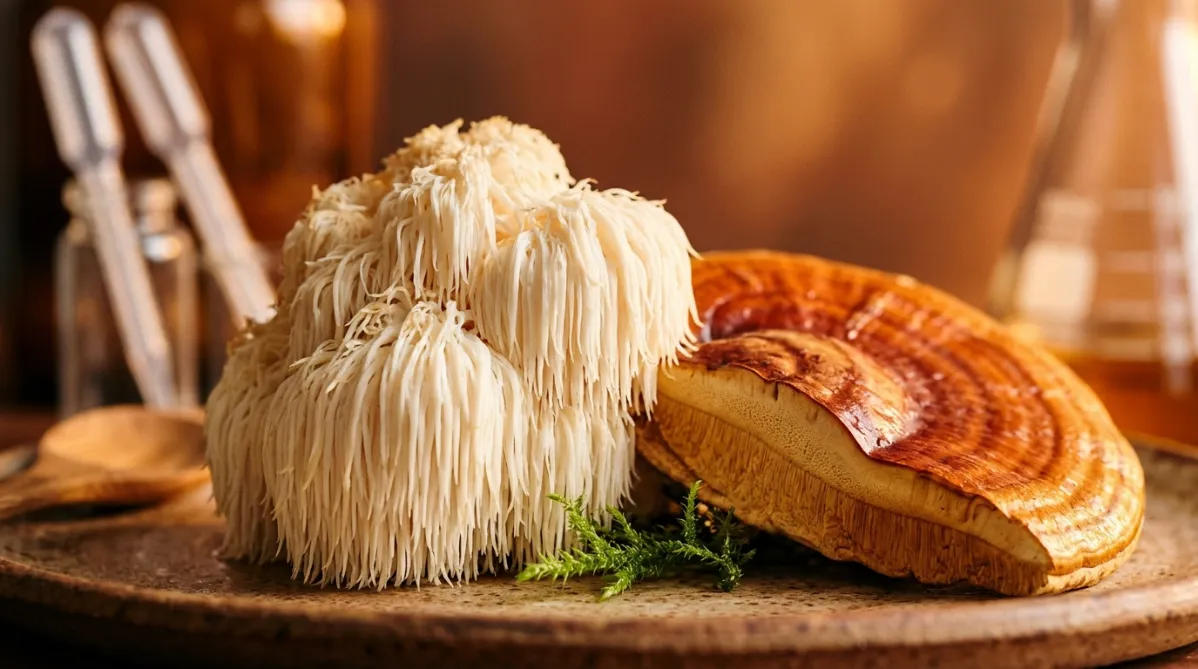
Everyone has been telling you to take Lion's mane for your brain. A new randomised trial asked a sharper question: what happens if you add Reishi? In young women with stress and anxiety, the blend beat Lion's mane alone on the study's main anxiety measure. The details matter, though, and they make the result more interesting and less hype-ready than a headline suggests.
The Study at a Glance
Researchers at Northumbria University (Smith and Docherty) published the trial in Frontiers in Nutrition (doi 10.3389/fnut.2026.1887408; registered as NCT06406946).
- Design: randomised, double-blind, placebo-controlled, parallel-groups trial
- Participants: 84 women aged 18-26 (Gen Z) with subjective stress and/or anxiety
- Arms: 1.8 g powdered Lion's mane (Hericium erinaceus), 1.8 g powdered Lion's mane + Reishi (Ganoderma lucidum) blend, or placebo, all taken as capsules
- Duration: 28 days of supplementation, with a follow-up at Day 42
- Measures: mood and wellbeing at baseline, weekly during the intervention, and at follow-up, plus qualitative feedback on Days 28 and 42
Before the trial, the team ran a sort-and-rank study to identify which outcomes mattered most to this population. That is a thoughtful touch, because many supplement trials pick outcomes without asking the people they are meant to help.
The Headline Finding: The Blend Beat Lion's Mane Alone
On the primary outcome, anxiety measured by the GAD-7, the mushroom blend produced lower anxiety than Lion's mane alone. The difference was significant overall (p = 0.018) and at Day 28 (p = 0.003).
Note the comparison. The headline result is blend versus Lion's mane. It is not a clean "blend crushes placebo" story. The paper's conclusion is that the blend improved the primary anxiety outcome relative to Lion's mane alone.
The Plot Twist: Everyone Got Better
The authors report significant improvements across all psychological measures regardless of which group people were in. That includes the placebo group.
They suggest this reflects "participatory benefits" alongside the intervention effects. Taking part in a structured study, with weekly check-ins and a sense of doing something proactive, may itself lift mood. Expectation effects and natural fluctuation may also play a part, though the paper frames the finding as participatory benefit. Either way, a big chunk of the improvement was not mushroom-specific.
The Honest Part: Secondary Outcomes Faded
The study also tracked secondary measures of anxiety (HADS) and stress (PSS). After false discovery rate (FDR) correction for multiple comparisons, those interactions were attenuated to trend level. They no longer met the bar for a confirmed effect.
The researchers then ran exploratory post hoc tests. These suggested a pattern of benefit for the blend over both Lion's mane and placebo at various timepoints (p = 0.001-0.043). The authors say these should be interpreted cautiously, not as confirmatory. Qualitative feedback from participants supported the same pattern, but it is subjective and adds supporting colour rather than proof.
Practical Takeaways
What was tested: 1.8 g per day of powdered mushroom, in capsules, for 28 days. The blend contained both Lion's mane and Reishi. The abstract does not specify the ratio, so no one should assume a particular split works best.
Timing: The source material does not report an optimal time of day, so there is no evidence-based timing advice here. The signal in this study appeared by Day 28, so the duration tested was about four weeks.
Who it might be relevant for: The evidence applies to young women (18-26) with self-reported stress or anxiety. Whether it translates to men, older adults, or people with clinically diagnosed anxiety disorders is unknown.
Who should be cautious or skip it:
- Anyone with a diagnosed anxiety disorder or depression should not replace treatment with a mushroom supplement. This trial did not test that use.
- People who are pregnant, breastfeeding, on medication, or managing a medical condition should check with a healthcare professional before starting any supplement. The paper does not address these groups.
- Anyone expecting a dramatic effect. The overall pattern was that everyone improved, and the blend-specific edge was modest and statistically fragile outside the primary outcome.
Limitations You Should Know About
- Small sample. With 84 participants split across three arms, the trial is modest in size. The authors say the secondary findings need confirmation in adequately powered trials.
- Narrow population. Only young women with subjective stress or anxiety were studied.
- Short duration. 28 days of supplementation plus a follow-up at Day 42 says little about long-term effects.
- Self-reported outcomes. Mood and anxiety scales capture how people feel, which is relevant but vulnerable to expectation.
- Placebo response. Large improvements in all groups make it harder to isolate the mushroom effect.
- Open methodological questions. The authors state that substantial work is needed on dosage, intervention duration and blend composition.
The Bottom Line
This trial gives a credible, preregistered, double-blind hint that Lion's mane plus Reishi may do more for anxiety than Lion's mane alone, at least over four weeks in young women. It is a signal worth following up, not a verdict. The functional mushroom market is projected to reach $62.18 billion by 2032, and evidence still lags behind marketing. Studies like this one, which report FDR-corrected results and flag their own caveats, are what the field needs more of.
This article is for information only and is not medical advice.