
Biocracked
Approach 4, conceptual metaphor, in palette D, bold color field.

A single frayed shoelace-style aglet stands in for a telomere cap: a glossy brass-tipped cord end, photographed in tight macro, its braided fibers splitting apart and unraveling at the worn end. The cord is cream white and the brass tip catches a crisp highlight. It rests on a seamless saturated mustard-yellow backdrop. The camera sits at a low three-quarter angle, with the frayed end sharp in the foreground and the rest of the cord falling softly out of focus to the right. Hard, directional studio light from the upper left casts a clean, short shadow on the yellow surface. A thin electric green thread runs through the braid, the only trace of green in the frame. Mood: skeptical, scrutinizing, a promise that doesn't hold together. No text anywhere.
Peptides

Epitalon: The Telomere Peptide Everyone's Injecting Is Unproven

Nova Chen · · 4 min read

Epitalon is promoted online as a way to lengthen telomeres, reset your sleep clock, and slow aging. A new narrative review in the International Journal of Molecular Sciences gives it a more sober label: "biologically active but clinically unproven." That phrase says a lot about where the hype and the data currently diverge.

The review comes from a group of US pain and rehabilitation physicians. They report no financial or commercial interest in epitalon, epithalamin, or any product discussed. Here is what they found, and what it means if you're tempted by the vial.

What Epitalon Actually Is

Epitalon is a synthetic tetrapeptide with four amino acids: Ala-Glu-Asp-Gly. It was developed from the amino-acid composition of epithalamin, a pineal-derived polypeptide preparation. The authors stress that the two are chemically distinct. Much of the older literature is about epithalamin, an extract, not the synthetic four-amino-acid compound sold today.

The review therefore treats epithalamin separately, as historical context. This matters because online claims often blend the two, borrowing credibility from older studies of a different material.

The Big Claims: Telomeres, Sleep, and Oxidative Stress

The review says epitalon has been reported to modulate several things:

  • Telomere-maintenance pathways
  • Circadian and neuroendocrine function
  • Oxidative stress
  • Cellular aging markers

The authors conclude that preclinical studies suggest biological activity. But "reported to modulate" and "suggest biological activity" are cautious phrases. They describe signals in lab and animal-type models, not proof that a person who uses epitalon will live longer, age more slowly, or feel better.

The review also notes that direct evidence in musculoskeletal disease models is lacking. That gap is relevant because the authors were assessing the peptide's potential in regenerative medicine, and they found no direct support there.

What the Human Evidence Looks Like

This is where the headline claims run out of road. According to the review, human evidence is limited to:

  1. Small physiological or biomarker studies
  2. An older controlled study in retinitis pigmentosa

That's it. The review states plainly that no adequately powered randomized trial has established therapeutic efficacy. There is no large, modern human trial showing that epitalon extends lifespan, improves healthspan, or treats a disease.

Biomarker changes are not the same as health outcomes. A shift in a lab marker may be interesting, but it doesn't show that someone is healthier or lives longer. The authors also evaluated evidence by sample size, safety reporting, and independent replication, which are exactly the areas where the epitalon literature is thin.

What We Don't Know About Safety

The review lists several unresolved issues:

  • Pharmacokinetics: how the body absorbs, distributes, and clears the peptide is inadequately characterized.
  • Dose-ranging: there are no adequate data identifying effective or safe doses.
  • Long-term safety: data are insufficient.
  • Oncologic questions: telomere-related biology raises open cancer-risk questions that remain unresolved.
  • Immunogenicity: it is uncertain whether the body might mount immune responses to the peptide.
  • Product quality: the review flags uncertainty about what is actually in the products people obtain.
  • Regulatory status: uncertainties remain following a 2026 FDA advisory review.

The cancer question deserves context. Telomere maintenance is a normal feature of some healthy cells, but cancer cells also rely on it to keep dividing. The review lists oncologic uncertainty as unresolved, not as established harm. Still, "we don't know" is not reassuring for a compound people use for years in the name of anti-aging.

Practical Takeaways

Dosing is unvalidated. The review found no adequate dose-ranging or pharmacokinetic data, so there is no evidence-based dose, schedule, or cycle length. Any protocol you see online is not backed by validated clinical dosing data. This article won't offer injection instructions, because none can be responsibly supported.

Forms and quality are a gamble. Because the review flags product-quality and regulatory uncertainty, you can't assume a purchased product matches its label in identity, purity, or sterility. That is especially important for anything injected.

Who it might be "for": realistically, researchers and people who want to follow the science. As a self-directed therapy, the evidence doesn't support using it to treat or prevent any condition.

Who should skip it:

  • Anyone with a personal or family history of cancer, or active cancer concerns, given the unresolved oncologic questions
  • People who are pregnant or breastfeeding, since no safety data support use
  • Anyone seeking treatment for a specific disease, including eye disease, based on old or limited studies
  • Anyone unwilling to accept unknown product quality for an injected substance

If you're interested in longevity, discuss it with a clinician who can point you to approaches with stronger evidence.

The Bottom Line

Epitalon is not nonsense. The review credits it with biological activity in preclinical work. But a compound that does something in a lab model is a long way from a proven therapy. With no adequately powered randomized trial, inadequate dosing and long-term safety data, and open questions about cancer risk, immune response, product quality, and regulation, the honest 2026 verdict is the authors' own: biologically active, clinically unproven.

The authors call for standardized pharmacologic, safety, and disease-specific studies before clinical translation. Until those arrive, the telomere peptide everyone is talking about remains a promising question, not an answer.

This article is for information only and is not medical advice.
Original study

Read the original research on pubmed.ncbi.nlm.nih.gov →

This article summarizes published research for general information. It is not medical advice.

NC

Written by

Nova Chen

Nova Chen writes for Biocracked: biohacking science, longevity & human performance.

Related Articles

Approach: Lab in action. Palette: D, bold color field.

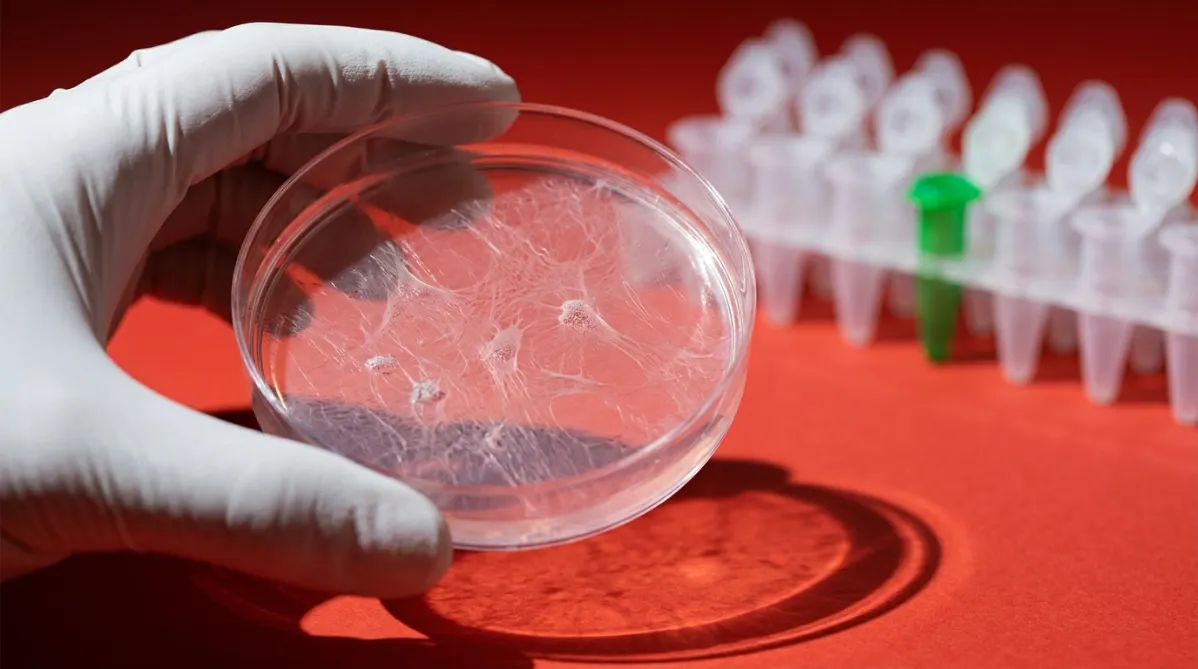
A gloved hand holds a clear petri dish at a slight low angle, close and slightly above eye level, against a saturated tomato-red backdrop. Inside the dish, a thin, translucent layer of pale pink culture medium holds a faint, lacy web of fibroblast cells, with a few small clusters just visible. Hard, clean studio light from the upper left throws a crisp curved shadow of the dish onto the red surface and picks out bright highlights on the rim and the glove's matte white nitrile. In the soft-focus background, a rack of empty microcentrifuge tubes stands out in cool white. One tiny electric green cap on a single tube adds a small accent. The mood is precise and skeptical: a promising result still confined to the dish.
peptides

Epithalon Switched On Telomerase in Cells—But Not in People

BY HELIX WARD ·

A tiny four-amino-acid peptide reportedly switched on telomerase, an enzyme most adult cells keep silent, and lengthened telomeres in human cells. That is the finding behind Epithalon's longevity buzz. But it came from fetal fibroblasts in a dish, not from people, and the paper's talk of extending lifespan is a hypothesis. Here is what the 2003 study actually showed, what it leaves out, and how to read it before you buy anything.

Approach: macro science. Palette: bold color field (magenta/violet).

An extreme close-up macro photograph of a single halved blueberry-like dark berry, its translucent flesh cut open to reveal glistening deep violet and magenta pulp, with tiny juice droplets and fine cell-like fibers catching the light. The berry rests on a saturated magenta acrylic surface, which fills the background in a smooth, out-of-focus gradient. A few whole berries blur softly in the foreground. Shot at a low 30-degree angle with a shallow depth of field, lit by a soft large diffused key light from the upper left and a subtle rim light that makes the juice sparkle. One small electric green leaf tip enters at the frame edge. Mood: vivid, crisp, curious and scientific, with rich saturated color and no text.
longevity

Berry Pigment Linked to 6.6 Years Younger Telomeres in Women Under 55

BY HELIX WARD ·

A Nurses' Health Study analysis of nearly 5,000 women found a tantalizing link between anthocyanins, the pigments in blueberries and other berries, and longer telomeres. The catch is that it appeared only in women under 55, and it translated to about 6.6 years of aging in the authors' estimate. Overall, flavonoid intake showed no association with telomere length. The study is cross-sectional, so it cannot show cause and effect or actual telomere shortening over time. Here is what the findings do and don't mean, and who might care.

**Approach: Conceptual metaphor. Palette: B, Warm.**

A close, slightly high three-quarter view of a single weathered hemp rope stretched horizontally across the frame, shot at a shallow depth of field. On the left the rope is thick and tightly twisted. On the right it has frayed down to a few thin strands, with a short, neat whipping of bright electric green thread binding the rope just where the fraying stops. Golden-hour sunlight enters low from the left and picks out each individual fiber in honey and copper tones. Soft amber shadows fall across a blurred, sun-warmed wooden dock in the background. The mood is quiet and cautiously hopeful, suggesting something worn down slowly but partly held in place. The image is photorealistic and has no text.
longevity

Vitamin D3 Preserved 140 Base Pairs of Telomere in a 4-Year RCT

BY DR. SYNAPSE ·

A large, randomized, placebo-controlled trial found that four years of vitamin D3 slowed telomere shortening by about 140 base pairs. The data come from the VITAL study of older U.S. adults taking 2,000 IU/day. The effect was modest and borderline significant (p=0.039), and telomere length is a surrogate marker, not proof of a longer life. Omega-3s, meanwhile, did nothing for telomeres in this trial. Here is what the numbers show, what the limits are, and how to use the finding sensibly.

Approach: conceptual metaphor. Palette: bold color field.

A single ripe, glossy red tomato-colored apple sits at the center of a saturated mustard-yellow seamless backdrop, with a neat row of five identical white capsules lined up beside it on the same surface. The apple is the clear winner of the frame. One capsule has rolled slightly away, cracked open and spilling a tiny pile of pale powder. Shot at a low three-quarter angle with a shallow depth of field, so the back capsules blur softly. Lighting is a large, soft key light from the upper left, giving crisp but gentle shadows with warm yellow bounce. A thin sprig of electric green (#00e676) leaves rises from the apple stem as the only green accent. Mood: confident, playful and skeptical, a clean verdict that real food outweighs pills. No text or labels.
longevity

Zombie Cell Supplements? 27 Human Trials Say Diet Beats Pills

BY NOVA CHEN ·

Supplement labels love to promise they'll "clear zombie cells," but a new systematic review of 27 human trials and 3,811 participants suggests the evidence is thin. Calorie restriction produced the most consistent drop in senescence-linked inflammatory signals. Omega-3 was the most promising supplement, though the evidence was limited and mixed. Telomere length and the classic p16/p21 markers mostly failed to move. Here's what that means for what you eat and what you buy.

This page is available in