Biocracked
←

#taurine

1 article
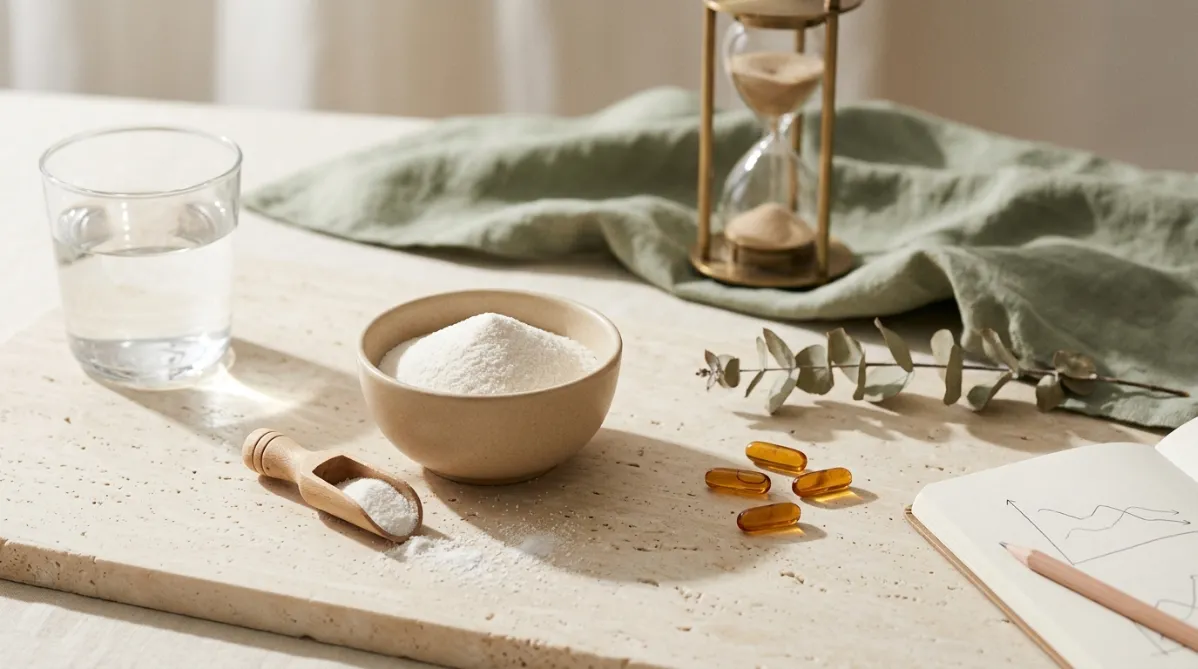
A serene editorial still life shot from a slightly elevated angle on a pale travertine surface, bathed in soft morning window light with gentle long shadows. At the center sits a small matte ceramic bowl in warm oatmeal tone, holding a fine mound of white crystalline powder, with a delicate wooden scoop resting beside it. A few grains are scattered naturally across the stone. To the left, a clear glass of water catches the light, throwing a subtle caustic shimmer onto the surface. To the right, a neatly arranged trio of translucent amber glass capsules and a single sprig of dried eucalyptus add organic texture.

In the softly blurred background, a sage-green linen cloth drapes across the frame, and a vintage brass hourglass stands upright, its sand halfway through. This is a subtle nod to aging and time. A small open notebook with faint, abstract hand-drawn line graphs trending gently downward, with no legible text, rests at the edge of the composition, with a slim pencil placed across it.

The palette is calm and modern: creamy ivory, warm sand, muted sage, soft terracotta, and touches of honey amber. The mood is quiet, thoughtful, and scientific without being clinical, like a contemporary wellness and science magazine cover. Shallow depth of field keeps the powder bowl crisp, with creamy bokeh behind it. Generous negative space on the right side of the wide 16:9 frame leaves room for headline overlay. Fine film-like grain, natural color grading, and minimalist composition give it a refined, trendy journal feel.
longevity

Taurine, the Cheap Amino Acid That Stretched Mouse Lifespans by Up to 12%, Falls With Age in Humans

BY DR. SYNAPSE ·

A 2023 Science study found that circulating taurine, a cheap and widely available amino acid, declines with age in mice, monkeys and humans. Supplementing middle-aged mice extended median lifespan by roughly 10-12% and improved healthspan in both rodents and monkeys. The compound appeared to curb cellular senescence, DNA damage, mitochondrial dysfunction and inflammaging. Human data remain observational, and the mouse doses scale to several grams a day, so the evidence is far from proof. Here is what the study showed, what doses people have discussed, and why researchers say trials are needed before anyone treats taurine as an anti-aging pill.

This page is available in