Biocracked
←

#lithium orotate

1 article
Approach: macro science, a lithium-themed image built around the actual metal and tissue. Palette: bold color field in saturated teal.

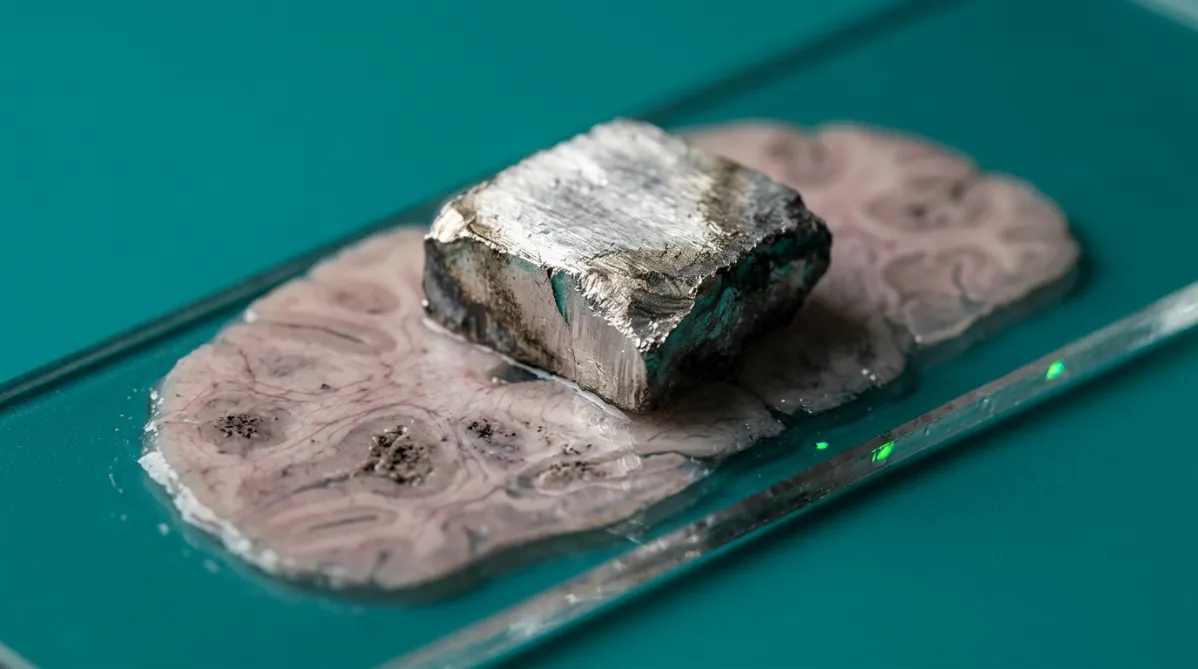
Extreme close-up photograph of a single freshly cut piece of silvery lithium metal, its surface partly tarnishing to grey and matte black at the edges, resting on a thin slice of translucent brain tissue on a glass microscope slide. The slice shows fine pink-grey folds and a few dark clumped plaque-like specks. The backdrop is a smooth saturated teal field, with the slide placed diagonally. Shallow depth of field keeps the metal edge razor sharp while the tissue softens toward the corners. Lighting is a crisp, slightly warm side light from the left, with a small specular highlight on the metal and a soft shadow on the teal. A tiny electric green reflection glints in the glass edge. The mood is quiet, investigative and precise. Shot from a low 30-degree angle, with no text or labels.
research

Het spoorelement dat verdwijnt uit de hersenen vóór Alzheimer

BY DR. SYNAPSE ·

Een baanbrekende *Nature*-studie van Harvard ontdekte dat lithium het enige metaal was dat significant is verminderd in de hersenen van mensen met een milde cognitieve stoornis. Bij muizen leidde een halfing van de lithiumspiegel tot meer amyloïde‑opbouw, tau‑pathologie, ontsteking en geheugenverlies, terwijl lage doses lithium‑orat dit voorkomen. Het lijkt erop dat deze verbinding de amyloïde‑plaques omzeilt die andere lithiumzouten vasthouden. Toch gelden de supplementresultaten alleen voor muizen; er is nog geen klinische proef bij mensen, en lithium brengt risico’s voor nieren, schildklier en interacties met zich mee. Hieronder staat wat de studie wel en niet aantoont en waar je op moet letten.

This page is available in