Biocracked
←

#glp-1

2 articles
Approach: Macro science. Palette: B, warm.

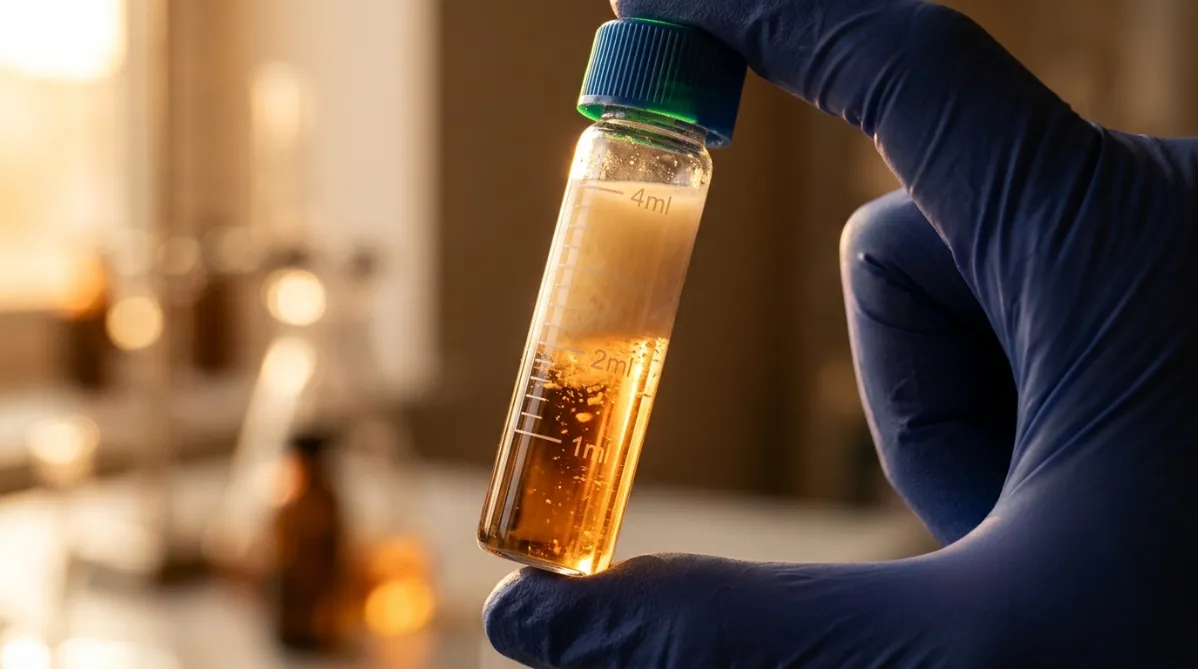
Extreme macro photograph of a clear glass vial of blood plasma held in a gloved hand, shot at a slight low angle so the camera looks up through the tube. The plasma is cloudy and creamy at the top, where large fat-rich particles gather, and it clears to translucent golden amber toward the bottom, showing the drop in triglyceride particles. Tiny suspended droplets catch the light as bright specks. Warm honey-colored backlight from a low window-like source glows through the liquid and casts copper highlights across the glass. The background is a soft blur of warm brown and amber, with a faint electric green reflection on the rim of the vial cap. The mood is calm, precise and cautious, with a shallow depth of field and a real clinical texture on the glass. No text or labels.
metabolism

Retatrutide réduit de 84 % les grosses particules de triglycérides — mais lisez ceci d’abord

BY DR. SYNAPSE ·

Retatrutide est surtout connu pour son effet sur la perte de poids, mais une analyse post‑hoc de deux essais de phase 2 a évalué ses effets sur les biomarqueurs sanguins. Chez les adultes diabétiques de type 2, les grosses particules lipoprotéiques riches en triglycérides ont diminué jusqu’à 84,4 %, et l’apolipoprotéine B a baissé de 21 à 24 %. Chez les sujets non diabétiques, le hsCRP et l’IL‑6 ont chuté respectivement de 54,8 % et 29,6 %, sans atteinte de signification dans le groupe diabétique. Aucun résultat n’est fourni pour le Lp(a) ni pour une relation dose‑réponse. Il s’agit d’un médicament investigateur sous prescription, pas d’un complément, et ces chiffres restent des biomarqueurs, pas la preuve d’une réduction d’infarctus.
Approach: Macro science. Palette: D, bold color field.

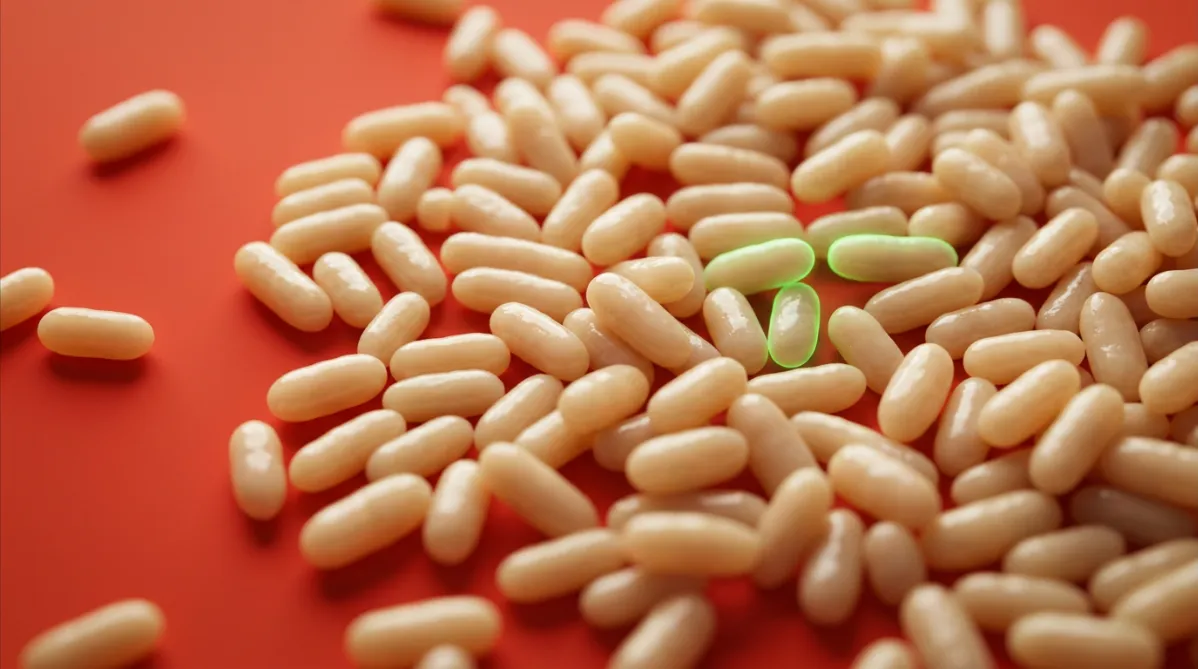
Extreme close-up microscopy-style image of a dense cluster of oval, rod-shaped bacteria with a slightly mucous, glossy membrane texture, shot from a shallow top-down angle with a razor-thin focal plane. Most of the colony sits in the sharp center, softening into creamy blur at the edges. The cells are warm ivory with subtle translucent depth, resting on a saturated tomato-red backdrop. A scattering of sparser, isolated cells on one side suggests "low baseline" and hints at the subgroup story. One or two cells carry a faint electric green (#00e676) fluorescent rim glow. Lighting is soft, directional studio light with gentle specular highlights on the cell walls and clean shadows in warm red tones. Mood: curious, precise, quietly skeptical, with a vivid but grounded look. No text and no blue cast.
supplements

Akkermansia n’a pas atteint son objectif principal – sauf chez les personnes qui en manquaient

BY NOVA CHEN ·

Une bactérie intestinale pasteurisée, souvent présentée comme un « stimulateur naturel de GLP‑1 », a été évaluée dans un essai en double‑aveugle sur 142 participants. Elle n’a pas atteint son critère principal d’amélioration de la sensibilité à l’insuline. Cependant, les analyses exploratoires ont révélé une hausse du GLP‑1 après une charge glucidique, et les sujets présentant initialement un faible niveau d’Akkermansia ont affiché une meilleure sensibilité à l’insuline et moins de graisse du tronc. Ces résultats de sous‑groupes, proches du seuil de signification, ne sont que des hypothèses et proviennent d’une étude fortement liée à l’industrie. Voici ce que les données montrent, ce qu’elles ne montrent pas, et à qui elles peuvent intéresser.

This page is available in