Biocracked
←

#akkermansia

1 article
Approach: Macro science. Palette: D, bold color field.

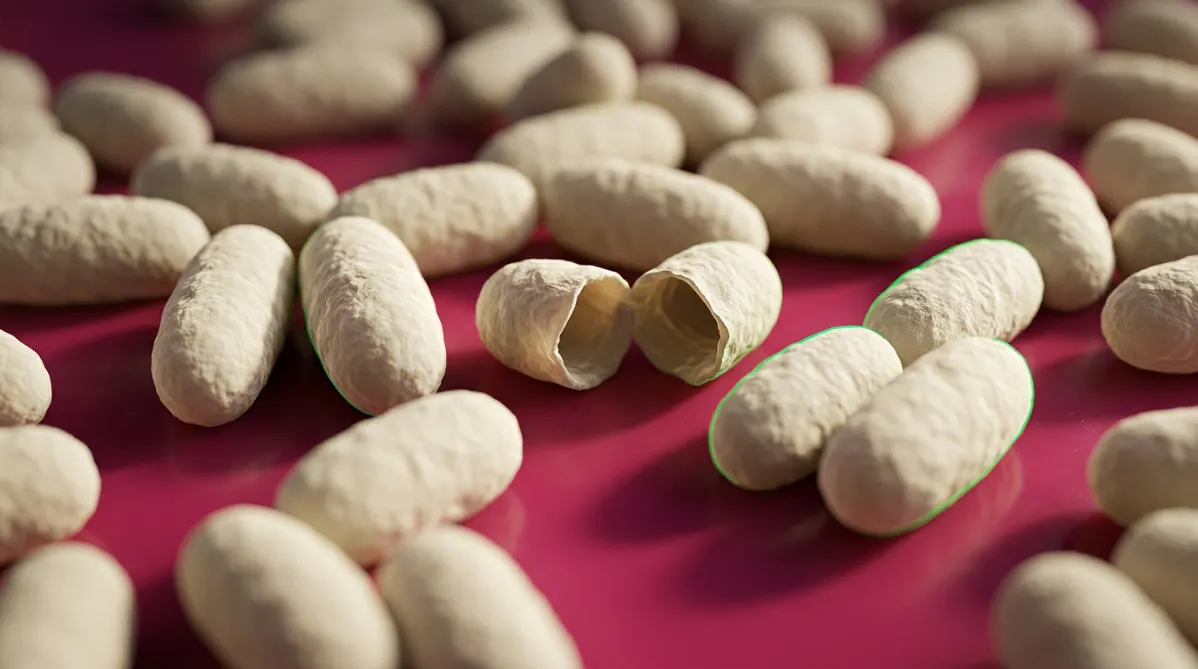
Extreme close-up microscopy-style photograph of a dense cluster of oval, rod-shaped bacterial cells, rendered as slightly wrinkled, matte, pale cream-white forms with visible surface texture. They rest on a smooth, saturated magenta-pink gel surface. Several cells in the foreground are crisp, while the rest fall into soft shallow depth of field. One cell near the center is split open and visibly hollow, to suggest a dead, heat-treated organism. Camera is a low three-quarter angle, as if through a scanning microscope. Lighting is a single hard, warm-white side light that casts short crisp shadows and creates bright rim highlights. A thin electric green (#00e676) line of reflected light traces the edge of one cell. The mood is stark, curious and quietly skeptical. There is no text and no labels.
metabolism

La bactérie intestinale qui fonctionne mieux lorsqu’elle est morte : un gain de 29 % grâce à Akkermansia

BY HELIX WARD ·

Lors du premier essai clinique humain d’Akkermansia muciniphila, c’est la forme pasteurisée (tuée par la chaleur), et non la forme vivante, qui a donné les résultats les plus frappants. La sensibilité à l’insuline a augmenté de 28,6 % et l’insulinémie à jeun a chuté de 34,1 % versus placebo chez des adultes en surpoids et résistants à l’insuline. Les pertes de poids et de masse grasse attendues n’ont pas atteint la significativité statistique, et plusieurs auteurs détiennent des brevets et ont co‑fondé une société commercialisant la bactérie. Voici ce que l’étude montre réellement, ce qu’elle ne garantit pas, et les points à vérifier avant d’acheter un complément.

This page is available in