
Biocracked
Approach: conceptual metaphor, in palette D (bold color field).

A saturated mustard-yellow backdrop holds seven identical wooden-handled stopwatches in a staggered row, shot from a slightly raised three-quarter angle. Five stopwatches have run on and show tarnished, cloudy glass faces. The two in front have clean, glossy glass, and each carries a small electric green (#00e676) ribbon tied to its crown. The faces carry no numerals or readable marks. Soft, even studio light from a large overhead softbox gives gentle, short shadows. Shallow depth of field blurs the back of the row. The mood is playful but analytical, with crisp contrast between the dull watches and the bright pair. The image suggests that extra time and good time are not the same thing.
Longevity

All 7 Longevity Compounds Extended Lifespan. Only 2 Kept Worms Functional

Dr. Synapse · · 4 min read

A new study in GeroScience suggests that living longer and staying functional are not the same thing, at least in male roundworms. Researchers at the University of Oregon tested seven well-known pro-longevity compounds and found that every one extended male lifespan. Only two, sulforaphane and metformin, also preserved a measurable function late in life.

Important caveat up front: this is worm-only research. The experiments were done in Caenorhabditis elegans, a roundworm widely used in aging biology. Nothing here shows that these compounds extend lifespan or healthspan in humans, and nothing here is a basis for supplement or medication decisions.

What the researchers did

The study, led by Al-Saadi and Phillips at the Institute of Ecology & Evolution, University of Oregon, addresses a gap in aging research. Most compound screens in C. elegans have been run in hermaphrodites, the dominant sex in the species. Sex differences in aging are well documented across animals, yet the biology behind them, and whether interventions work equally in both sexes, remains understudied.

The team asked whether compounds known to extend hermaphrodite lifespan do the same in males. They tested seven compounds, each at two concentrations:

  • Metformin
  • Sulforaphane
  • Resveratrol
  • Propyl gallate
  • All-trans retinoic acid
  • Thioflavin T
  • Gold sodium thiomalate

They measured two things: lifespan, and reproductive healthspan, assessed through mating success in late life.

Lifespan: a clean sweep

On lifespan, the result was uniform. Every compound extended male lifespan under every tested condition. That consistency is notable in itself. It suggests that many interventions identified in hermaphrodites translate to males, at least for the blunt endpoint of how long the animals live.

If lifespan were the only readout, the study would read as a straightforward success story for all seven compounds.

Healthspan: only two survive the cut

The picture changed when the researchers looked at late-life mating success. Male mating is a demanding behavior that requires coordinated neuromuscular function, sensory processing, and motivation. It makes a useful stand-in for how well an aging animal retains complex function, in this case reproductive healthspan.

Only two conditions improved late-life mating: sulforaphane and metformin. The other compounds extended life without improving this functional measure. In other words, those worms lived longer but did not mate better in old age.

The authors conclude that lifespan and healthspan can be decoupled in C. elegans males. Adding days to life does not guarantee that those added days are functional ones.

Why this matters for longevity screening

Aging research has increasingly stressed that the goal is not merely longer life but more years of healthy function. Many compound screens, particularly high-throughput ones in invertebrates, use lifespan as the primary readout because it is easy to measure. This study illustrates a risk of that approach: a compound can look like a winner on survival curves while doing little for function.

The authors position their work as a new framework for screening pro-longevity compounds. Adding a functional, behavior-based endpoint such as mating success could help separate interventions that merely prolong survival from those that preserve capacity.

Why sulforaphane and metformin?

The abstract does not explain the mechanism, so any explanation here is speculative. Both compounds have been studied widely in aging biology. Metformin is a common diabetes drug that has been linked to effects on cellular energy sensing and metabolism. Sulforaphane, a compound derived from cruciferous vegetables such as broccoli, is associated with stress-response and detoxification pathways. Whether these pathways explain the preserved mating performance in males is not established by this study, and the work does not test mechanisms.

It is also worth noting that the other five compounds are not shown to be useless. They extended lifespan, and the study measured only one healthspan proxy. Other functions, such as movement or stress resistance, might respond differently.

Limitations and context

  • Worms, not humans. C. elegans is a powerful model, but its biology differs substantially from mammals. Results often fail to translate.
  • Male-focused, single healthspan measure. Mating success captures reproductive and neuromuscular function, but it is not a complete picture of healthspan.
  • Two concentrations per compound. Dose-response relationships were only coarsely explored.
  • No mechanism. The study shows an association between compound and outcome, not the biological reason.

The paper is also an update of a 2025 bioRxiv preprint, now published after peer review, and the authors declare no competing interests.

The takeaway

The main message is conceptual rather than clinical. Lifespan extension and preserved function can come apart, and screening only for the former may overstate a compound's value. In male worms, sulforaphane and metformin stood out because they delivered both. Whether anything similar holds in mammals, or in people, is an open question that this study does not attempt to answer.

For now, the finding is best read as a methodological nudge to the longevity field: measure how well animals live, not just how long.

Original study

Read the original research on pubmed.ncbi.nlm.nih.gov →

This article summarizes published research for general information. It is not medical advice.

DS

Written by

Dr. Synapse

Dr. Synapse writes for Biocracked: biohacking science, longevity & human performance.

Related Articles

Approach 2, lab in action, with palette D, bold color field.

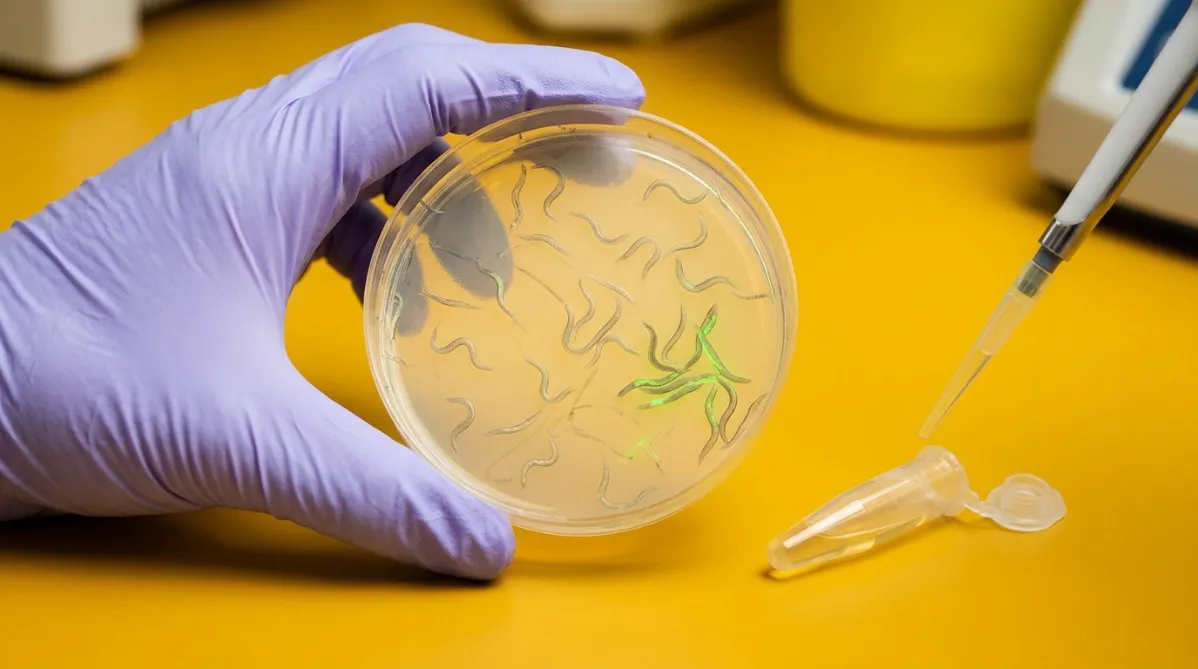
Overhead-angled close shot of a gloved hand in a pale purple nitrile glove holding an open agar petri dish above a saturated mustard-yellow lab bench. Inside the dish, dozens of tiny translucent C. elegans worms trace sinuous curved tracks across a faintly glowing bacterial lawn. A small cluster of the worms shows a subtle electric green fluorescence along their bodies, suggesting neurons. Beside the dish, a microcentrifuge tube holds a pale golden-yellow DHM solution, with a pipette tip hovering nearby. Lighting is bright, crisp, directional studio-style lab light with soft short shadows. The shallow depth of field blurs the background to a smooth yellow. The mood is curious, precise and optimistic, with a slightly playful contrast between the vivid backdrop and the delicate, nearly invisible animals.
longevity

Hangover Supplement DHM Stretched Worm Lifespan by Up to 15%

BY NOVA CHEN ·

The same compound sold in hangover capsules just stretched worm lifespan by up to 15%. In a new C. elegans study, dihydromyricetin (DHM) also protected touch-receptor neurons, kept the worms moving longer, and lowered intestinal fat. The lifespan effect did not depend on the classic longevity gene daf-16, and standard antioxidant reporters were not induced, which hints at a more unusual mechanism. But this is worms only, the micromolar doses do not translate to capsule doses, and there is no human longevity data.

Approach: conceptual metaphor. Palette: D, bold color field.

A single glass beaker-shaped water pitcher sits on a saturated mustard-yellow seamless backdrop, photographed straight-on at eye level. It is almost empty, with only a thin line of clear liquid at the bottom, standing for drained B12. Beside it, a clean white ceramic head-shaped bust, with no face detail, glows with warm light, as if it were full. A small electric green ribbon is draped over the pitcher handle as the only green accent. Lighting is soft, diffused studio light from the upper left, with gentle, crisp shadows falling to the right on a glossy surface that gives a faint reflection. The mood is curious and paradoxical, a puzzle in which something is depleted yet the outcome looks better. The composition is minimal, with the objects on the right third and generous empty yellow space on the left. Photorealistic, with no text.
longevity

Metformin Drains B12, Yet Diabetic Brains Scored Higher. Why?

BY DR. SYNAPSE ·

Metformin is known to lower vitamin B12, a nutrient your brain depends on. Yet in a new analysis of 587 older adults with type 2 diabetes, metformin users scored higher on a cognitive test, with about 3.5 to 3.75 points more on the DSST after adjustment. B12 and MMA levels didn't statistically explain the difference, with roughly 95% of the association being direct. The benefit appeared concentrated in people aged 60-69 and those with weaker baseline scores. But this is observational, exploratory work in people who already have diabetes, so it can't show that metformin protects the brain.

Approach: conceptual metaphor. Palette: D, bold color field.

A single brass pocket-scale balance sits at the center of a saturated mustard-yellow seamless backdrop, shot straight-on from slightly below at eye level. Its two pans hang almost perfectly level. One pan holds a small pile of pale, matte white powder, and the other holds a similar pile, so the tiny, nearly equal difference reads at a glance. A thin electric green thread is tied around the balance's pointer, a subtle accent. Soft, large-window studio light comes from the left and casts a crisp, short shadow to the right on the glossy surface below. Shallow depth of field blurs the background edges. The mood is quiet, skeptical and unresolved, with a clean, editorial look. No text, numerals or markings are visible on the scale.
longevity

Rapamycin Failed a Huge Human Longevity Test. Here's the Catch

BY DR. SYNAPSE ·

Rapamycin is the darling of the longevity world, but its biggest real-world human test just came back unimpressive. Among 4,885 kidney transplant patients on rapamycin and 6,589 who weren't, median survival age was 64.6 vs 64.3 years, a statistically similar result after adjustment. Over a median 11-year follow-up with 6,443 deaths, researchers saw no meaningful lifespan gain. But the study involved transplant patients on immunosuppressive regimens and was observational, so it can't settle whether low, intermittent dosing works in healthy people. Here's what it does and doesn't tell you.

Approach: macro science. Palette: warm (amber and copper).

Extreme close-up of a freshly sliced king oyster mushroom stem and gill edge, shot at a slight 30-degree overhead angle with a macro lens and shallow depth of field. The pale cream flesh shows individual fibrous hyphae and glistening moisture beads. Warm low-angle golden light rakes across from the left, turning the gill ridges into amber and copper lines with deep honey-brown shadows. A single tiny droplet on the cut surface catches a pinpoint of electric green reflection, as if lit from a hidden source. Background melts into out-of-focus burnished orange and chocolate tones. The mood is quiet, intimate and investigative, with real organic texture and no text.
longevity

Mushroom 'Longevity Vitamin' Raised NAD+ in Aged Rats via H2S Switch

BY HELIX WARD ·

Ergothioneine, the mushroom compound nicknamed the 'longevity vitamin,' just got a mechanism to match its buzz. In a Cell Metabolism study, aged rats given ET ran farther, gained vascularization and muscle, and showed higher muscle NAD+. The effect traced back to a hydrogen sulfide pathway: CSE, persulfidation, and the enzyme cGPDH. Knock out CSE or cGPDH and the benefits vanished. But this is animal and lab work, and the effective rat dose scales to roughly 10x what supplements typically provide.

This page is available in