Biocracked
**Approach: Conceptual metaphor. Palette: D, bold color field.**

A saturated mustard-yellow seamless backdrop. In the center, shot from a slightly high three-quarter angle, a single old brass balance scale stands on a matte surface. One pan holds a small, glossy, translucent green glass sphere with a faint electric green (#00e676) glow inside, standing for the peptide's promise. The other pan holds a plain grey stone of similar size. The beam is almost level but tilts slightly toward the green side, so the result looks real but not decisive. Hard, directional studio light from the upper left casts crisp, defined shadows across the yellow. Fine scratches and patina show on the brass. The background is clean and the framing is wide, with open space on the right. The mood is curious, skeptical and balanced.
Peptides

N-PEP-12 Brain Peptide: Memory Gains at 90 Days, But There's a Catch

Nova Chen · · 4 min read

Can a peptide supplement sharpen a foggy mind? A new randomized trial of N-PEP-12 says something interesting happened at the 90-day mark. It also comes with caveats you should read before you buy anything.

The Quick Take

  • Who was studied: 276 adults aged 50-75 with subjective cognitive complaints (SCCs) and no clinically significant cognitive impairment.
  • What they took: placebo, N-PEP-12 at 45 mg, or N-PEP-12 at 90 mg.
  • How long: assessments at baseline, 30, 90 and 180 days.
  • Headline result: a significant group-by-visit interaction (p = 0.003) across three primary attention outcomes, meaning the groups diverged over time.
  • The catch: the main effect of treatment arm was not significant (p = 0.133), and the endpoint-by-endpoint findings are labeled exploratory by the authors.

What Is N-PEP-12?

The paper, published in Nutrients (2026) by Chira and colleagues, describes N-PEP-12 as a peptide-based nutritional supplement with potential neuroprotective effects. The abstract does not spell out the peptide's composition or mechanism, so I won't speculate here. The authors note that evidence for benefits in healthy adults with SCCs has been limited, which is the gap this trial tries to fill.

SCCs are the "where did I put my keys" or "why can't I focus" experiences that are common in midlife and later. They can sit alongside changes in stress, mood, sleep and quality of life. They may also reflect early cognitive change, which is why researchers target this group.

How the Trial Worked

This was a prospective, randomized, double-blind, placebo-controlled trial, the standard design for supplement research. Participants were split across placebo, 45 mg and 90 mg arms.

Primary outcomes were measures from the Test of Attentional Performance. Secondary outcomes included:

  • WAIS-IV Digit Span Forward and Backward (a working-memory measure)
  • Perceived stress
  • Mood
  • Sleep quality
  • The EQ-5D-5L visual analog scale (self-rated health)

The Numbers That Matter

The three primary attention outcomes were analyzed together in a multivariate repeated-measures model. The results:

Test Result
Group-by-visit interaction p = 0.003 (significant)
Effect of visit p < 0.001 (significant)
Main effect of treatment arm p = 0.133 (not significant)

The authors read this as a time-dependent treatment effect: the active groups' trajectories differed from placebo as the weeks went on. A non-significant main effect means you can't simply say "N-PEP-12 beats placebo overall." The signal is about how scores changed across visits.

The significant result also came from a sensitivity analysis population in which missing data were imputed under assumptions least favorable to the active arms. That is a deliberately conservative approach, and it is a point in the study's favor.

The 90-Day Findings

In exploratory endpoint-specific comparisons at 90 days, both N-PEP-12 groups showed greater improvements than placebo in:

  • Alertness
  • Attention omissions (missed targets on attention tasks)
  • Memory omissions

Digit Span Forward and Backward scores also improved. The abstract reports these as improvements without giving effect sizes, so I can't quote magnitudes here. The full text is the place to look for those.

The authors' conclusion links N-PEP-12 to improvements in attention, working memory and mental wellbeing. Note the word associated, which is more cautious than "causes."

The Extension Phase: Interesting, Not Proof

After the controlled period, there was an uncontrolled extension in which everyone received active treatment. Participants who started on placebo showed comparable improvements after switching to N-PEP-12 90 mg.

This is encouraging for consistency, but without a control group it can't separate the supplement's effect from practice effects, expectation or natural fluctuation. The authors themselves describe these observations as exploratory.

Safety

Adverse events were infrequent and similarly distributed across groups. That is reassuring for a 180-day study, but the abstract doesn't detail event types, so check the full paper if you take medications or have health conditions.

Practical Takeaways

Doses used: 45 mg and 90 mg of N-PEP-12 per day. Both showed greater 90-day improvements than placebo on the exploratory endpoints. The abstract doesn't declare one dose superior, and the extension used 90 mg.

Timing: the abstract doesn't say whether participants took it in the morning or evening, or with food. No timing recommendation is supported by what I could see. Follow the product label and the full paper's methods.

Time horizon: the benefits were described as time-dependent and highlighted at 90 days. If you try it, don't expect an overnight effect.

Who it might suit: the evidence applies to generally healthy adults aged 50-75 with subjective cognitive complaints and no clinically significant impairment. It does not tell us about people with diagnosed mild cognitive impairment or dementia, younger adults, or people seeking a performance boost with no complaints.

Limitations to Keep in Mind

  1. Exploratory endpoints. The authors flag the endpoint-specific findings as exploratory, so they are hypothesis-generating rather than confirmatory.
  2. No significant main treatment effect (p = 0.133).
  3. Uncontrolled extension. It can't establish causation.
  4. Subjective population. SCCs are self-reported and vary widely.
  5. Unclear mechanism. The abstract gives no detail on how the peptide might work.
  6. Funding and conflicts of interest. These aren't stated in the abstract. With supplement trials, it's worth checking the full paper.
  7. Needs replication. The authors say the results support further investigation, not clinical recommendation.

Bottom Line

N-PEP-12 is a promising candidate rather than a proven brain booster. The time-dependent signal, the conservative imputation and the low rate of side effects are encouraging. The non-significant main effect and exploratory framing of the specific endpoints mean the results warrant larger confirmatory trials before anyone calls it a cognitive solution. If you're considering it, talk to a clinician, especially if memory complaints are new or worsening, since those deserve proper evaluation.

Study: Chira et al. Impact of N-PEP-12 Supplementation on Attentional Performance and Mental Wellbeing in Healthy Adults with Subjective Cognitive Complaints: A Randomized, Placebo-Controlled Trial. Nutrients, 2026. DOI: 10.3390/nu18162739 | PubMed 42654319

Original study

Read the original research on pubmed.ncbi.nlm.nih.gov →

This article summarizes published research for general information. It is not medical advice.

NC

Written by

Nova Chen

Nova Chen writes for Biocracked: biohacking science, longevity & human performance.

Related Articles

Approach: conceptual metaphor. Palette: bold color field.

A single glass hourglass stands center-frame on a saturated tomato-red seamless backdrop, photographed at a low three-quarter angle just above tabletop level. The upper chamber holds only a thin layer of pale sand, while the lower chamber is heaped with it. A narrow stream of fine grains falls through the neck, and a few of them glow faintly electric green (#00e676) as they pass the waist. Beside it, a second hourglass has been tipped onto its side, its sand motionless. This stands for the age cutoff. Soft, large-source studio light comes from the upper left and casts crisp, warm-grey shadows on the glossy red surface. Fine scratches and dust show on the glass. The shallow depth of field blurs the background hourglass slightly. The mood is playful but precise, curious and a little skeptical.
supplements

2 Grams of Carnosine Boosted Brain Speed, But Only Under 35

BY NOVA CHEN ·

A trial built to test air-pollution defenses ended up revealing something odd about carnosine and the brain. In adults aged 23 to 35, 2 grams a day for up to 12 weeks was linked to better overall cognitive speed and efficiency, while older groups saw few or no gains. The catch is big: it was a post-hoc, subgroup analysis of a randomized trial of 299 people. Here's what the NEAT trial actually found, how carnosine differs from beta-alanine, and who might (and might not) want to pay attention.

Approach: Data as art, with a conceptual twist. Palette: bold color field (D).

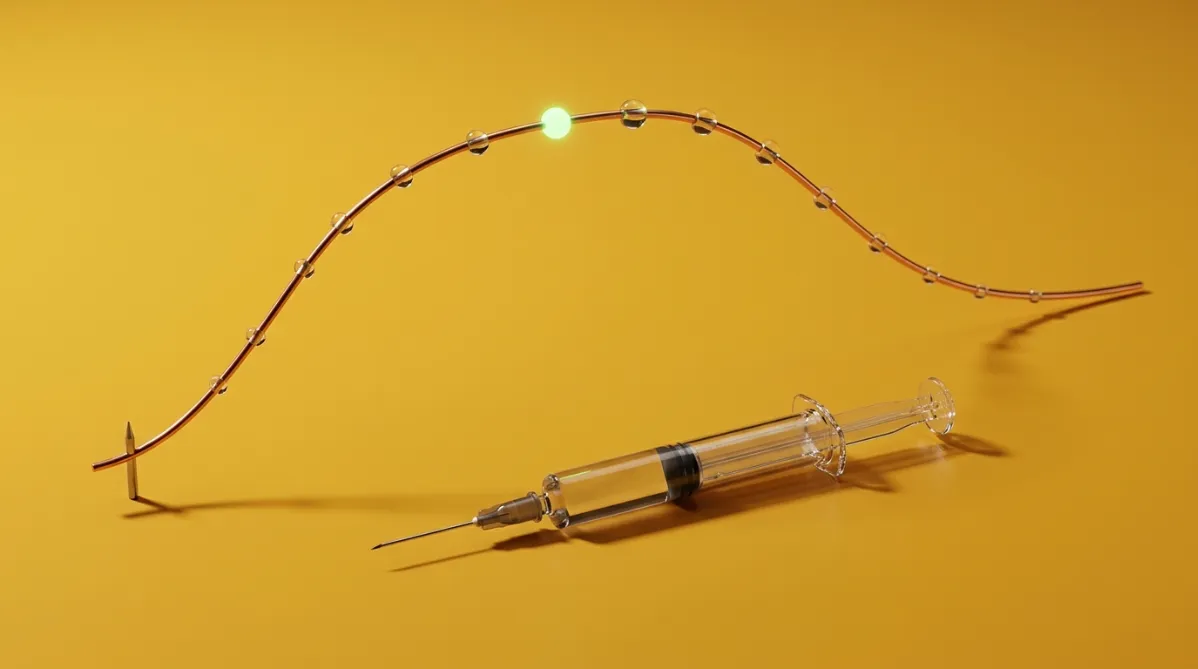
Subject: a single glass syringe lying on a saturated mustard-yellow acrylic surface, shot from a low three-quarter angle with a shallow depth of field. Behind it, a long arc of thin copper wire rises in a gentle curve from a small spike to a broad plateau and then slowly tapers, echoing a hormone curve stretched across days. Small, evenly spaced glass beads sit along the wire, each slightly larger toward the plateau. One bead glows soft electric green.

Lighting: hard single softbox from the upper left, creating crisp, short shadows in warm umber on the yellow. Specular highlights on the glass and copper.

Mood: precise, patient, and quietly analytical, with a slow-release rhythm. No text or markings anywhere.
peptides

CJC-1295 Human Trial: What the Original GH and IGF-I Data Show

BY HELIX WARD ·

A single injection of CJC-1295 raised growth hormone 2- to 10-fold for six days or more and IGF-I 1.5- to 3-fold for 9-11 days in healthy adults aged 21-61. The peptide's half-life was estimated at 5.8-8.1 days, and IGF-I stayed above baseline for up to 28 days after repeated dosing. No serious adverse reactions were reported, with 30-60 µg/kg doses best tolerated. But this 2006 trial measured hormones and safety, not muscle, fat or performance. Here is what the original data actually show, how CJC-1295 with DAC differs from mod GRF 1-29, and why the drug remains an unapproved, WADA-banned research peptide.

Approach: conceptual metaphor. Palette: D, bold color field.

Subject: a single old-fashioned mechanical light switch, photographed straight on, with its toggle stuck halfway between on and off. It is mounted on a saturated mustard-yellow painted wall. A thin electric green (#00e676) glow leaks from the gap behind the toggle and casts a small green rim onto the plate. Beside it, a row of six small matte black tally marks is scratched into the paint, with the third and fifth marks fainter and partly worn, hinting at inconsistent results across days.

Camera: slightly low, eye-level angle with a 50mm lens, shallow depth of field, and the switch placed on the right third of the frame.

Lighting: hard directional side light from the left casts crisp, warm-neutral shadows with no blue cast. The wall texture and brushstrokes are visible.

Mood: curious, skeptical, and measured. The scene suggests a mechanism that is partly engaged.
longevity

Fasting-Mimicking Diet Nudged Human Autophagy—But Not Every Time

BY HELIX WARD ·

Does the fasting-mimicking diet really switch on autophagy in people, or only in mice? A new pilot randomized trial in 30 healthy adults tested ProLon and a second FMD formulation against control. By the end of the roughly 6-day diet, the groups differed in autophagic flux, weight, glucose, ketones, and insulin resistance. But those differences did not hold at every time point, and the trial was small and sponsored by ProLon's maker. Here is the protocol, what it showed, and who should think twice.

Approach: Macro science. Palette: D, bold color field.

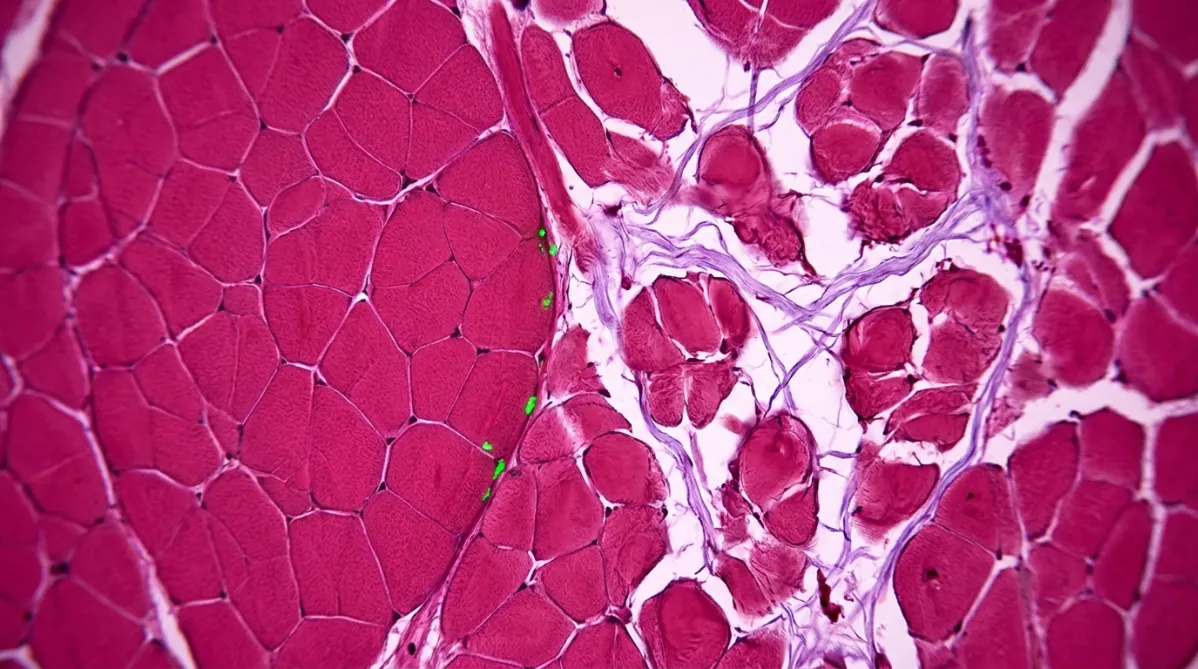
Extreme close-up microscopy-style photograph of a stained rat skeletal muscle cross-section, shot straight down through the microscope objective. Polygonal muscle fibers fill the frame in saturated magenta and pink eosin tones. A cluster of fibers on the left is neatly packed and uniform. On the right, the tissue is disrupted, with swollen gaps and thin, fibrous collagen strands in pale violet threading between damaged cells. A few tiny electric green fluorescent specks sit along one fiber edge as a subtle accent. Lighting is bright, even transmitted light with crisp focus at the center and soft falloff at the edges. The mood is analytical and tense, a rescue only partly complete. No text, no labels.
peptides

BPC-157 Protected Rat Muscle From Blood-Flow Injury—With a Catch

BY NOVA CHEN ·

Cut off blood flow to a muscle and then restore it, and the comeback itself can do serious damage. A new rat study found that BPC-157 given at the end of ischemia was linked to lower oxidative stress, less apoptosis signaling, less inflammation and partial recovery of VEGF. Tissue staining also showed better muscle structure and less collagen buildup. But the study used just 6 rats per group, one intraperitoneal dose of 20 µg/kg and only 2 hours of reperfusion. BPC-157 is not an approved drug, and this is animal-only research that doesn't justify human use.

This page is available in