Biocracked
Approach: Data as art, with a conceptual twist. Palette: bold color field (D).

Subject: a single glass syringe lying on a saturated mustard-yellow acrylic surface, shot from a low three-quarter angle with a shallow depth of field. Behind it, a long arc of thin copper wire rises in a gentle curve from a small spike to a broad plateau and then slowly tapers, echoing a hormone curve stretched across days. Small, evenly spaced glass beads sit along the wire, each slightly larger toward the plateau. One bead glows soft electric green.

Lighting: hard single softbox from the upper left, creating crisp, short shadows in warm umber on the yellow. Specular highlights on the glass and copper.

Mood: precise, patient, and quietly analytical, with a slow-release rhythm. No text or markings anywhere.
Peptides

CJC-1295 Human Trial: What the Original GH and IGF-I Data Show

Helix Ward · · 4 min read

CJC-1295 turns up constantly in biohacking forums, clinic marketing and anti-doping bulletins. Far less often quoted is the human study that started the conversation. Published in 2006 in The Journal of Clinical Endocrinology and Metabolism, the trial by Teichman and colleagues is the foundational dataset for this long-acting growth hormone-releasing hormone (GHRH) analog. It is worth reading for what it shows and for what it never set out to show.

The Problem CJC-1295 Was Built to Solve

Natural GHRH tells the pituitary to release growth hormone (GH), which in turn prompts the liver and other tissues to produce insulin-like growth factor I (IGF-I). The hormone works, but it is short-lived. As the study's authors note, the therapeutic use of GHRH to boost GH secretion has been limited by its brief duration of action. A molecule that clears within minutes is hard to turn into a practical treatment.

CJC-1295 was designed as a long-acting GHRH analog. The trial asked three questions: how does the body handle the drug (pharmacokinetics), what does it do to GH and IGF-I (pharmacodynamics), and is it safe in healthy adults?

How the Trial Was Designed

The work consisted of two randomized, double-blind, placebo-controlled, ascending-dose trials lasting 28 and 49 days, run at two investigational sites. Participants were healthy adults aged 21 to 61.

  • Study one: Participants received CJC-1295 or placebo as a single subcutaneous injection at one of four ascending dose levels.
  • Study two: Participants received two or three doses of CJC-1295 or placebo, given weekly or biweekly.

The main outcomes were peak concentrations and area under the curve for GH and IGF-I, along with standard pharmacokinetic parameters for the drug itself.

What the Numbers Showed

The results are striking for a single injection:

  • Growth hormone: Mean plasma GH concentrations rose 2- to 10-fold in a dose-dependent manner, and the elevation lasted 6 days or more.
  • IGF-I: Mean plasma IGF-I rose 1.5- to 3-fold, staying elevated for 9 to 11 days.
  • Half-life: The estimated half-life of CJC-1295 was 5.8 to 8.1 days. Most injectable peptides are cleared in minutes to hours, so this is exceptionally long.
  • Repeated dosing: After multiple doses, mean IGF-I levels stayed above baseline for up to 28 days. The authors describe evidence of a cumulative effect.
  • Safety: No serious adverse reactions were reported. The drug was described as safe and relatively well tolerated, particularly at doses of 30 or 60 µg/kg.

The dose-dependence is useful. It suggests the hormonal response tracks with the amount of drug given, which is what you would expect from a real pharmacological effect rather than noise.

DAC vs. "Mod GRF 1-29": Clearing Up a Common Confusion

Much of the confusion around CJC-1295 comes from two different products sharing one name.

The molecule in this trial is the long-acting version. It is commonly described as CJC-1295 "with DAC," where DAC stands for drug affinity complex. That chemical modification is what lets the peptide persist for days, and it is the reason a half-life of nearly a week was observed.

The other product is usually sold as "CJC-1295 without DAC." Strictly speaking, that is a different peptide, more accurately called modified GRF (1-29), or "mod GRF 1-29." It is a modified fragment of GHRH without the long-acting component and is expected to act far more briefly. The trial described here did not test it. Data from this study cannot be carried over to mod GRF 1-29, and the reverse is also true. If someone cites "the CJC-1295 study" to support a short-acting product, they are mixing up two molecules.

What This Study Does Not Tell Us

This is the part that gets lost in online discussion. The trial was a pharmacokinetic, pharmacodynamic and safety study in healthy volunteers. The outcomes were hormone levels and drug behavior. The abstract reports no measurements of:

  • muscle mass or strength
  • fat loss or body composition
  • athletic or physical performance
  • sleep, recovery, bone density or cognitive function
  • long-term safety

Raising GH and IGF-I is a biomarker result. It is not the same as demonstrating a clinical benefit. Whether higher IGF-I translates into meaningful improvements in healthy adults is a separate question that this trial did not answer. The trial was also short, with durations of 28 and 49 days, so it says little about what happens with months or years of exposure. Sustained elevation of IGF-I is something researchers watch carefully, because the GH/IGF-I axis is deeply tied to growth, metabolism and aging biology. The abstract does not address those long-term questions, and neither should readers assume they were settled.

Regulatory Reality

CJC-1295 has never been approved as a medicine. The authors concluded that the data support its potential utility as a therapeutic agent, but potential is not approval. Today it exists as a research peptide, and products sold under the name vary in quality, identity and labeling. It is also prohibited in sport: the World Anti-Doping Agency bans it as a growth hormone-releasing factor, so competitive athletes risk sanctions.

The Bottom Line

The 2006 trial is a solid early-phase study. It shows that a single subcutaneous dose of a long-acting GHRH analog can lift GH for roughly a week and IGF-I for more than a week, that repeated dosing builds on that effect, and that short-term tolerability in healthy adults looked good. It is also a narrow study: no body composition, no performance endpoints, no long-term follow-up, and no data on the shorter-acting mod GRF 1-29 that is so often sold under the same label. Anyone weighing claims about CJC-1295 should treat this paper as evidence of hormonal activity and short-term safety, not as proof of the benefits that marketing often implies.


Original study

Read the original research on pubmed.ncbi.nlm.nih.gov →

This article summarizes published research for general information. It is not medical advice.

HW

Written by

Helix Ward

Helix Ward writes for Biocracked: biohacking science, longevity & human performance.

Related Articles

Macro science: an extreme close-up of GHK-Cu copper peptide crystals, deep blue-violet needle-like crystals with faceted edges, shot at a low three-quarter angle with a shallow depth of field so the nearest crystals are razor sharp and the rest dissolve into soft blur. The crystals sit on a smooth, glossy tomato-red backdrop that fills the frame, creating a bold color field. Lighting is a single large softbox from the upper left, giving crisp specular highlights on the crystal faces and a soft, warm-red bounce in the shadows. One tiny thread of electric green light refracts through a single crystal edge as a subtle accent. Mood: striking, precise, curious, scientific without feeling sterile. Photorealistic microscopy-meets-studio look, no text, no labels, no people.
peptides

GHK-Cu Copper Peptide May Tune Gene Networks Behind Skin Repair

BY NOVA CHEN ·

GHK-Cu, the copper peptide in countless serums, may do far more than moisturize. A 2018 review argues that new gene-expression data could explain how this one small molecule is linked to collagen building, tissue repair, inflammation control, and even DNA repair. Here's what the paper actually reports on aging skin and regeneration, and where the evidence stops. Before you buy into the hype, read the practical caveats on topical use and what a review can and can't prove.

Approach: Lab in action. Palette: D, bold color field.

A gloved hand holds a clear petri dish at a slight low angle, close and slightly above eye level, against a saturated tomato-red backdrop. Inside the dish, a thin, translucent layer of pale pink culture medium holds a faint, lacy web of fibroblast cells, with a few small clusters just visible. Hard, clean studio light from the upper left throws a crisp curved shadow of the dish onto the red surface and picks out bright highlights on the rim and the glove's matte white nitrile. In the soft-focus background, a rack of empty microcentrifuge tubes stands out in cool white. One tiny electric green cap on a single tube adds a small accent. The mood is precise and skeptical: a promising result still confined to the dish.
peptides

Epithalon Switched On Telomerase in Cells—But Not in People

BY HELIX WARD ·

A tiny four-amino-acid peptide reportedly switched on telomerase, an enzyme most adult cells keep silent, and lengthened telomeres in human cells. That is the finding behind Epithalon's longevity buzz. But it came from fetal fibroblasts in a dish, not from people, and the paper's talk of extending lifespan is a hypothesis. Here is what the 2003 study actually showed, what it leaves out, and how to read it before you buy anything.

Approach: conceptual metaphor. Palette: bold color field.

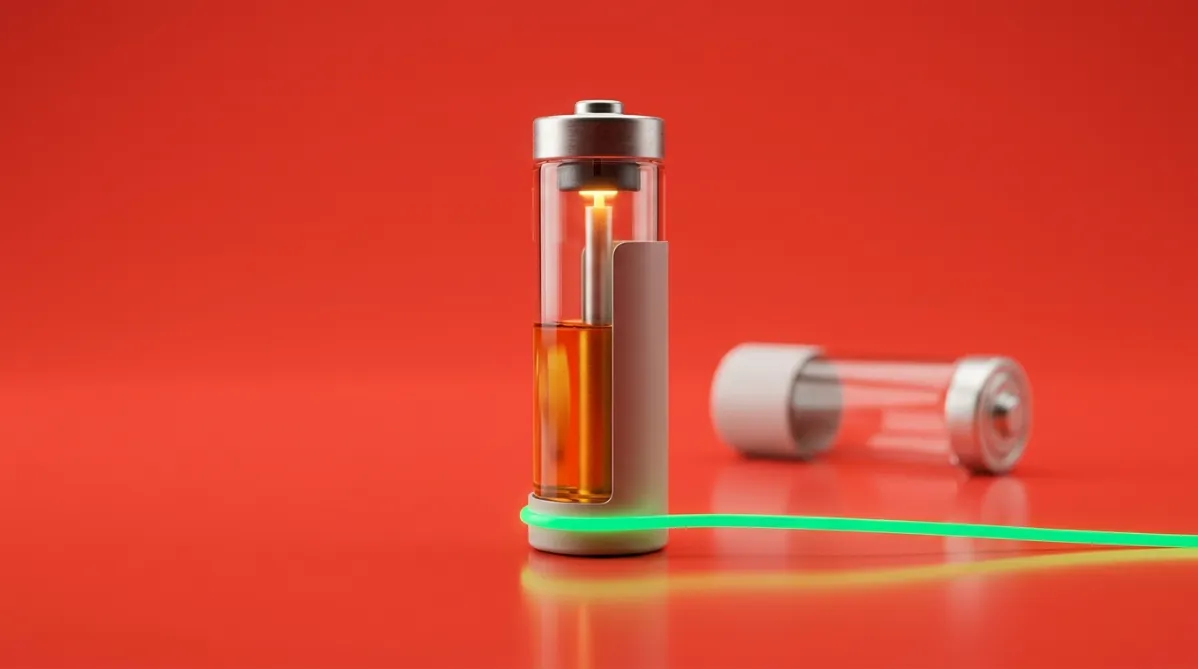
A single AA-style cylindrical battery, shown as a real object with a bare metal cap and a plain unlabeled matte sleeve, stands upright on a glossy surface. It is photographed from a low three-quarter angle against a saturated tomato-red seamless backdrop. The battery is half-filled with a translucent amber liquid that visibly rises inside a clear glass cutaway section. A thin ribbon of electric green light (#00e676) wraps around its base like a charging band. Soft large-softbox light comes from the upper left and produces crisp highlights on the metal and a clean, slightly blurred red reflection beneath it. A second, shorter battery sits out of focus behind, nearly drained and empty, to suggest contrast. The mood is energetic, optimistic and precise, with a tactile product-photography look and shallow depth of field.
supplements

NR + Pterostilbene Lifts NAD+ ~40–90% in Human Trial

BY NOVA CHEN ·

Can a daily capsule of nicotinamide riboside and pterostilbene raise NAD+ in older adults? In the first-in-human NRPT (Basis) trial, 120 people aged 60 to 80 took it for eight weeks. Blood NAD+ rose about 40% at the recommended dose and about 90% at double the dose, and the rise held steady through the study. No serious adverse events were reported. Here is what the numbers show, what the dose takeaways are, and what the study cannot tell you.

Approach: conceptual metaphor. Palette: bold color field.

A single steel bathroom-style analog tape measure, pulled taut and wrapped around a ripe, glossy yellow-orange pear lying on its side, with the tape's tip locked at the same unmarked point, suggesting a waistline that did not shrink. The pear sits on a saturated magenta seamless backdrop, shot from a low three-quarter angle with a shallow depth of field, the stem sharp and the background softly blurred. Hard but slightly diffused studio key light from upper left casts a crisp, short shadow in deeper magenta on the surface. A tiny electric green sticky dot marks the tape's end, with no numbers or writing visible. Mood: playful, skeptical, deadpan, scientific restraint rather than hype.
longevity

Weekly Rapamycin for a Year: Safe, But Did Visceral Fat Budge?

BY REX MERIDIAN ·

Everyone wants to know whether weekly rapamycin can shrink visceral fat and boost healthspan, and the PEARL trial has an answer that may surprise you. After 48 weeks in healthy adults, the primary endpoint of visceral fat did not budge, yet safety looked comparable to placebo. Some secondary signals, including lean mass and pain in women on 10 mg and better well-being on 5 mg, hint at benefits. But those are subgroup and self-reported findings, the drug was compounded, and no one has shown that it extends human lifespan. Here is what the data supports and what it does not.

This page is available in