Biocracked
**Approach: Macro science. Palette: D, bold color field.**

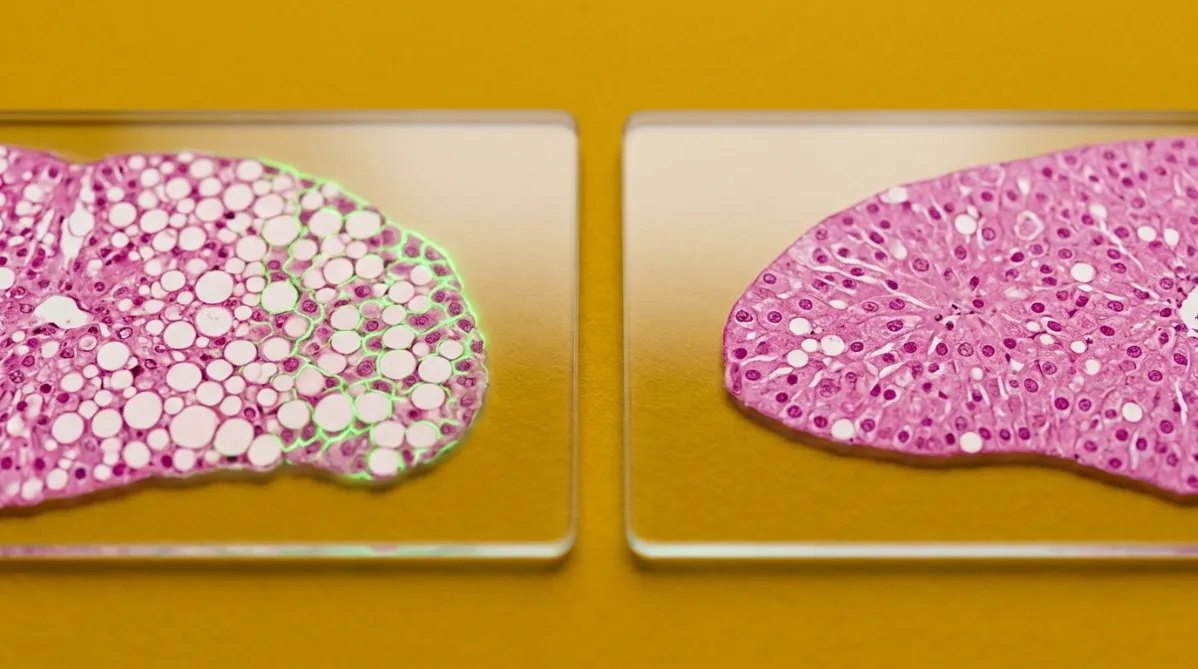
Extreme close-up microscopy-style photograph of two cross-sections of fatty mouse liver tissue, shown side by side on glass slides. Each slice is stained, with translucent pink-magenta tissue and pale, round fat droplets scattered through it. The left slice is dense with droplets and shows a faint electric green fluorescent glow along its cell edges. The right slice has clearer, more intact cell architecture and fewer droplets. The camera looks straight down at a slight tilt with a shallow depth of field, so the slide edges blur softly. Both slides lie on a saturated mustard-yellow backdrop. Crisp, even studio light casts soft, short shadows and gives the glass a clean reflection. The mood is analytical, comparative and precise, with a clear sense of two different outcomes.
Peptides

MitoQ vs SS-31 in Aged Fatty-Liver Mice: Which Did What?

Helix Ward · · 4 min read

Two of the best-known mitochondria-targeted compounds were put head-to-head in the same fatty-liver model, and they did not do the same thing. MitoQ leaned toward antioxidant defense. SS-31 (elamipretide) leaned toward protecting mitochondrial structure. Both reduced liver fat and inflammation.

Important up front: this is a mouse study. It used aged female C57BL/6 mice, not people. Nothing here is a human dosing guide or evidence that either compound treats fatty liver in humans.

The Study at a Glance

The work, by Xiao and colleagues at Shandong University-affiliated Public Health Clinical Center and published in Physiological Research (2026), asked a practical question. Mitochondrial dysfunction is widely seen as an early driver of metabolic dysfunction-associated steatotic liver disease (MASLD, formerly NAFLD). There is still no broadly approved drug for it, so which mitochondria-targeted strategy looks better in a stressed, aged liver?

The design:

  • Animals: aged female C57BL/6 mice, 12-14 months old
  • Diet: high-fat, high-fructose for 16 weeks to induce MASLD
  • Groups: (1) control diet, (2) untreated MASLD, (3) MASLD + MitoQ, (4) MASLD + SS-31
  • MitoQ: 25 mg/kg/day, oral
  • SS-31: 3 mg/kg/day, intraperitoneal injection

The researchers measured liver proteins by western blot and assessed fat accumulation with H&E histology.

What Each Compound Is

MitoQ is a modified form of coenzyme Q10 (ubiquinone) attached to a triphenylphosphonium cation. That positively charged tag lets it accumulate inside mitochondria, where it can act as an antioxidant at the site where reactive oxygen species are produced. It is sold as an oral dietary supplement in many markets.

SS-31 (elamipretide) is a small synthetic tetrapeptide from the Szeto-Schiller family. It is thought to associate with cardiolipin, a phospholipid found in the inner mitochondrial membrane, and help stabilize cristae architecture and electron-transport efficiency. Rather than scavenging radicals directly, it is usually described as supporting the structure that keeps respiration efficient. It has been studied in clinical trials for mitochondrial and cardiac conditions and is a drug-development compound, not a supplement.

What Both Compounds Did

Compared with untreated MASLD mice, both treatments produced broadly similar improvements:

  • Mitochondrial biogenesis markers: higher PGC-1α, NRF1, and TFAM, which are central to making and maintaining mitochondria
  • Inflammation: lower NF-κB and NLRP3 inflammasome activation
  • Insulin signaling: higher p-Akt and GLUT2
  • Liver histology: marked reductions in steatosis on H&E staining

The authors also describe reduced fibrosis-related signaling, though the abstract frames this mainly through inflammatory and fibrotic mediators rather than detailed scarring measures.

The convergence is notable because the two molecules work through different mechanisms. It suggests the broader mitochondrial-health pathway may matter more than any single mechanism.

Where They Differed

MitoQ: stronger antioxidant signature. MitoQ more clearly upregulated SOD2 (the main mitochondrial superoxide dismutase) and Nrf2 (a master regulator of antioxidant genes). It also lowered 4-HNE adducts, a marker of lipid peroxidation. This fits its design as a mitochondria-localized antioxidant.

SS-31: better structural preservation. SS-31 was more effective at preserving mitochondrial structural integrity. That is consistent with its proposed cardiolipin-based mechanism, which targets membrane architecture more than redox chemistry.

These are differences in emphasis, not a clean winner. Which profile is more useful depends on what you think is driving the disease at a given stage: oxidative damage, membrane and structural breakdown, or both.

What This Doesn't Prove for Humans

This kind of study is useful for generating hypotheses, but the limitations are substantial.

  • Mice are not people. Mouse liver metabolism, diet responses, and drug handling differ considerably from humans.
  • Single sex and strain. Only aged female C57BL/6 mice were used. The results may not carry over to males, other strains, or postmenopausal women in any predictable way.
  • Unequal delivery. MitoQ was given orally and SS-31 by injection, at very different mg/kg doses. Differences in absorption, tissue exposure, and potency make a true like-for-like comparison impossible.
  • Mostly protein-level readouts. The abstract emphasizes western blot markers and histology. Those are informative, but they are not clinical outcomes like liver stiffness, fibrosis stage, or long-term events.
  • Prevention-style context. Treatment occurred alongside a diet that induced disease. That is not the same as treating established MASLD in a person who has had it for years.
  • Dose translation. A 25 mg/kg/day mouse dose does not convert directly to a human supplement dose. Standard body-surface-area scaling typically lowers it by roughly an order of magnitude, and that still may not match what a typical capsule provides.

Practical Takeaways

If you are curious about MitoQ: it is commercially available as a supplement, which makes it the more accessible of the two. Availability is not the same as proven benefit for liver disease. Human evidence for MitoQ in fatty liver is limited, so it should not replace established steps like weight management, diet changes, exercise, and medical follow-up. Anyone with liver disease, or taking medications, should talk to a clinician first.

If you are curious about SS-31/elamipretide: this is a prescription or investigational drug, not a supplement. Its regulatory status has been evolving and is tied to specific rare mitochondrial indications, so check current labeling rather than assuming. It is not an approved treatment for MASLD.

A caution on the research-peptide market: SS-31 is widely sold online as a "research peptide." Products in that market often lack verified identity, purity, sterility, or dosing. Injecting an unverified compound based on a mouse paper is a real safety risk. The study used a controlled laboratory compound under a defined protocol, which is not what a gray-market vial guarantees.

Bottom Line

The most useful reading of this study is that mitochondrial support, through either antioxidant or structural routes, improved key markers of fatty liver in aged, diet-stressed mice. MitoQ showed the stronger redox profile, and SS-31 the better structural preservation. The study does not show that either one works in people, or that one is better. The next step is well-designed human trials. Until then, this is promising preclinical science and not a treatment recommendation.
Original study

Read the original research on pubmed.ncbi.nlm.nih.gov →

This article summarizes published research for general information. It is not medical advice.

HW

Written by

Helix Ward

Helix Ward writes for Biocracked: biohacking science, longevity & human performance.

Related Articles

**Approach: Lab in action. Palette: D, bold color field (teal).**

Overhead three-quarter angle on a gloved hand holding a small insulin-style syringe over a tray of mouse-muscle tissue samples. The nitrile glove is bright white, and the backdrop is a saturated teal lab bench surface with a soft sheen. Tiny clear microtubes sit in a rack, and a few contain a faint amber liquid. One thin electric green cap on a tube is the only green accent. The lighting is bright, even studio-like lab light with crisp, soft-edged shadows and a gentle highlight on the syringe barrel and a single hanging droplet at the needle tip. The depth of field is shallow, so the background tubes blur into teal. The mood is precise, focused and quietly hopeful, with no readable text or labels anywhere.
peptides

One Shot Made Old Mouse Muscle Mitochondria Act Young in 1 Hour

BY HELIX WARD ·

A single injection of SS-31 (elamipretide) restored muscle mitochondrial energy production in very old mice to young levels within one hour. That result comes from a 2013 mouse study, not from human trials. The peptide had no observable effect on young muscle, and eight days of treatment improved endurance in the old animals. In humans, elamipretide won FDA accelerated approval for Barth syndrome but missed its primary endpoints in the MMPOWER-3 mitochondrial myopathy trial. Here is what the study showed, where it falls short, and why grey-market versions are a bad idea.

Visual approach: Macro science. Palette: Warm.

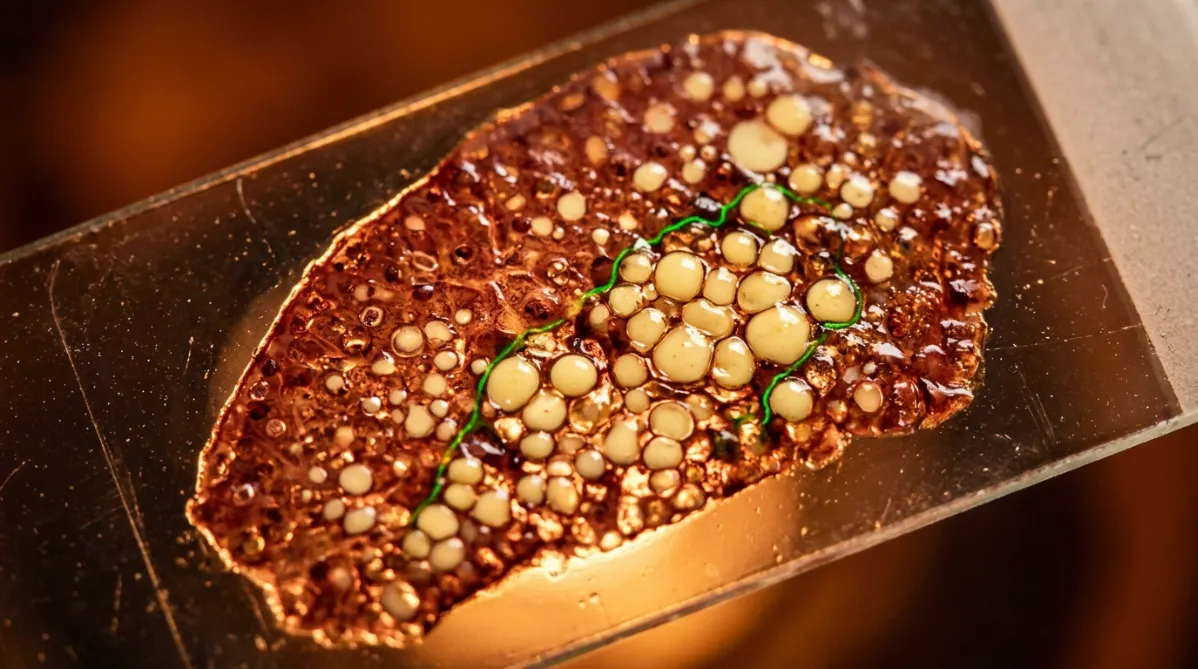
Extreme close-up of a sliced mouse liver tissue sample on a glass microscope slide, shot from a shallow overhead angle with a macro lens. The pale, creamy-yellow fat droplets mottle the deep reddish-brown tissue, so the fatty infiltration looks like glistening honey-colored bubbles of varying size. Warm amber backlight shines through the translucent edges, producing copper highlights and soft golden glows on the glass. The background falls into a blurred, burnt-orange haze. A thin, sharp line of electric green fluorescent stain traces one cluster of droplets as a subtle accent. The mood is tense and investigative, and the textures look wet, real and microscopic, with no text or labels.
longevity

Popular Longevity Supplement AKG Caused Fatty Liver in Mice

BY DR. SYNAPSE ·

Alpha-ketoglutarate (AKG) is one of the most popular longevity supplements, praised for its healthspan benefits in aging mice. A new study in Research found that long-term AKG in food or drinking water raised liver triglycerides and caused fatty liver in healthy mice. The cause was a chain of events: AKG lowered H3K4me3 at Pck1, which boosted lactate and lactylated Cidec, shielding it from TRIM21 and suppressing the fat-burning enzyme ATGL. Knocking down Cidec or Pck1 in the liver prevented the effect. This is mouse-only data, but it raises real questions for healthy people taking AKG chronically.

Approach 3, the human outcome, in palette C, natural.

Low-angle side view of an older adult's lower legs and walking shoes mid-stride on a long outdoor paved path in a park, shot with a shallow depth of field. The face is out of frame. Late-morning daylight filters through green trees and casts dappled light across weathered skin, worn grey sneakers and the pavement. Two faint chalk-white distance marks on the path sit in soft focus ahead, suggesting a measured walk test. Plant greens, warm earth-brown soil edges and natural skin tones dominate, with a tiny electric green detail on the shoe's lace tip. The mood is calm, honest and measured, hopeful but cautious, and the image feels like documentary photography with crisp texture and no staged gloss.
supplements

Urolithin A for Muscle: What 5 Human Trials Actually Show

BY DR. SYNAPSE ·

Urolithin A supplements like Mitopure are marketed as a way to renew mitochondria and protect aging muscle. A new meta-analysis pooled every randomized human trial it could find, just five studies with 236 participants. Only the 6-minute walk test could be combined, showing a +17 m gain that wasn't statistically significant and rested on low-certainty evidence. Strength, endurance, and mitochondrial findings were too inconsistent to pool and are best viewed as hypothesis-generating. Here's what the data say, who might still try it, and how to weigh the cost.

Approach 2, lab in action, with palette D, bold color field.

Overhead-angled close shot of a gloved hand in a pale purple nitrile glove holding an open agar petri dish above a saturated mustard-yellow lab bench. Inside the dish, dozens of tiny translucent C. elegans worms trace sinuous curved tracks across a faintly glowing bacterial lawn. A small cluster of the worms shows a subtle electric green fluorescence along their bodies, suggesting neurons. Beside the dish, a microcentrifuge tube holds a pale golden-yellow DHM solution, with a pipette tip hovering nearby. Lighting is bright, crisp, directional studio-style lab light with soft short shadows. The shallow depth of field blurs the background to a smooth yellow. The mood is curious, precise and optimistic, with a slightly playful contrast between the vivid backdrop and the delicate, nearly invisible animals.
longevity

Hangover Supplement DHM Stretched Worm Lifespan by Up to 15%

BY NOVA CHEN ·

The same compound sold in hangover capsules just stretched worm lifespan by up to 15%. In a new C. elegans study, dihydromyricetin (DHM) also protected touch-receptor neurons, kept the worms moving longer, and lowered intestinal fat. The lifespan effect did not depend on the classic longevity gene daf-16, and standard antioxidant reporters were not induced, which hints at a more unusual mechanism. But this is worms only, the micromolar doses do not translate to capsule doses, and there is no human longevity data.

This page is available in