Biocracked
**Approach: Macro science, with Palette C (natural).**

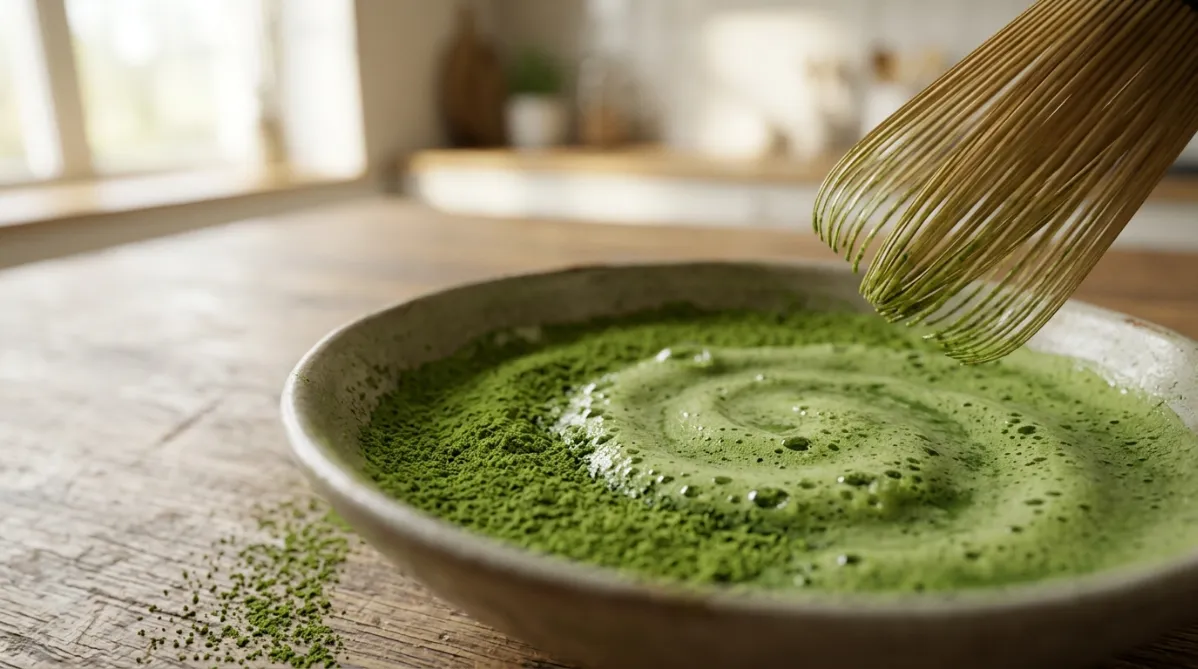
Extreme close-up, shot from a low 30-degree angle, of finely sifted matcha powder in a shallow matte ceramic bowl. A bamboo whisk's tines have just lifted from the surface, leaving a swirl of vivid green foam with a few tiny bubbles. Individual powder grains and the soft ridges of the foam are sharp in the foreground, and the background falls into a creamy blur. Soft side light from a window at left picks out the velvety texture and a faint sheen on the bubbles. The palette is grassy greens, with a worn wooden table in warm brown and a hint of pale daylight. The mood is calm and focused, with a clean, airy, natural feel. The green is the vivid, near-electric tone of fresh matcha. No text, no logos.
Supplements

Matcha Beat Plain Caffeine for Working Under Stress, Study Finds

Nova Chen · · 4 min read

Coffee drinkers have long assumed that caffeine is the active ingredient in any focus-boosting drink. A randomized, placebo-controlled trial in Nutrients suggests the picture is more nuanced. In middle-aged and older adults, a single dose of caffeine sharpened attention, but only continuous daily matcha intake increased how much work people got done on a stress-inducing task.

The study, led by Baba and colleagues and published in 2021, is a useful reminder that a food's effects may not be reducible to its most famous compound. It also comes with limits that are worth stating plainly.

What the researchers set out to test

Matcha is a powdered green tea. Because the whole leaf is consumed, it delivers more amino acids than other teas, including L-theanine, alongside caffeine. The same group had previously reported that continuous matcha intake improved attention and executive function in older adults. That raised an obvious question: is matcha just a delivery vehicle for caffeine, or does something else contribute?

To find out, the team compared matcha, caffeine and placebo. They also compared single-dose and continuous intake, and they added a stress element. The study was registered with the University Hospital Medical Information Network in Japan (UMIN000036578), and participants were Japanese adults in middle and older age.

How stress and cognition were measured

Two tools did most of the work:

  • The Uchida-Kraepelin test (UKT). This is a long-running Japanese task built on continuous simple arithmetic, used here to induce mild acute psychological stress. The key output is the amount of work, meaning how much a person completes under sustained, monotonous pressure.
  • Cognitrax. This is a computerized cognitive battery that captures domains such as attention and reaction time.

The design let the researchers separate two questions. How does a one-off dose affect performance? And does a habit of daily intake change how people cope when stress is applied?

The headline findings

As reported in the abstract:

  1. A single dose of caffeine improved attentional function during or after stress loading.
  2. A single dose of matcha shortened reaction time on Cognitrax, which the authors judged was likely due to its caffeine content.
  3. The matcha group increased its amount of work after continuous intake.
  4. The caffeine group increased its amount of work on the UKT only after a single dose, not with continued use.

The authors concluded that taking matcha with its caffeine improves both attention and work performance under psychological stress, compared with caffeine alone.

The abstract does not report effect sizes, sample sizes or doses, so none are quoted here. Anyone who wants magnitudes should read the full paper (DOI: 10.3390/nu13051700) rather than rely on summaries, including this one.

Why caffeine alone may not be the whole story

The authors credit the combination of caffeine with matcha's amino acids, particularly L-theanine. This is plausible, but the study does not prove it. The trial compared matcha with caffeine, not with caffeine plus isolated theanine, so it cannot say which matcha component drives the sustained effect.

The pattern in the data is still interesting. Caffeine's benefit looked acute: it helped attention in the moment and boosted work output after a single dose, but that output gain did not show up with continued use. This is consistent with the familiar idea that tolerance blunts caffeine's effects over time. Matcha's work-output gain appeared with continuous intake. That would fit a mechanism in which theanine and related compounds smooth or extend caffeine's effects, though the abstract stops short of demonstrating this.

Caveats worth keeping in mind

  • Population. Participants were middle-aged and older Japanese adults. The results may not carry over to young people, to other populations, or to people with very different habitual caffeine intake.
  • Mild, lab-induced stress. The UKT is a standardized arithmetic task. It resembles a monotonous deadline more than a family crisis or a high-stakes presentation.
  • Mixed signals. Single-dose matcha showed faster reaction time that the authors attributed to caffeine, so matcha did not beat caffeine on every measure. Its edge was in sustained work output.
  • One study. A single randomized trial from a research group that had already reported positive matcha findings should be treated as promising, not settled.

Practical takeaways

Matcha versus coffee for focus. If you need a quick lift in attention, caffeine from either source appears to do the job. If you work through long, grinding, stressful stretches, matcha's caffeine-plus-amino-acid package may offer something coffee does not. That inference comes from this study, not a head-to-head matcha-versus-coffee test.

Daily habit versus one-off. The sustained work-output gain showed up with continuous matcha intake. A single cup before a big day is unlikely to replicate that, while a routine might be a better fit.

Theanine stacking. The finding may encourage people to pair caffeine with L-theanine supplements. That is reasonable to explore, but this trial tested whole matcha, which contains many compounds beyond theanine. Don't assume an isolated theanine capsule produces the same results.

Who it's for. Adults in midlife and beyond who want steady performance under pressure are the closest match to the participants. People sensitive to caffeine, those with sleep problems, and anyone on medication or with a health condition should consult a clinician first. Matcha still contains caffeine.

Bottom line

This trial suggests that matcha is more than a caffeine delivery system. Caffeine sharpened attention on its own, but only regular matcha intake was linked to getting more done under mild stress. The result is encouraging and mechanistically sensible. It still calls for replication, larger and more diverse samples, and trials that isolate theanine's contribution before anyone treats it as a firm recommendation.
Original study

Read the original research on pubmed.ncbi.nlm.nih.gov →

This article summarizes published research for general information. It is not medical advice.

NC

Written by

Nova Chen

Nova Chen writes for Biocracked: biohacking science, longevity & human performance.

Related Articles

Macro science close-up of spirulina itself: a dense mound of dried spirulina filaments and flakes, shot from a low three-quarter angle with a macro lens and a shallow depth of field. Crisp, deep blue-green coils and fine threads sit in the focal plane, and the rest melts into soft blur. One small pile rests on a smooth, glossy tomato-red ceramic surface, and the saturated red field contrasts hard with the green algae. Lighting is bright, diffuse studio daylight from the upper left, with soft highlights on the powdery grains and gentle warm shadows. A single wooden spoon edge enters the frame at the corner, dusted with fine green powder. The mood is clean, curious and clinical, with no text, labels or packaging, and no blue cast.
supplements

Spirulina Cut Anxiety and Stress in Men on Methadone, RCT Finds

BY NOVA CHEN ·

A 12-week, double-blind trial found that 500 mg of spirulina twice daily significantly lowered anxiety and stress scores compared with placebo. The catch: all 50 participants were men on methadone maintenance therapy, so the results may not apply to the general population. Depression, sexual function, drug craving and cognitive test scores did not change. This article breaks down what the study showed, what it didn't, and what to consider on dosing and product quality if you're curious about spirulina.

Approach: macro science. Palette: warm (amber and honey).

Extreme macro photograph of a single golden droplet of DHA-rich fish oil suspended at the tip of a glass pipette, shot at eye level with a shallow depth of field. Inside the droplet, a tiny inverted reflection of a window shows through like a lens. Behind it, a softly blurred second droplet rests on a curved glass surface, catching a thin rim of light. Backlit by low golden-hour sunlight from camera left, producing glowing honey and copper tones, warm brown shadows, and delicate caustic patterns on the surface below. The oil shows fine texture, with microscopic bubbles and a slight viscous sheen. A faint electric green reflection glints along the pipette's edge. The mood is quiet, precise and hopeful, with a clean, uncluttered composition and generous empty space on the right. Photorealistic, no text.
supplements

DHA for the Brain: 12 Months Slowed Hippocampus Shrinkage in MCI

BY NOVA CHEN ·

A year of DHA slowed shrinkage of the hippocampus, the brain's memory center, in older adults with mild cognitive impairment. In a 240-person randomized trial from China (219 completers), the DHA group also outperformed placebo on Full-Scale IQ, Information and Digit Span. The dose was a 2 g/day supplement, about 0.9 g of actual DHA. The findings may help explain why omega-3 trials in healthy people have been mixed, since the benefit may be concentrated in those already showing cognitive decline. This article covers the numbers, the likely mechanisms, practical tips on dose and sourcing, and the limits of a single trial.

Approach: Macro science. Palette: B, warm.

Extreme close-up macro photograph of a thin slice of raw chicken breast muscle, shot at a slight 30-degree angle with a shallow depth of field. The pale pink-gold fibers run diagonally across the frame, with glistening moisture and fine striations visible. In the foreground, a few tiny translucent anserine crystals sit on the surface, catching light like small shards of amber glass. A single small point of electric green light reflects off one crystal as a subtle accent. Warm, low golden-hour side light from the left casts honey and copper highlights and soft brown shadows. The background melts into creamy amber bokeh. The mood is quiet, curious and scientific, with a tactile, organic feel and no blue cast.
supplements

Chicken Breast Dipeptide Anserine Lifted Memory Scores in MCI

BY NOVA CHEN ·

A chicken-breast dipeptide called anserine just posted a surprisingly clean result in people with mild cognitive impairment. In a 12-week randomized trial, 500 mg a day lifted MMSE scores by about 1.9 points while placebo stayed flat (p=0.036). The proposed mechanism involves scavenging hypochlorous acid, a reactive molecule tied to neuroinflammation. It fits with earlier carnosine blend studies and a 2024 meta-analysis showing better delayed recall. But with just 30 people analyzed and one cognitive test, here is what the data does and does not tell you.

Approach: The human outcome. Palette: C, Natural.

A close, low-angle shot of a sleeping person's bare forearm and hand resting on a rumpled white cotton duvet, a matte black smart ring on the index finger, with a small electric green LED glint on the ring's inner edge. Early morning daylight comes through a sheer curtain at the left and casts soft golden-green light across the skin, showing fine arm hair and natural skin texture. In the background, out of focus, are a wooden nightstand with a glass of water and the blurred green leaves of a houseplant by the window. The face is not shown. Shot at a 35mm equivalent with shallow depth of field, focused on the ring and knuckles. The mood is calm, restorative and quietly observational, as if the night's data were about to be checked.
supplements

Magnesium L-Threonate Lifted Oura Deep and REM Scores in 3 Weeks

BY NOVA CHEN ·

A 2024 randomized trial tested a brain-targeted form of magnesium, magnesium L-threonate (Magtein), in 80 adults with sleep complaints. After 21 days at 1 g/day, the MgT group had better Oura deep and REM sleep scores than placebo, along with improved mood, energy and alertness. But the placebo group also got worse, the sleep staging came from a consumer wearable, and the study never compared threonate to glycinate or citrate. Here's what the trial actually shows, what a 1 g dose really delivers in elemental magnesium, and where the caveats lie.

This page is available in