Biocracked
**Approach: Conceptual metaphor. Palette: Bold color field (saturated orange).**

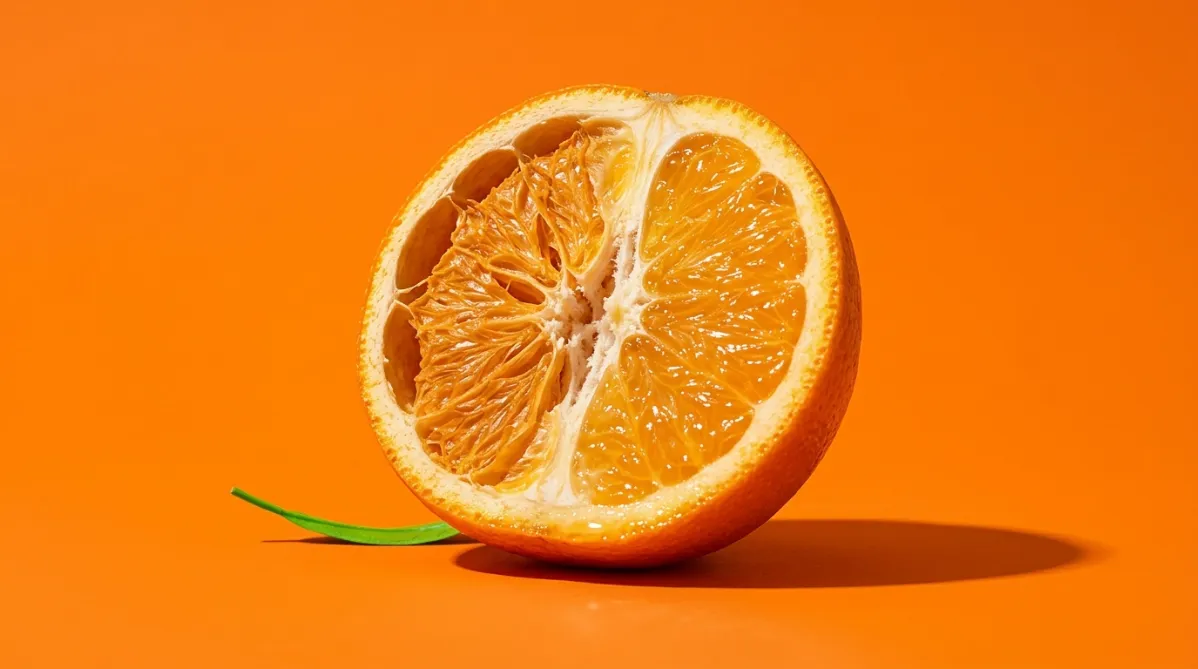
A single halved orange sits on a seamless saturated tangerine-orange backdrop, shot from a low three-quarter angle with a macro lens. The flesh is shrunken and dried on one side, with the juice vesicles collapsed and pulled back from the rind. The other half is plump and glistening. The shrunken side leaves a visible gap inside the peel, which suggests lost brain volume. Hard, directional studio light from the upper left throws a crisp, warm-neutral shadow across the backdrop. Tiny droplets of juice catch the highlights. A thin electric green leaf stem rests beside the fruit as a small accent. The mood is vivid and clean, with a quiet tension between fullness and depletion. There is no text and no blue cast.
Longevity

Low Blood Vitamin C Linked to Smaller Brain Volume in Older Adults

Dr. Synapse · · 5 min read

A large Japanese imaging study has added a new data point to the long-running debate over vitamin C and brain aging. Researchers led by Nagaya and colleagues, publishing in PLOS ONE in 2026, found that older adults with lower plasma vitamin C had less gray matter relative to head size and weaker connectivity in the brain's default mode network. The finding is intriguing, but it comes with an important caveat: it shows an association, not a cause.

What the researchers did

The study enrolled 2,044 older adults in Japan, with a median age of 69. About 61% were women. Every participant had a 3T MRI scan, a high-resolution format widely used in brain research, and had plasma vitamin C measured.

Using the CAT12 toolbox in SPM12, the team calculated total intracranial volume (ICV), gray matter volume (GMV) and white matter volume (WMV). To account for the fact that bigger people tend to have bigger heads and brains, they expressed brain tissue as ratios: GMV/ICV and WMV/ICV.

They also assessed default mode network (DMN) connectivity. The DMN is a set of brain regions most active during rest, self-reflection and memory retrieval, and it is often disrupted early in Alzheimer's disease. Here, connectivity was derived through independent component analysis based on shared gray matter volume variance across voxels, then quantified with loading coefficients. This is a structural covariance approach, not a measure of real-time neural firing as in functional MRI.

The key findings

Lower plasma vitamin C was significantly associated with a lower GMV/ICV ratio (p < 0.001) and with weaker DMN connectivity (p < 0.001). These associations held in multiple regression models adjusted for:

  • Age and sex
  • Mini-Mental State Examination score
  • Education level
  • Diabetes, hypertension and hyperlipidemia
  • Smoking history, drinking history and physical activity

The adjustment matters. Older age, vascular risk factors and smoking are all tied to brain atrophy, and smoking in particular depletes vitamin C. That the association persisted after accounting for them suggests vitamin C status tracks with brain structure beyond these obvious confounders. The authors describe plasma vitamin C as "independently" associated with gray matter integrity and DMN connectivity.

The summary available does not report an effect on white matter volume as a headline result, so the clearest signal is for gray matter, where neuronal cell bodies and synapses are concentrated.

Why vitamin C might matter for the brain

There are plausible biological reasons to take the idea seriously. The brain concentrates vitamin C far above blood levels, and neurons rely on it as an antioxidant in a tissue with high oxygen use and heavy oxidative load. Vitamin C also acts as a cofactor in synthesizing neurotransmitters such as norepinephrine and in collagen formation, and it is involved in recycling other antioxidants such as vitamin E. Chronic oxidative stress and inflammation are both implicated in neurodegeneration.

Previous work has linked higher dietary vitamin C intake to a lower risk of cognitive impairment. What the new study adds is a biomarker-based look, since plasma levels reflect actual status rather than self-reported diet, which is notoriously imprecise, paired with detailed imaging in a sizable cohort.

The limits: association is not causation

This is where honesty matters. The study is cross-sectional and observational, meaning vitamin C and brain structure were measured at one point in time. That design cannot tell us which came first, and it cannot show that vitamin C supplements prevent brain shrinkage.

Several alternative explanations are plausible:

  • Reverse causation: People with early neurodegeneration may eat less well, forget meals or have reduced appetite, leading to lower vitamin C.
  • Residual confounding: Overall diet quality, socioeconomic factors, inflammation and general health can all affect both vitamin C and brain volume, and statistical adjustment never removes every confounder.
  • Marker of healthy living: Plasma vitamin C is a well-known proxy for fruit and vegetable intake. The benefit, if any, might come from the broader dietary pattern, including polyphenols, fiber, potassium and other nutrients.
  • Population specifics: Findings in Japanese older adults may not translate directly to other populations with different diets and genetics.

The authors themselves frame the result cautiously, saying it generates the hypothesis that vitamin C may play a role in brain health. Testing that would require longitudinal studies or randomized trials tracking brain volume over time.

Practical takeaways

The study does not justify megadosing, but it does reinforce a low-risk, sensible goal: avoid vitamin C deficiency or marginal status.

Who is at risk of low levels

  • Smokers, who typically need an extra roughly 35 mg per day because of increased oxidative turnover
  • People with low fruit and vegetable intake, including some older adults living alone or with limited appetite
  • Those with restrictive diets, heavy alcohol use or certain chronic illnesses
  • People with poor absorption or limited access to fresh produce

How to reach healthy status through food

Common recommended intakes are roughly 75 mg per day for adult women and 90 mg for men in the US, with somewhat lower official figures in some countries. Food can easily meet this. A medium orange supplies around 70 mg, a cup of strawberries about 85 mg, half a cup of raw red pepper roughly 95 mg, and kiwi, broccoli, guava and citrus all contribute meaningfully. Eating five or more servings of fruit and vegetables daily generally produces adequate plasma levels.

What about supplements?

Typical supplements deliver 100 to 500 mg, and 1,000 mg tablets are common. Absorption becomes less efficient at higher single doses, so more is not necessarily better. The tolerable upper limit for adults is 2,000 mg per day, above which gastrointestinal upset and diarrhea become likely. People with a history of kidney stones or iron overload conditions should talk to a clinician before taking high doses. A modest supplement of 100 to 250 mg may make sense for smokers or people who struggle to eat produce, but food remains the better first choice.

The bottom line

This large imaging study ties lower vitamin C status to lower gray matter volume and weaker default mode network structure in older adults, even after thorough adjustment. It strengthens the case for further research, but it cannot show that taking vitamin C will protect your brain. For now, the practical message is simple and unglamorous: eat your fruit and vegetables, quit smoking, and consider a modest supplement only if your diet falls short.

Original study

Read the original research on pubmed.ncbi.nlm.nih.gov →

This article summarizes published research for general information. It is not medical advice.

DS

Written by

Dr. Synapse

Dr. Synapse writes for Biocracked: biohacking science, longevity & human performance.

Related Articles

Approach: macro science. Palette: warm (amber and honey).

Extreme macro photograph of a single golden droplet of DHA-rich fish oil suspended at the tip of a glass pipette, shot at eye level with a shallow depth of field. Inside the droplet, a tiny inverted reflection of a window shows through like a lens. Behind it, a softly blurred second droplet rests on a curved glass surface, catching a thin rim of light. Backlit by low golden-hour sunlight from camera left, producing glowing honey and copper tones, warm brown shadows, and delicate caustic patterns on the surface below. The oil shows fine texture, with microscopic bubbles and a slight viscous sheen. A faint electric green reflection glints along the pipette's edge. The mood is quiet, precise and hopeful, with a clean, uncluttered composition and generous empty space on the right. Photorealistic, no text.
supplements

DHA for the Brain: 12 Months Slowed Hippocampus Shrinkage in MCI

BY NOVA CHEN ·

A year of DHA slowed shrinkage of the hippocampus, the brain's memory center, in older adults with mild cognitive impairment. In a 240-person randomized trial from China (219 completers), the DHA group also outperformed placebo on Full-Scale IQ, Information and Digit Span. The dose was a 2 g/day supplement, about 0.9 g of actual DHA. The findings may help explain why omega-3 trials in healthy people have been mixed, since the benefit may be concentrated in those already showing cognitive decline. This article covers the numbers, the likely mechanisms, practical tips on dose and sourcing, and the limits of a single trial.

Approach: conceptual metaphor. Palette: bold color field.

A single vintage brass pocket watch, open, with its movement visible, sits at the center of a saturated mustard-yellow seamless backdrop. The balance wheel and gears are in sharp focus. A single plain, unmarked oval multivitamin tablet is wedged between two gear teeth, as if gently slowing the mechanism. A tiny, crisp electric-green glass bead rests on the rim of the watch case as the only accent. Camera: shot from slightly above at about 35 degrees, with a macro lens and shallow depth of field, so the gears behind the tablet melt into soft golden blur. Lighting: a large softbox from the upper left, with crisp highlights on the brass and a soft, short shadow falling to the right on the yellow surface. Mood: curious, optimistic and precise, suggesting a modest, measurable slowing of time and not a miracle cure.
longevity

Daily Multivitamin Slowed Epigenetic Aging Clocks in COSMOS Trial

BY DR. SYNAPSE ·

A two-year randomized trial in 958 older adults found that a daily Centrum Silver multivitamin modestly slowed two epigenetic aging clocks compared with placebo. PCGrimAge advanced 0.113 years per year more slowly and PCPhenoAge 0.214 years more slowly. The benefit was larger in people who were already aging fast, with PCGrimAge slowed by 0.236 years per year. Cocoa extract with 500 mg of flavanols had no effect on any of the five clocks tested. The effects are small and their clinical relevance is unproven, so this is encouraging rather than conclusive.

Approach: macro science. Palette: warm (amber and copper).

Extreme close-up of a freshly sliced king oyster mushroom stem and gill edge, shot at a slight 30-degree overhead angle with a macro lens and shallow depth of field. The pale cream flesh shows individual fibrous hyphae and glistening moisture beads. Warm low-angle golden light rakes across from the left, turning the gill ridges into amber and copper lines with deep honey-brown shadows. A single tiny droplet on the cut surface catches a pinpoint of electric green reflection, as if lit from a hidden source. Background melts into out-of-focus burnished orange and chocolate tones. The mood is quiet, intimate and investigative, with real organic texture and no text.
longevity

Mushroom 'Longevity Vitamin' Raised NAD+ in Aged Rats via H2S Switch

BY HELIX WARD ·

Ergothioneine, the mushroom compound nicknamed the 'longevity vitamin,' just got a mechanism to match its buzz. In a Cell Metabolism study, aged rats given ET ran farther, gained vascularization and muscle, and showed higher muscle NAD+. The effect traced back to a hydrogen sulfide pathway: CSE, persulfidation, and the enzyme cGPDH. Knock out CSE or cGPDH and the benefits vanished. But this is animal and lab work, and the effective rat dose scales to roughly 10x what supplements typically provide.

Approach: macro science. Palette: bold color field (violet).

Extreme close-up of fisetin crystals, a small cluster of pale yellow needle-like flavonoid crystals with translucent, faceted edges, resting on a smooth glossy deep violet surface. The camera sits low at a shallow three-quarter angle with a very shallow depth of field, so the front crystals are razor sharp and the rest dissolves into soft magenta-violet blur. Lighting is a single crisp, slightly warm studio key from upper left that makes the crystal edges glow and throws long soft shadows across the violet. A few tiny electric green (#00e676) specks of reflected light catch on the crystal tips. The mood is precise, curious and quietly promising, like a sample under inspection, with plenty of clear violet space on the right side of the frame.
longevity

Fisetin Senolytic Extended Mouse Lifespan—Human Proof Still Missing

BY HELIX WARD ·

Fisetin, a plant flavonoid, emerged as the most potent senolytic among ten compounds in a widely cited 2018 EBioMedicine study. In aged mice, treatment late in life reduced senescence markers, eased age-related pathology and extended both median and maximum lifespan. The catch is that this is mouse and lab evidence, not a completed human longevity trial. This article explains what the researchers found, what the dosing context really means, and who should pay attention as human studies develop.

This page is available in