Biocracked
Approach: macro science. Palette: bold color field (magenta/violet).

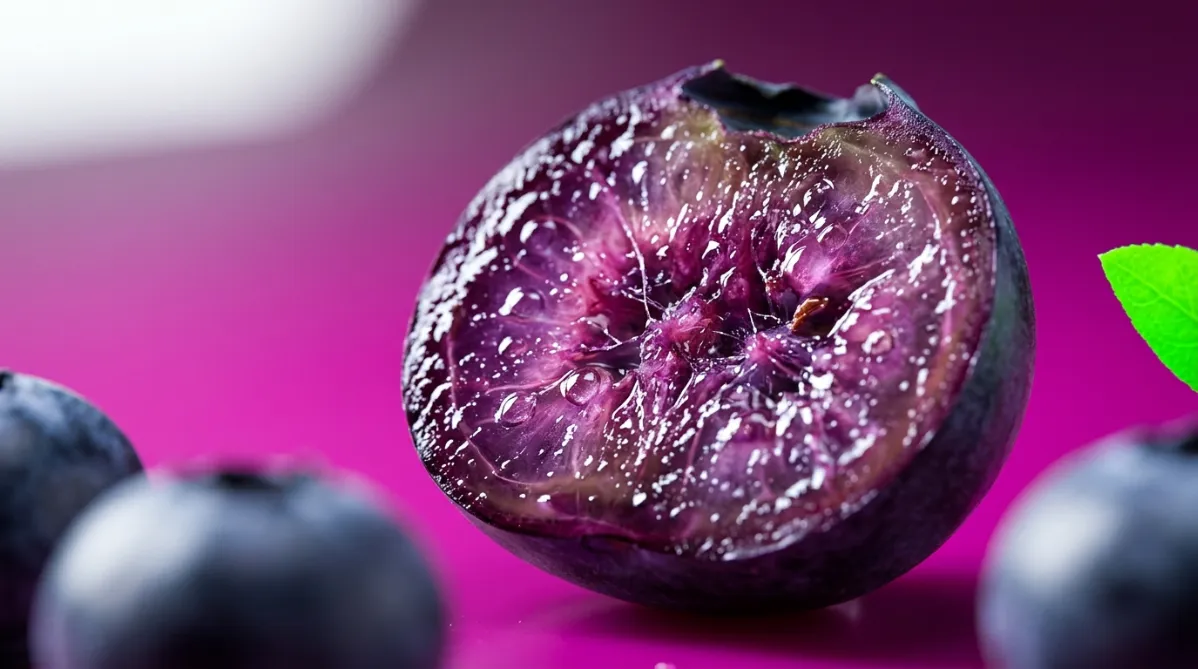
An extreme close-up macro photograph of a single halved blueberry-like dark berry, its translucent flesh cut open to reveal glistening deep violet and magenta pulp, with tiny juice droplets and fine cell-like fibers catching the light. The berry rests on a saturated magenta acrylic surface, which fills the background in a smooth, out-of-focus gradient. A few whole berries blur softly in the foreground. Shot at a low 30-degree angle with a shallow depth of field, lit by a soft large diffused key light from the upper left and a subtle rim light that makes the juice sparkle. One small electric green leaf tip enters at the frame edge. Mood: vivid, crisp, curious and scientific, with rich saturated color and no text.
Longevity

Berry Pigment Linked to 6.6 Years Younger Telomeres in Women Under 55

Helix Ward · · 3 min read

Blueberries may not be a fountain of youth, but one new Harvard-linked analysis found a pattern that longevity nerds will want to see. In women under 55, the people eating the most anthocyanins, the pigments that make berries blue, purple and red, had longer telomeres. The gap was roughly the equivalent of 6.6 years of biological aging.

Before you restock the freezer aisle, read the fine print. It matters a lot here.

What the researchers actually did

The study, published in GeroScience, analyzed data from 4,944 disease-free women in the Nurses' Health Study. The team looked at habitual intake of five flavonoid subclasses:

  • Flavonols
  • Flavones
  • Flavanones
  • Flavan-3-ols and their polymers
  • Anthocyanins

Intake came from food frequency questionnaires. Telomere length (TL) was measured in blood leukocytes using quantitative PCR. Telomeres are the protective caps on chromosome ends, and shorter ones are widely used as a marker of cellular aging.

No one had looked at habitual flavonoid intake and telomere length at the population level before. Earlier support came mostly from mechanistic work, meaning lab and cell studies.

The headline result is a subgroup result

In the full group, no flavonoid subclass was significantly associated with telomere length. The authors say so directly: overall, habitual flavonoid intake was not associated with TL attrition.

The interesting signal appeared only after the researchers restricted the analysis to women under 55:

  • Higher anthocyanin intake was associated with longer telomeres (P-trend = 0.042). The authors translate the difference between top and bottom quintiles to about 6.6 years of aging (95% CI, 1.7–14.5).
  • Berry intake told a similar story. Women under 55 who ate two or more servings a week had longer telomeres than those who never or rarely ate them (P = 0.033 for trend). The top group's estimate was imprecise, with a wide error margin.
  • Among pre-menopausal women, the anthocyanin link was stronger (P-trend = 0.001).

The abstract's printed quintile figures for the under-55 group look reversed relative to the conclusion, with the highest quintile listed lower than the lowest. The authors' stated conclusion is that higher intake went with longer telomeres. Check the full paper if exact values matter to you.

Why you should not oversell this

This is an observational, cross-sectional study. That has consequences:

  • No causation. Women who eat lots of berries may also exercise more, smoke less, or eat better overall. Statistical adjustment helps but cannot remove all of that.
  • No true "attrition." The title refers to telomere attrition, but a single blood draw captures one moment. It cannot show telomeres shortening over time.
  • Subgroup finding. The age cutoff produced the signal. The P-value of 0.042 is borderline, and subgroup analyses are more likely to produce chance results. The authors themselves say it warrants further investigation.
  • Noisy measurements. Diet came from self-reported questionnaires, and qPCR telomere length is a coarse biomarker. A longer leukocyte telomere is not a proven predictor of longer life or less disease for any individual.
  • Limited population. Participants were women in a cohort of nurses. The results say nothing about men.
  • Funding context. One author has received funding from the US Highbush Blueberry Council and advises its grant committee. The paper states that funders had no role in the study's design, analysis or writing, but the relationship is worth knowing about.

Practical takeaways

Dose: The paper does not establish an anthocyanin dose. The only practical benchmark is food-based: the berry finding compared two or more servings per week with little or none. Treat that as the pattern studied, not a prescription. This was about whole foods, not supplements, and nothing here supports extracts or megadoses.

Timing: No timing effect was tested. The data reflect long-term habitual intake, so consistency is the relevant idea, not a specific time of day.

Who it's relevant for: The signal showed up in women under 55, especially pre-menopausal women. Older women showed nothing clear, and men were not studied. If you fall outside that group, this study gives you no particular reason to expect a telomere effect.

Realistic move: Adding berries a couple of times a week is cheap and low-risk, and berries have other reasons to be in a healthy diet. Just don't expect this study to prove they will make you biologically younger.

The bottom line

This is a hypothesis-generating finding, not a longevity hack. The best reading is that anthocyanin-rich foods, particularly berries, might support healthy aging earlier in life, and that the question deserves prospective follow-up. Studies that track telomere change over time and test berries or anthocyanins directly in randomized trials would be the real test. Until then, the "6.6 years" is an intriguing statistical association in one subgroup, not proof of reversed aging.

Original study

Read the original research on pubmed.ncbi.nlm.nih.gov →

This article summarizes published research for general information. It is not medical advice.

HW

Written by

Helix Ward

Helix Ward writes for Biocracked: biohacking science, longevity & human performance.

Related Articles

Approach 4, conceptual metaphor, in palette D, bold color field.

A single frayed shoelace-style aglet stands in for a telomere cap: a glossy brass-tipped cord end, photographed in tight macro, its braided fibers splitting apart and unraveling at the worn end. The cord is cream white and the brass tip catches a crisp highlight. It rests on a seamless saturated mustard-yellow backdrop. The camera sits at a low three-quarter angle, with the frayed end sharp in the foreground and the rest of the cord falling softly out of focus to the right. Hard, directional studio light from the upper left casts a clean, short shadow on the yellow surface. A thin electric green thread runs through the braid, the only trace of green in the frame. Mood: skeptical, scrutinizing, a promise that doesn't hold together. No text anywhere.
peptides

Epitalon: The Telomere Peptide Everyone's Injecting Is Unproven

BY NOVA CHEN ·

Epitalon is pitched online as the telomere peptide that could slow aging, but a new 2026 review says the evidence tells a different story. Human data are limited to small biomarker studies and one older retinitis pigmentosa trial, with no adequately powered randomized trial showing efficacy. Dosing, pharmacokinetics, and long-term safety remain unvalidated, and questions about cancer risk, immunogenicity, product quality, and FDA scrutiny are still open. Here's what the science supports, what it doesn't, and who should steer clear.

Approach: macro science. Palette: bold color field (violet).

Extreme close-up of fisetin crystals, a small cluster of pale yellow needle-like flavonoid crystals with translucent, faceted edges, resting on a smooth glossy deep violet surface. The camera sits low at a shallow three-quarter angle with a very shallow depth of field, so the front crystals are razor sharp and the rest dissolves into soft magenta-violet blur. Lighting is a single crisp, slightly warm studio key from upper left that makes the crystal edges glow and throws long soft shadows across the violet. A few tiny electric green (#00e676) specks of reflected light catch on the crystal tips. The mood is precise, curious and quietly promising, like a sample under inspection, with plenty of clear violet space on the right side of the frame.
longevity

Fisetin Senolytic Extended Mouse Lifespan—Human Proof Still Missing

BY HELIX WARD ·

Fisetin, a plant flavonoid, emerged as the most potent senolytic among ten compounds in a widely cited 2018 EBioMedicine study. In aged mice, treatment late in life reduced senescence markers, eased age-related pathology and extended both median and maximum lifespan. The catch is that this is mouse and lab evidence, not a completed human longevity trial. This article explains what the researchers found, what the dosing context really means, and who should pay attention as human studies develop.

Approach: Lab in action. Palette: D, bold color field.

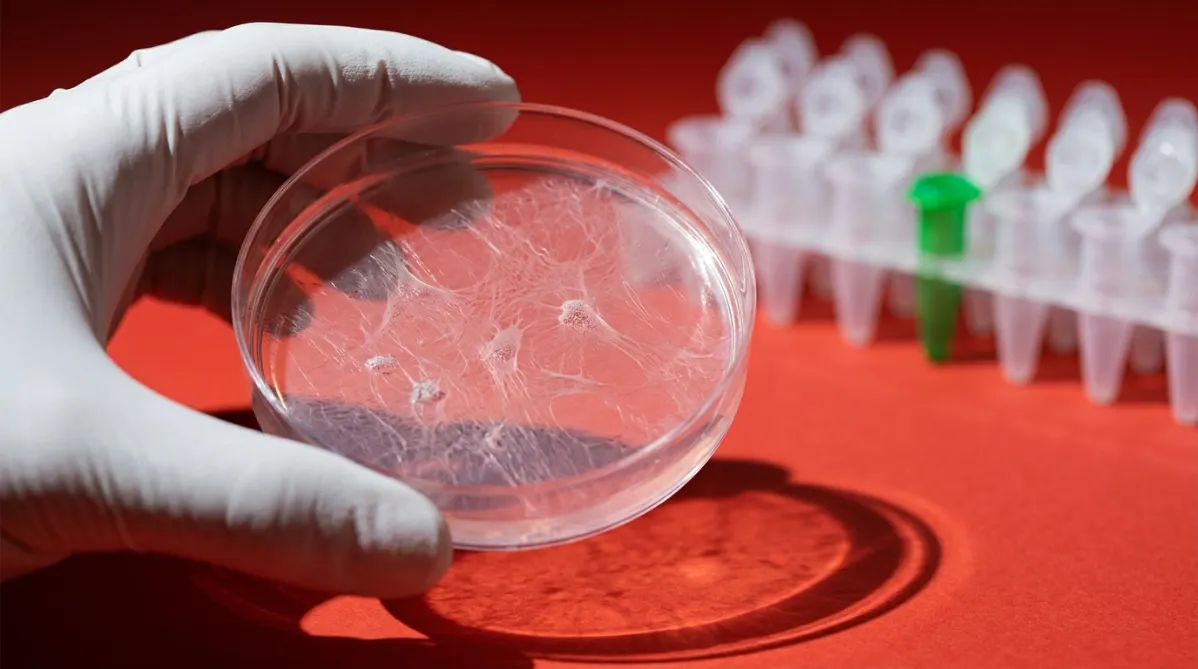
A gloved hand holds a clear petri dish at a slight low angle, close and slightly above eye level, against a saturated tomato-red backdrop. Inside the dish, a thin, translucent layer of pale pink culture medium holds a faint, lacy web of fibroblast cells, with a few small clusters just visible. Hard, clean studio light from the upper left throws a crisp curved shadow of the dish onto the red surface and picks out bright highlights on the rim and the glove's matte white nitrile. In the soft-focus background, a rack of empty microcentrifuge tubes stands out in cool white. One tiny electric green cap on a single tube adds a small accent. The mood is precise and skeptical: a promising result still confined to the dish.
peptides

Epithalon Switched On Telomerase in Cells—But Not in People

BY HELIX WARD ·

A tiny four-amino-acid peptide reportedly switched on telomerase, an enzyme most adult cells keep silent, and lengthened telomeres in human cells. That is the finding behind Epithalon's longevity buzz. But it came from fetal fibroblasts in a dish, not from people, and the paper's talk of extending lifespan is a hypothesis. Here is what the 2003 study actually showed, what it leaves out, and how to read it before you buy anything.

**Approach: Conceptual metaphor. Palette: B, Warm.**

A close, slightly high three-quarter view of a single weathered hemp rope stretched horizontally across the frame, shot at a shallow depth of field. On the left the rope is thick and tightly twisted. On the right it has frayed down to a few thin strands, with a short, neat whipping of bright electric green thread binding the rope just where the fraying stops. Golden-hour sunlight enters low from the left and picks out each individual fiber in honey and copper tones. Soft amber shadows fall across a blurred, sun-warmed wooden dock in the background. The mood is quiet and cautiously hopeful, suggesting something worn down slowly but partly held in place. The image is photorealistic and has no text.
longevity

Vitamin D3 Preserved 140 Base Pairs of Telomere in a 4-Year RCT

BY DR. SYNAPSE ·

A large, randomized, placebo-controlled trial found that four years of vitamin D3 slowed telomere shortening by about 140 base pairs. The data come from the VITAL study of older U.S. adults taking 2,000 IU/day. The effect was modest and borderline significant (p=0.039), and telomere length is a surrogate marker, not proof of a longer life. Omega-3s, meanwhile, did nothing for telomeres in this trial. Here is what the numbers show, what the limits are, and how to use the finding sensibly.

This page is available in