Biocracked
←

#diabetic cardiomyopathy

1 article
Approach: macro science. Palette: bold color field, a saturated teal backdrop.

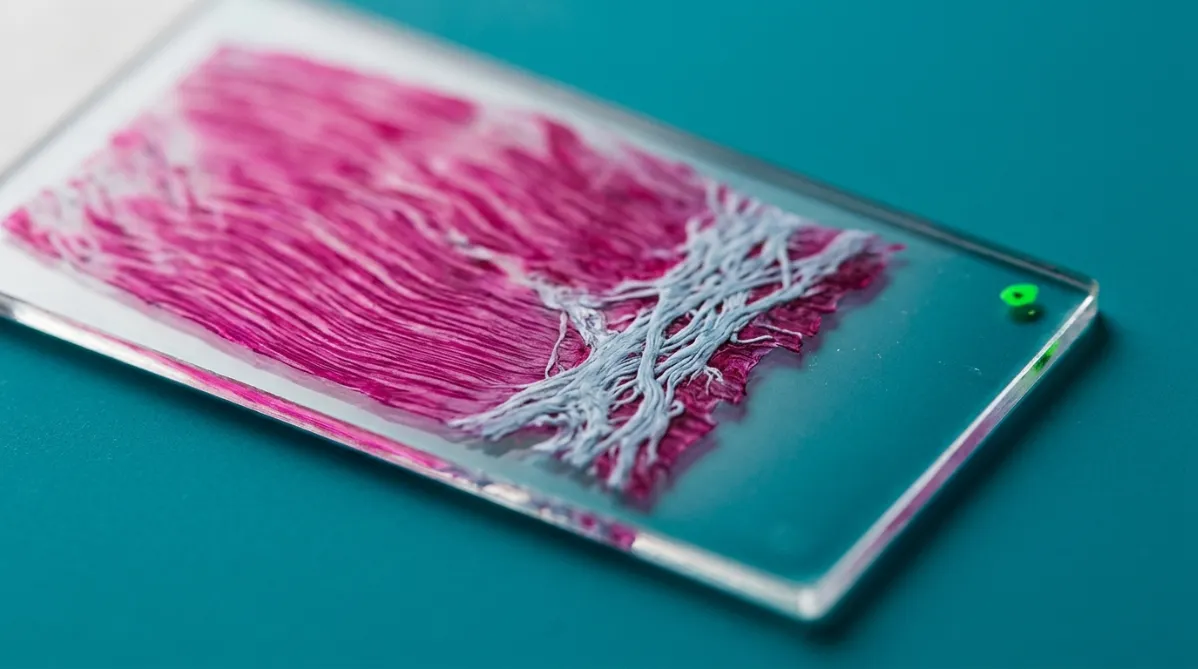
Extreme close-up microscopy-style photograph of a thin slice of rat heart muscle on a glass slide, stained in rich magenta-pink with fine, wavy parallel muscle fibers. In one half of the frame the fibers are neat and orderly. In the other half, thick pale-blue-grey strands of fibrous scar tissue cut across them in a ragged band. The slide sits on a saturated teal surface and is shot from slightly above at a shallow angle, so the glass edge catches a crisp highlight. Soft, even studio light with a shallow depth of field blurs the slide's far corner. A single tiny electric green marker dot sits on the slide's edge. The mood is precise, investigative and slightly tense, with a vivid, graphic contrast between the teal and the magenta tissue. No text or labels.
supplements

GlyNAC Shielded Diabetic Rat Hearts From Scarring—With One Catch

BY NOVA CHEN ·

A new rat study found that glycine plus NAC, the pairing behind the GlyNAC trend, best preserved heart structure and cut key stress signals in diabetic animals. But the combo didn't win every round, because NAC alone did better on some oxidative-stress markers. This was a streptozotocin-induced diabetes model in 34 rats, not human evidence. Here's what the researchers found, why rat mg/kg doses can't be translated to people, and what NAC cautions to know about.

This page is available in