Biocracked
←

#diabetic cardiomyopathy

1 article
Approach: macro science. Palette: bold color field, a saturated teal backdrop.

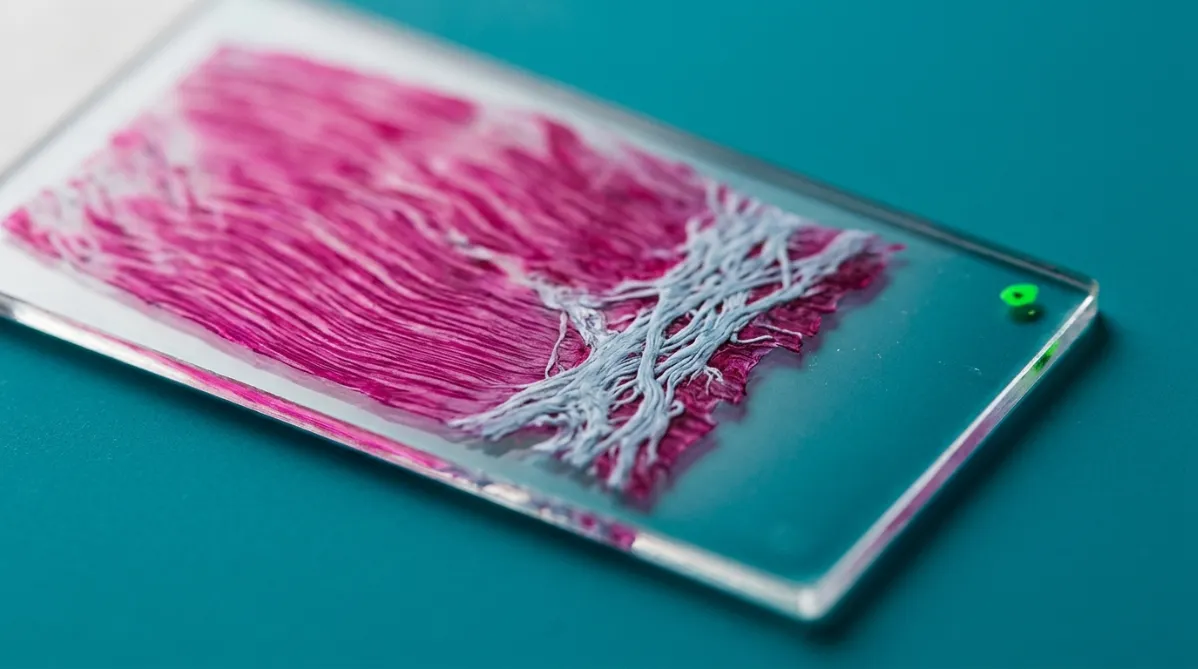
Extreme close-up microscopy-style photograph of a thin slice of rat heart muscle on a glass slide, stained in rich magenta-pink with fine, wavy parallel muscle fibers. In one half of the frame the fibers are neat and orderly. In the other half, thick pale-blue-grey strands of fibrous scar tissue cut across them in a ragged band. The slide sits on a saturated teal surface and is shot from slightly above at a shallow angle, so the glass edge catches a crisp highlight. Soft, even studio light with a shallow depth of field blurs the slide's far corner. A single tiny electric green marker dot sits on the slide's edge. The mood is precise, investigative and slightly tense, with a vivid, graphic contrast between the teal and the magenta tissue. No text or labels.
supplements

GlyNAC schützte die Herzen diabetischer Ratten vor Narbenbildung – mit einem Haken

BY NOVA CHEN ·

Eine neue Rattenstudie zeigte, dass Glycin + N‑Acetylcystein (NAC) – die Kombination, die dem GlyNAC‑Trend zugrunde liegt – die Herzstruktur am besten erhalten und wichtige Stresssignale bei diabetischen Tieren reduzieren konnte. Doch das Duo war nicht in allen Bereichen überlegen, da NAC allein bei einigen oxidativen Stress‑Markern besser abschnitt. Die Untersuchung wurde an einem streptozotoxin‑induzierten Diabetesmodell mit 34 Ratten durchgeführt und liefert keine Human‑Daten. Im Folgenden erfahren Sie, welche Ergebnisse die Forscher fanden, warum mg/kg‑Dosen bei Ratten nicht auf Menschen übertragbar sind und welche Vorsichtsmaßnahmen bei NAC zu beachten sind.

This page is available in