Biocracked
←

#sirtuins

1 article
Approach: macro science. Palette: bold color field, magenta and violet.

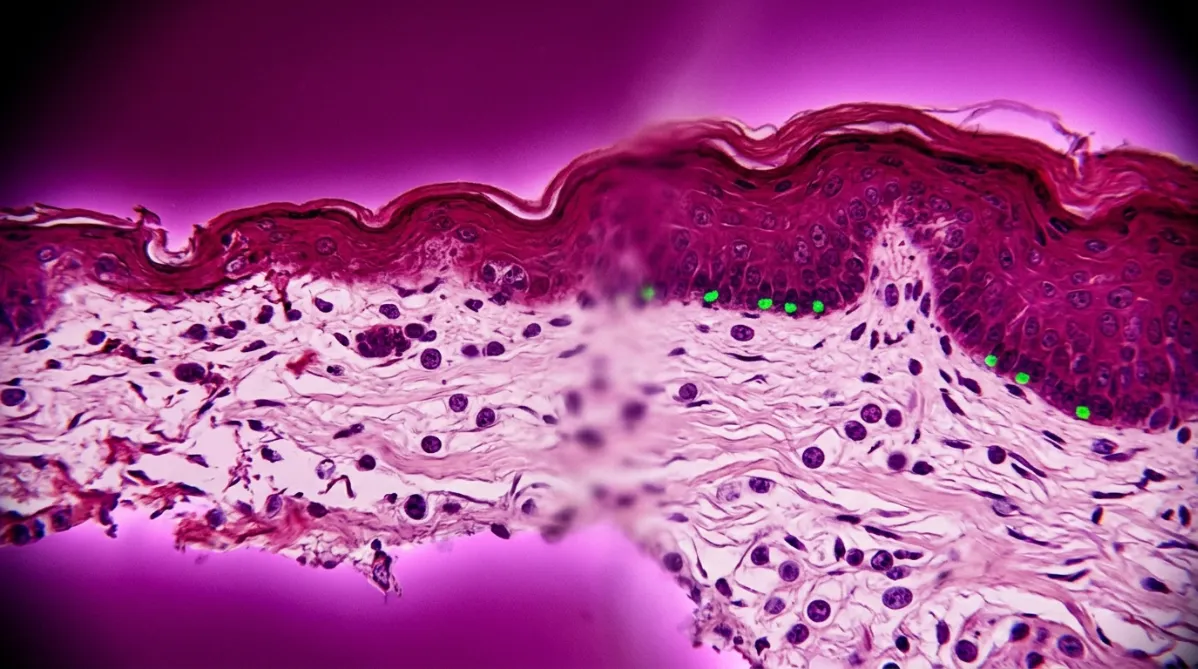
Extreme close-up microscopy photograph of a stained skin tissue cross-section, shot straight-on through the eyepiece with shallow depth of field. A thin, wavy epidermis in deep magenta sits above a fibrous dermis in pale pink, with visible collagen strands and a few round cell nuclei in dark violet. The left half of the frame shows noticeably thinned, flattened tissue, and the right half shows thicker, healthier layers, separated by a soft focus fall-off rather than a hard line. A few tiny electric green fluorescent dots mark nuclei along the basal layer. Lighting is bright, transmitted microscope light with a luminous glow behind the tissue and a saturated magenta backdrop in the out-of-focus edges. The grain is realistic and the mood is precise, curious and cautionary. No text or labels.
longevity

Resweratrol zatrzymał cienienie skóry myszy z wiekiem — ale jest haczyk

BY NOVA CHEN ·

Skóra z wiekiem staje się cieńsza, a nowe badanie na myszach sugeruje, że popularny suplement może spowolnić ten proces. W starszych zwierzętach 32‑tygodniowa dieta z dodatkiem resweratrolu zmniejszyła utratę grubości naskórka i skóry właściwej, przywróciła podział komórek skóry i zahamowała wzrost enzymów degradujących kolagen – MMP‑9 i MMP‑13. Mechanizm wiązany jest z aktywacją SIRT1, co potwierdzono eksperymentami na keratynocytach. To jednak badanie na zwierzętach – nie wiadomo, jaka dawka byłaby skuteczna u ludzi, a niska biodostępność resweratrolu stanowi poważną przeszkodę. Oto, co wykazało badanie i co z tego wynika.

This page is available in