Biocracked
**Approach: Macro science with a conceptual touch. Palette: B, warm.**

An extreme close-up, shot from slightly above at a 30-degree angle, of a clear glass cup of freshly brewed tea. The amber liquid fills the frame as a glowing disc, and a few loose tea leaves unfurl beneath the surface. Low golden-hour window light from the left passes through the tea. It makes the liquid glow honey-to-copper and casts a caustic ring of light on a dark walnut tabletop. Rising steam curls softly in the backlight. The shallow depth of field blurs the background into warm brown bokeh. The radial pattern of the leaves and the light ring faintly echoes a retina. One small electric green tea leaf edge catches the light in the foreground. The mood is calm, warm and curious. Photorealistic, with no text.
Longevity

Thee, niet koffie, gekoppeld aan een jonger uitziend netvlies bij 35.740 mensen

Nova Chen · · 4 min read

Coffee gets the headlines, the wellness influencers and the morning ritual status. But when researchers looked at the back of the eye in more than 35,000 people, coffee showed nothing. Tea did.

A new analysis of the UK Biobank, published in Ophthalmic Epidemiology in 2026, found that tea drinkers had a smaller "retinal age gap", a biological ageing marker. The signal was strongest in people who drank more than four cups a day. Coffee drinkers showed no such link.

Before you swap your espresso for a teapot, the details matter. The finding is real, but the effect is small and the study design limits what it can tell us.

What the researchers actually did

The team, led by researchers at the Centre for Eye Research Australia at the University of Melbourne, analysed 35,740 UK Biobank participants. Their mean age was 56.8 years, and 55.7% were men. About 21.5% said they never drank coffee, and 14.4% never drank tea.

Participants reported their average daily coffee and tea intake over the past year on a touchscreen questionnaire. The researchers then compared those habits with each person's retinal age gap, using linear regression models adjusted for demographic factors. They also used restricted cubic spline models to check whether the relationships were curved rather than straight.

Wait, what is a retinal age gap?

The retina is the light-sensing tissue at the back of the eye. It is one of the few places where doctors can see small blood vessels and nerve tissue directly and non‑invasively. Deep‑learning models can be trained to estimate a person's age from a retinal photograph.

The retinal age gap is the predicted retinal age minus actual chronological age:

  • A positive gap means your retina looks older than your birth certificate says, which is read as accelerated biological ageing.
  • A negative or smaller gap means your retina looks relatively younger.

It is a research marker of biological ageing, not a diagnosis. It is not a test you can currently use to judge your own health.

The headline result: tea yes, coffee no

After adjusting for demographic covariates, the results split cleanly:

  • Coffee: no association with retinal age gap.
  • Tea: an association with a smaller retinal age gap (β = -0.03, 95% CI -0.04 to -0.01, p = 0.006).
  • Heavy tea drinking: people drinking more than 4 cups a day showed a larger difference (β = -0.22, 95% CI -0.36 to -0.08, p = 0.003).

The spline models found no significant non‑linear patterns for either drink (P non‑linear = 0.329 for coffee, 0.273 for tea). The tea relationship is better described as a steady, roughly linear trend than as a sweet spot or a threshold.

How big is the effect, really?

Honest answer: small. The retinal age gap is measured in years, so a coefficient of -0.03 amounts to a few days of retinal age per unit of tea. The heavy‑drinker figure of -0.22 is roughly 2.6 months. The abstract does not spell out the exact scaling of the lower coefficient, so treat the arithmetic as a rough guide.

That is a statistically detectable difference in a large sample. It is not a dramatic reversal of ageing. Nobody should expect a few cups of tea to knock years off their eyes.

Why this is association, not proof

This was a cross‑sectional analysis, a snapshot at one point in time. That brings several caveats:

  • Direction is unclear. The data cannot show that tea slowed ageing. Healthier or younger‑ageing people might simply drink more tea.
  • Confounding is possible. Only demographic covariates are noted in the abstract. Lifestyle, diet and socioeconomic patterns tied to tea habits could play a role.
  • Self‑reported intake. A questionnaire about the past year is a rough measure.
  • Unspecified tea type. The abstract does not report results by black, green or herbal tea, so no claim about a "best" tea can be drawn from it.
  • A single cohort. UK Biobank participants are not necessarily representative of everyone, and tea culture varies widely around the world.

The authors conclude that tea is "a dietary factor linked to" biological ageing as indexed by retinal age gaps. The wording is linked, not causal.

Practical takeaways

Don't ditch coffee over this. The study did not find coffee harmful for retinal ageing. It found no association either way after adjustment.

Tea type and caffeine. The paper's abstract does not compare tea varieties or caffeine content. Tea generally contains less caffeine per cup than coffee, though the amount varies with the leaf, brew time and strength. If you want to add tea without adding much caffeine, decaffeinated or herbal options exist, but this study gives no evidence on whether they carry the same association.

How to drink more tea without sugar. Habit matters more than hype, and sugar can undercut any benefit. A few simple approaches:

  • Swap the second or third coffee of the day for tea, rather than adding to your total intake.
  • Try a lighter brew or a shorter steep time if bitterness makes you reach for sweetener.
  • Add flavor without sugar: a slice of lemon, a cinnamon stick, fresh mint or a splash of milk.
  • Keep unsweetened iced tea in the fridge for warm days.

Who should watch caffeine. Drinking more than four cups a day is a lot of tea, and the largest effect appeared at that level. People who are pregnant, sensitive to caffeine, prone to palpitations or anxiety, have sleep problems, or are on medications that interact with caffeine should check with a clinician before raising their intake. This is general guidance rather than a finding of the paper.

The bottom line

In 35,740 adults, tea drinking was linked to a slightly younger‑looking retina, most clearly at more than four cups a day. Coffee showed no link. It is an intriguing signal for ageing research, and a reason to take tea seriously as a variable. It is not a reason to believe tea reverses ageing. Randomized or longitudinal studies would be needed to find out whether tea changes how the eye ages, or whether it just travels with people who age well.


Original study

Read the original research on pubmed.ncbi.nlm.nih.gov →

This article summarizes published research for general information. It is not medical advice.

NC

Written by

Nova Chen

Nova Chen writes for Biocracked: biohacking science, longevity & human performance.

Related Articles

Approach: conceptual metaphor. Palette: bold color field.

A single ripe, glossy red tomato-colored apple sits at the center of a saturated mustard-yellow seamless backdrop, with a neat row of five identical white capsules lined up beside it on the same surface. The apple is the clear winner of the frame. One capsule has rolled slightly away, cracked open and spilling a tiny pile of pale powder. Shot at a low three-quarter angle with a shallow depth of field, so the back capsules blur softly. Lighting is a large, soft key light from the upper left, giving crisp but gentle shadows with warm yellow bounce. A thin sprig of electric green (#00e676) leaves rises from the apple stem as the only green accent. Mood: confident, playful and skeptical, a clean verdict that real food outweighs pills. No text or labels.
longevity

Zombiecel‑supplementen? 27 menselijke studies zeggen: dieet wint van pillen

BY NOVA CHEN ·

Supplementclaims beloven vaak zombiecellen te “verwijderen”, maar een nieuwe systematische review van 27 menselijke trials met 3.811 deelnemers laat zien dat het bewijs schaars is. Caloriereductie leverde de meest consistente daling op in ontstekingssignalen die met senescentie verbonden zijn. Omega‑3 was het meest veelbelovende supplement, hoewel het bewijs beperkt en gemengd is. Telomeerlengte en de klassieke p16/p21‑markers bewogen nauwelijks. Dit betekent dat voeding meer effect heeft dan de meeste pillen die je in de winkel ziet.

Approach 4, conceptual metaphor, in palette D, bold color field.

A single frayed shoelace-style aglet stands in for a telomere cap: a glossy brass-tipped cord end, photographed in tight macro, its braided fibers splitting apart and unraveling at the worn end. The cord is cream white and the brass tip catches a crisp highlight. It rests on a seamless saturated mustard-yellow backdrop. The camera sits at a low three-quarter angle, with the frayed end sharp in the foreground and the rest of the cord falling softly out of focus to the right. Hard, directional studio light from the upper left casts a clean, short shadow on the yellow surface. A thin electric green thread runs through the braid, the only trace of green in the frame. Mood: skeptical, scrutinizing, a promise that doesn't hold together. No text anywhere.
peptides

Epitalon: Het telomeerpeptide waarop iedereen injecteert, is onbewezen

BY NOVA CHEN ·

Epitalon wordt online gepresenteerd als het telomeerpeptide dat veroudering zou kunnen vertragen, maar een review uit 2026 laat zien dat de bewijzen een ander verhaal vertellen. Menselijke data beperken zich tot kleine biomarkerstudies en één ouder onderzoek bij retinitis pigmentosa, zonder een voldoende grote gerandomiseerde trial die effectiviteit aantoont. Dosering, farmacokinetiek en de langetermijnveiligheid zijn nog niet gevalideerd; er blijven vragen over kankerrisico, immunogeniciteit, productkwaliteit en de FDA‑toezicht. Hieronder staat wat de wetenschap ondersteunt, wat niet, en voor wie het beter is om het te vermijden.

Approach 2, lab in action, with palette D, bold color field.

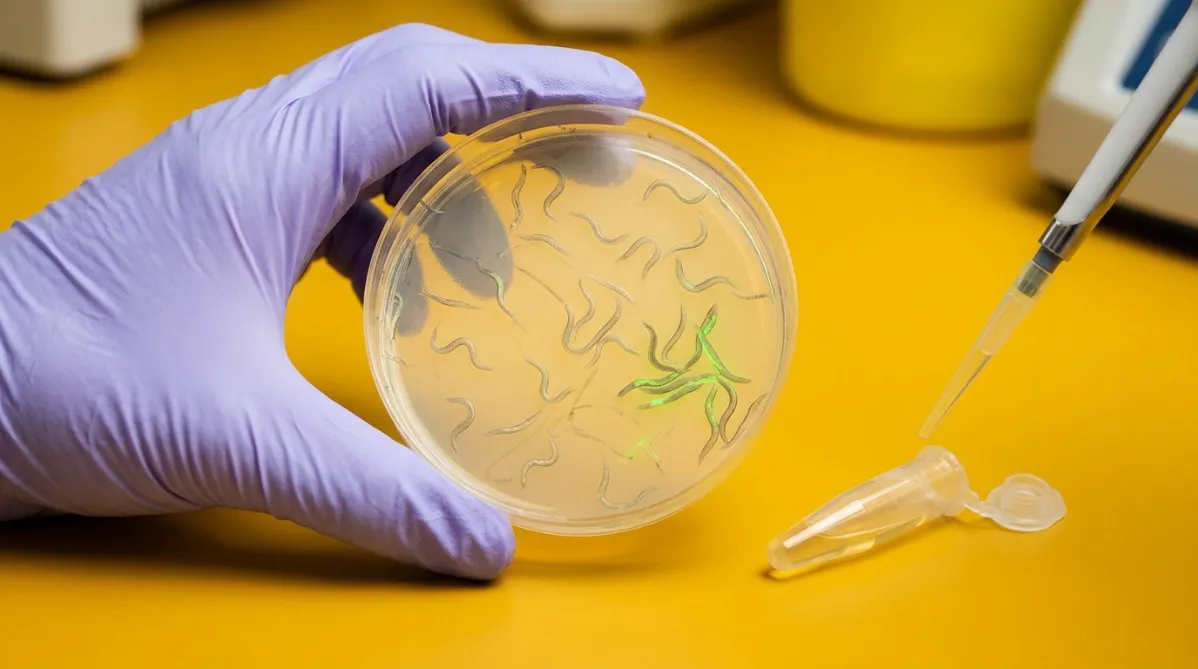
Overhead-angled close shot of a gloved hand in a pale purple nitrile glove holding an open agar petri dish above a saturated mustard-yellow lab bench. Inside the dish, dozens of tiny translucent C. elegans worms trace sinuous curved tracks across a faintly glowing bacterial lawn. A small cluster of the worms shows a subtle electric green fluorescence along their bodies, suggesting neurons. Beside the dish, a microcentrifuge tube holds a pale golden-yellow DHM solution, with a pipette tip hovering nearby. Lighting is bright, crisp, directional studio-style lab light with soft short shadows. The shallow depth of field blurs the background to a smooth yellow. The mood is curious, precise and optimistic, with a slightly playful contrast between the vivid backdrop and the delicate, nearly invisible animals.
longevity

Hangover‑supplement DHM verlengt de levensduur van wormen met tot 15 %

BY NOVA CHEN ·

Hetzelfde bestanddeel dat in hangover‑capsules wordt verkocht, verlengt de levensduur van rondwormen met tot 15 %. In een nieuwe studie met *C. elegans* beschermde dihydromyricetin (DHM) de tastreceptorneuronen, hield de wormen langer in beweging en verlaagde het de darmvetten. Het levensduur‑effect bleek onafhankelijk van het klassieke langlevendheidsgen *daf‑16* en de gebruikelijke antioxidant‑reporters werden niet geactiveerd, wat wijst op een minder voor de hand liggend mechanisme. Het blijft echter een wormstudie; micromolaire doses zijn niet te vertalen naar capsule‑doses en er zijn geen mens‑levensduur‑gegevens beschikbaar.

Approach 1, macro science, in palette D, bold color field.

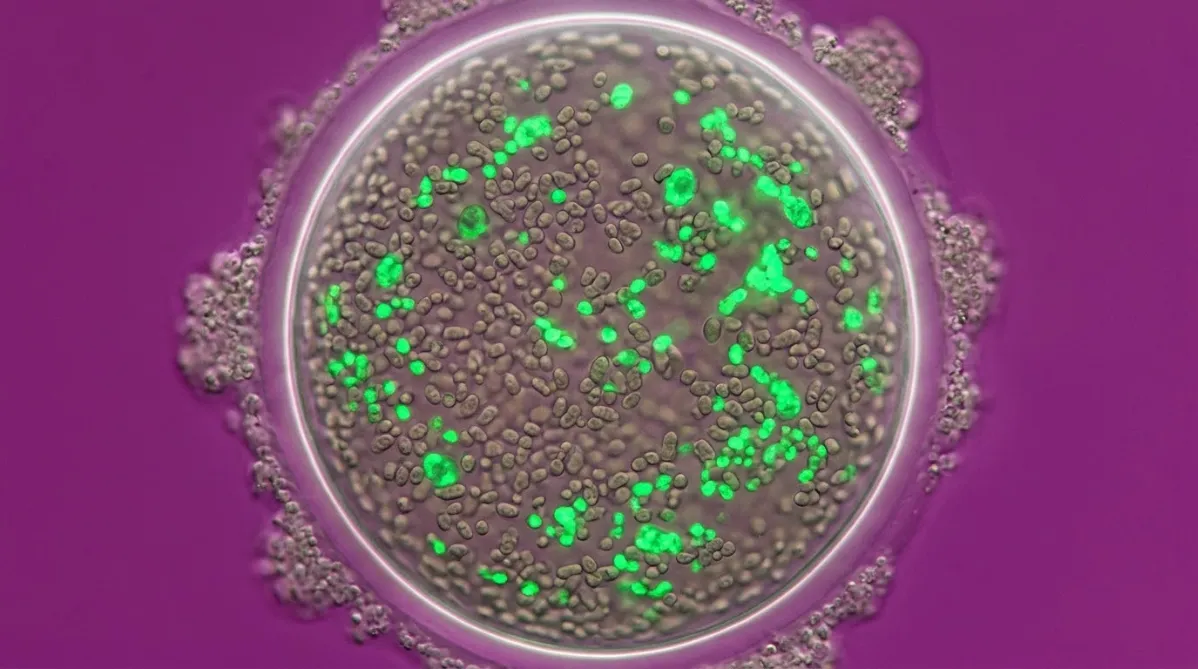
Extreme close-up microscopy-style image of a single mouse oocyte, a translucent spherical egg, shot straight on at its equator. Inside the cytoplasm, hundreds of mitochondria appear as tiny glowing grains. Most are a muted grey-amber, while a scattered subset of small and large organelles glows vivid electric green (#00e676), clustered unevenly to suggest an uneven response. Fine granular cumulus cells cling to the egg's edge, slightly out of focus. The backdrop is a saturated, flat magenta-violet field, with soft rim light wrapping the egg's glassy membrane and shallow depth of field blurring the edges. The mood is quiet, precise and slightly uneasy, a closer look revealing what the averages hid. Photoreal confocal-meets-studio look, with no text and no labels.
longevity

NMN verjongt verborgen mitochondriën in verouderde eicellen, maar niet gelijkmatig

BY NOVA CHEN ·

Verouderde muiseicellen leken gemiddeld genomen mitochondriaal normaal, maar een nieuwe studie op individuele organellen laat zien dat de gemiddelden iets verbergen. Specifieke subpopulaties – mitochondriën met een hoog membraanpotentiaal en kleine mitochondriën – hadden met de leeftijd een verhoogd mtDNA‑kopienaantal. NMN bracht die terug naar jonge niveaus, maar duwde grote mitochondriën in de tegenovergestelde richting, en in de omringende cumuluscellen overschoof het jonge niveaus in sommige groepen. Er werden geen vruchtbaarheids‑ of zwangerschapsresultaten gemeten; het onderzoek werd uitgevoerd bij muizen, en sommige auteurs hebben patenten en bedrijfsverbindingen. Hieronder staat wat dit betekent – en niet betekent – voor vrouwen die NMN overwegen voor vruchtbaarheid.

This page is available in