Biocracked
←

#sirt1

2 articles
Approach: macro science. Palette: bold color field, magenta and violet.

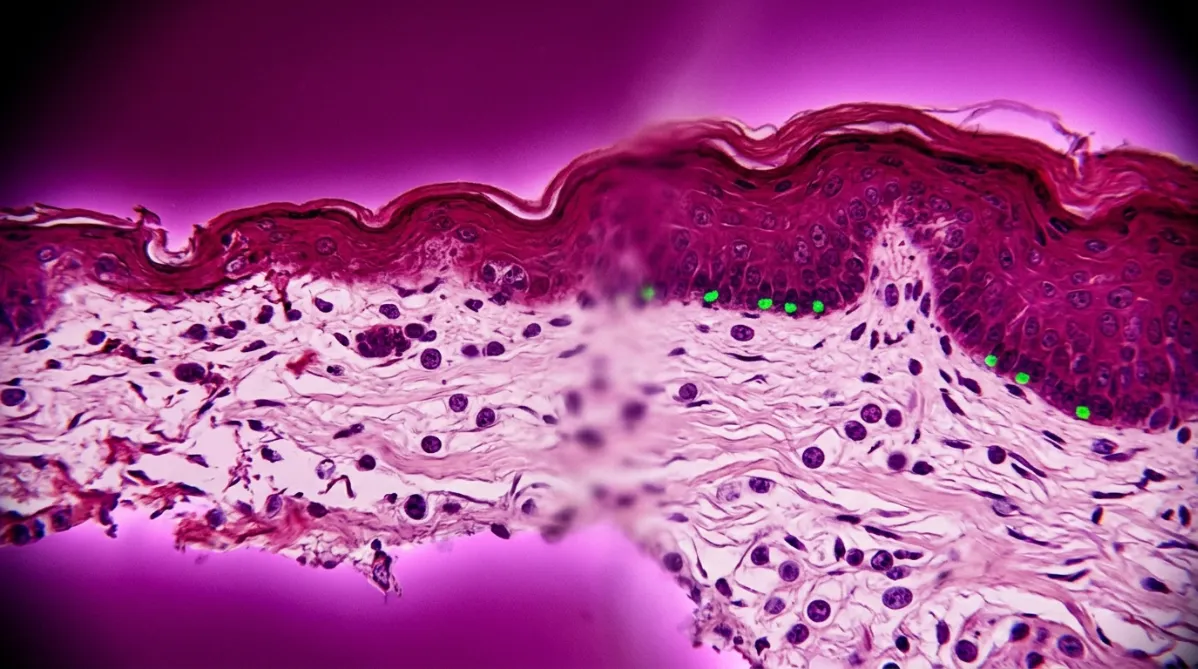
Extreme close-up microscopy photograph of a stained skin tissue cross-section, shot straight-on through the eyepiece with shallow depth of field. A thin, wavy epidermis in deep magenta sits above a fibrous dermis in pale pink, with visible collagen strands and a few round cell nuclei in dark violet. The left half of the frame shows noticeably thinned, flattened tissue, and the right half shows thicker, healthier layers, separated by a soft focus fall-off rather than a hard line. A few tiny electric green fluorescent dots mark nuclei along the basal layer. Lighting is bright, transmitted microscope light with a luminous glow behind the tissue and a saturated magenta backdrop in the out-of-focus edges. The grain is realistic and the mood is precise, curious and cautionary. No text or labels.
longevity

Resveratrol detuvo el adelgazamiento de la piel en ratones envejecidos: el detalle

BY NOVA CHEN ·

La piel envejecida se vuelve más delgada, y un nuevo estudio en ratones sugiere que un conocido suplemento podría frenar ese proceso. En ratones viejos, 32 semanas de resveratrol en la dieta atenuaron el adelgazamiento epidérmico y dérmico, restauraron la proliferación cutánea y bloquearon el aumento de las enzimas MMP‑9 y MMP‑13 que degradan colágeno. El mecanismo propuesto es la activación de SIRT1, respaldado por experimentos en queratinocitos que asocian la pérdida de SIRT1 con la senescencia. Sin embargo, no se trata de un ensayo en humanos, no se ha establecido una dosis para personas y la escasa biodisponibilidad del resveratrol es un obstáculo real. A continuación, lo que muestra el estudio y qué podemos hacer al respecto.
Approach: the human outcome. Palette: warm, golden-hour light.

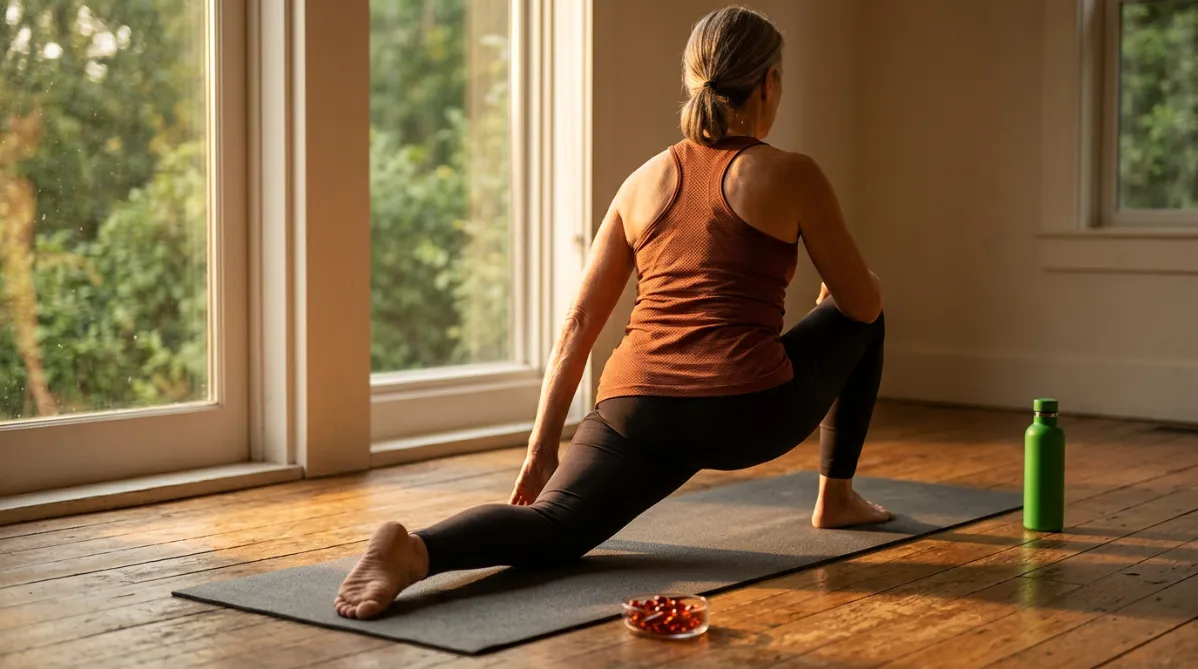
A woman in her fifties seen from behind and slightly above, in a low lunge on a yoga mat. Her face is out of frame, and only her shoulders, outstretched arms and tied-back silver-brown hair show. She practices on a wooden floor beside a tall window as low amber sunlight rakes across the room. The light picks out the weave of her rust-colored top and the fine skin texture of her forearms. In the foreground, a small glass dish of deep red-orange astaxanthin softgels sits slightly out of focus on the floor, catching a copper glow. A single small electric green water bottle sits at the edge of the mat. Shot at 35mm with shallow depth of field, in warm honey tones with soft brown shadows. The mood is calm, grounded and quietly hopeful.
supplements

Yoga + Astaxantina reducen las puntuaciones de depresión un 45 % (solo, mucho menos)

BY NOVA CHEN ·

Un ensayo aleatorio de 12 semanas con 100 mujeres postmenopáusicas mostró que combinar Hatha yoga con 12 mg/día de astaxantina redujo las puntuaciones de depresión un 45,1 %. Solo el yoga logró una disminución del 28,5 % y la astaxantina por sí sola apenas un 10,9 %. La combinación también mejoró los síntomas menopáusicos, la actividad de enzimas antioxidantes y la expresión de NRF1, mientras que SIRT1 y PGC‑1α aumentaron en ambos grupos de yoga. Sin embargo, el estudio es pequeño, probablemente unicéntrico y limitado a mujeres con síntomas leves‑moderados. A continuación se analizan los números, lo que no demuestran y a quién podría convenir este enfoque.

This page is available in