Biocracked
Approach: the human outcome. Palette: warm, golden-hour light.

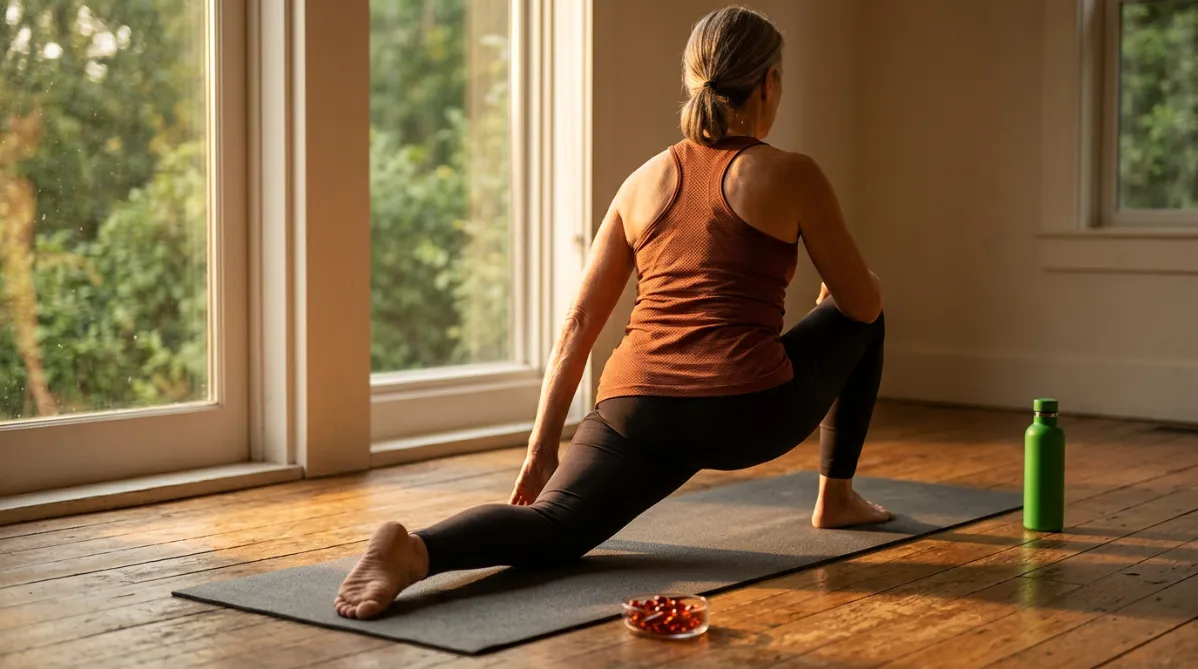
A woman in her fifties seen from behind and slightly above, in a low lunge on a yoga mat. Her face is out of frame, and only her shoulders, outstretched arms and tied-back silver-brown hair show. She practices on a wooden floor beside a tall window as low amber sunlight rakes across the room. The light picks out the weave of her rust-colored top and the fine skin texture of her forearms. In the foreground, a small glass dish of deep red-orange astaxanthin softgels sits slightly out of focus on the floor, catching a copper glow. A single small electric green water bottle sits at the edge of the mat. Shot at 35mm with shallow depth of field, in warm honey tones with soft brown shadows. The mood is calm, grounded and quietly hopeful.
Supplements

Yoga + Astaxanthin Cut Depression Scores 45%. Alone, Far Less

Nova Chen · · 4 min read

Neither astaxanthin nor yoga produced the biggest drop in depression scores in a new trial of postmenopausal women. The combination did: a 45.1% reduction on the Hamilton Depression Rating Scale (HAM-D) over 12 weeks. Yoga alone managed 28.5%, and astaxanthin alone just 10.9%. The randomized controlled trial, published in Explore in 2026, is small and has real limits. It is still one of the more interesting recent attempts to pair a supplement with a movement practice for menopause-related mood symptoms.

What the researchers did

Abdulrahman and Abdullah, both affiliated with Akre Obstetrics and Gynecology Hospital in Kurdistan, Iraq, enrolled 100 sedentary postmenopausal women aged 55 to 60 with mild-to-moderate depressive symptoms. Participants were randomly assigned to one of four arms for 12 weeks:

  • Control group (CG)
  • Hatha yoga group (HYG): 75-minute sessions, three times weekly
  • Astaxanthin group (ASG): 12 mg per day
  • Combined group (HYASG): Hatha yoga plus 12 mg per day of astaxanthin

The yoga program covered āsana (postures), prāṇāyāma (breathing), relaxation and brief meditation. Outcomes included depression (HAM-D), menopause symptom severity (Menopause Rating Scale, MRS), menopause-specific quality of life (MENQOL), blood markers of oxidative stress, and peripheral-blood gene expression of SIRT1, PGC-1α and NRF1.

The numbers, arm by arm

The paper reports significant group × time interactions for all major outcomes (p < 0.001). That means the groups changed differently over the 12 weeks.

Arm HAM-D reduction
Yoga + astaxanthin 45.1%
Yoga alone 28.5%
Astaxanthin alone 10.9%

In the combined arm, MRS scores fell 41.1% and MENQOL scores fell 50.0%. The abstract does not give equivalent per-arm percentages for those two scales in the other groups, so the combination's margin on them can't be stated here.

The pattern suggests the effects weren't simply additive. Yoga did most of the work on mood, and astaxanthin alone had a modest effect. Together they produced the largest improvement, which the authors describe as greater than either intervention alone.

The biology: antioxidant enzymes and mitochondrial signals

Menopause is linked to oestrogen deficiency, oxidative stress and mitochondrial dysfunction, and the trial was built around that framing. Astaxanthin is a fat-soluble carotenoid antioxidant, so the oxidative-stress panel was a logical measurement.

Antioxidant status. The combined group had the largest increases in total antioxidant capacity (TAC), superoxide dismutase (SOD) and catalase (CAT) activity. It also had the greatest reductions in the lipid-peroxidation markers malondialdehyde (MDA) and TBARS.

Mitochondria-related gene expression. Measured by qRT-PCR in peripheral blood:

  • SIRT1 and PGC-1α rose significantly in both yoga-containing groups. Based on the abstract, the signal came from yoga rather than from astaxanthin alone.
  • NRF1 upregulation was most pronounced in the combined group. This is where the pairing seems to add something beyond yoga.

SIRT1, PGC-1α and NRF1 are tied to mitochondrial biogenesis and cellular energy regulation. That makes them plausible mechanistic candidates. This trial doesn't show that these shifts caused the mood improvements, only that they moved alongside them.

Honest caveats

Several limits matter before anyone treats this as a protocol.

  • Blinding is likely limited. Yoga can't be blinded, and mood scales are sensitive to expectation and to the attention and social contact of a group program. The abstract doesn't say whether the astaxanthin was placebo-controlled. Check the full text before assuming the supplement effect was blinded.
  • Likely single-center. The authors are from one hospital in Iraq, and the abstract describes no multi-site recruitment. Results may not generalize to other populations, diets or healthcare settings.
  • Narrow population. Participants were sedentary women aged 55 to 60 with mild-to-moderate symptoms. The findings say nothing about severe depression, younger perimenopausal women or active women.
  • Short duration. The trial ran 12 weeks, and the abstract reports no long-term follow-up.
  • Surrogate markers. The gene expression data come from peripheral blood, not brain or muscle tissue. Serum oxidative-stress markers are indirect indicators.
  • Small sample. One hundred women across four arms is modest, and the effect sizes should be confirmed in larger, independent trials.

This is not a substitute for treatment. Depression in menopause can be serious, and anyone with significant symptoms should work with a clinician. The study's own conclusion is hedged: the combination was associated with greater improvements.

Practical takeaways

Dose: The trial used 12 mg per day of astaxanthin for 12 weeks.

Timing: The abstract doesn't specify meal timing. As general guidance rather than a finding from this paper, astaxanthin is fat-soluble, and taking it with a meal containing some fat is the usual advice for absorption.

Yoga: The program was three sessions a week of about 75 minutes, combining postures, breathing, relaxation and brief meditation. Of the two components, yoga showed the larger standalone effect.

Who it might suit: Sedentary postmenopausal women with mild-to-moderate low mood who want a non-drug option to discuss with their doctor. It is not a replacement for medical care. Check with a clinician first if you take blood thinners or other medications, or have other health conditions.

Bottom line

If you take one thing from this trial, make it the yoga: it carried most of the mood benefit and drove the SIRT1 and PGC-1α changes. Astaxanthin looks like a possible add-on that nudged oxidative-stress and NRF1 outcomes further. Larger, blinded, multi-center trials with longer follow-up will show whether that edge holds up.

Original study

Read the original research on pubmed.ncbi.nlm.nih.gov →

This article summarizes published research for general information. It is not medical advice.

NC

Written by

Nova Chen

Nova Chen writes for Biocracked: biohacking science, longevity & human performance.

Related Articles

Approach: the human outcome. Palette: C, natural.

A low-angle, side-on close shot of a sprinter's lower legs and spiked shoes at the start of a worn terracotta-red running track, just after sunrise. Low golden daylight rakes across the lane lines and picks out the sweat on the calf muscles and the tendons in the ankle. Behind the athlete, soft-focus green grass and a line of trees fill the background. The runner's face is out of frame. A single electric-green shoelace on one spiked shoe is the only accent. The depth of field is shallow, with the foreground track grain crisp and the background creamy. The mood is quiet and determined, with natural skin tones, earthy reds, and fresh greens. No blue cast, no text, no logos.
peptides

Athletes Have 59% More MOTS-c Before Anyone Injects a Thing

BY HELIX WARD ·

A small new study found that elite athletes carry about 59% more circulating MOTS-c than sedentary young men, with no injections involved. MOTS-c is a mitochondrial peptide often pitched online as an "exercise mimetic." Across 30 young males in three fitness tiers, higher levels tracked with VO2max and with lower post-exercise oxidative damage. But the design is cross-sectional with just 10 people per group, so it cannot show cause and effect, and it contains no data on injected MOTS-c. Here is what the numbers show, what they don't, and what it means if you're tempted by the vial.

Approach 2, lab in action, with palette D, bold color field.

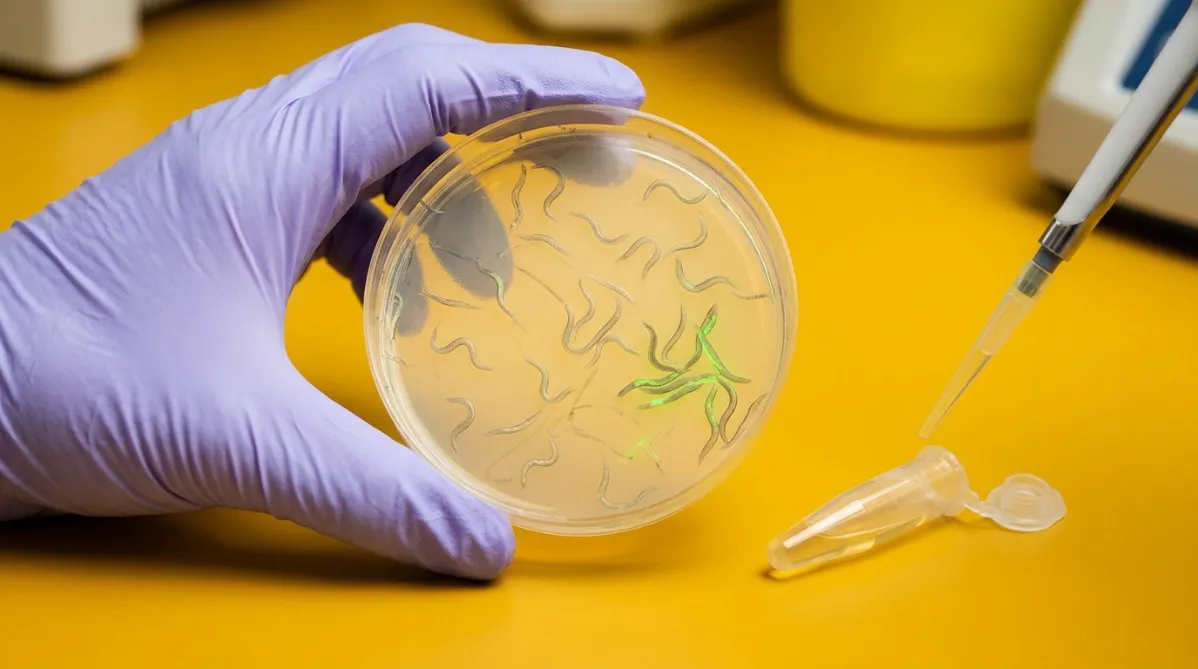
Overhead-angled close shot of a gloved hand in a pale purple nitrile glove holding an open agar petri dish above a saturated mustard-yellow lab bench. Inside the dish, dozens of tiny translucent C. elegans worms trace sinuous curved tracks across a faintly glowing bacterial lawn. A small cluster of the worms shows a subtle electric green fluorescence along their bodies, suggesting neurons. Beside the dish, a microcentrifuge tube holds a pale golden-yellow DHM solution, with a pipette tip hovering nearby. Lighting is bright, crisp, directional studio-style lab light with soft short shadows. The shallow depth of field blurs the background to a smooth yellow. The mood is curious, precise and optimistic, with a slightly playful contrast between the vivid backdrop and the delicate, nearly invisible animals.
longevity

Hangover Supplement DHM Stretched Worm Lifespan by Up to 15%

BY NOVA CHEN ·

The same compound sold in hangover capsules just stretched worm lifespan by up to 15%. In a new C. elegans study, dihydromyricetin (DHM) also protected touch-receptor neurons, kept the worms moving longer, and lowered intestinal fat. The lifespan effect did not depend on the classic longevity gene daf-16, and standard antioxidant reporters were not induced, which hints at a more unusual mechanism. But this is worms only, the micromolar doses do not translate to capsule doses, and there is no human longevity data.

Approach 1, macro science, in palette D, bold color field.

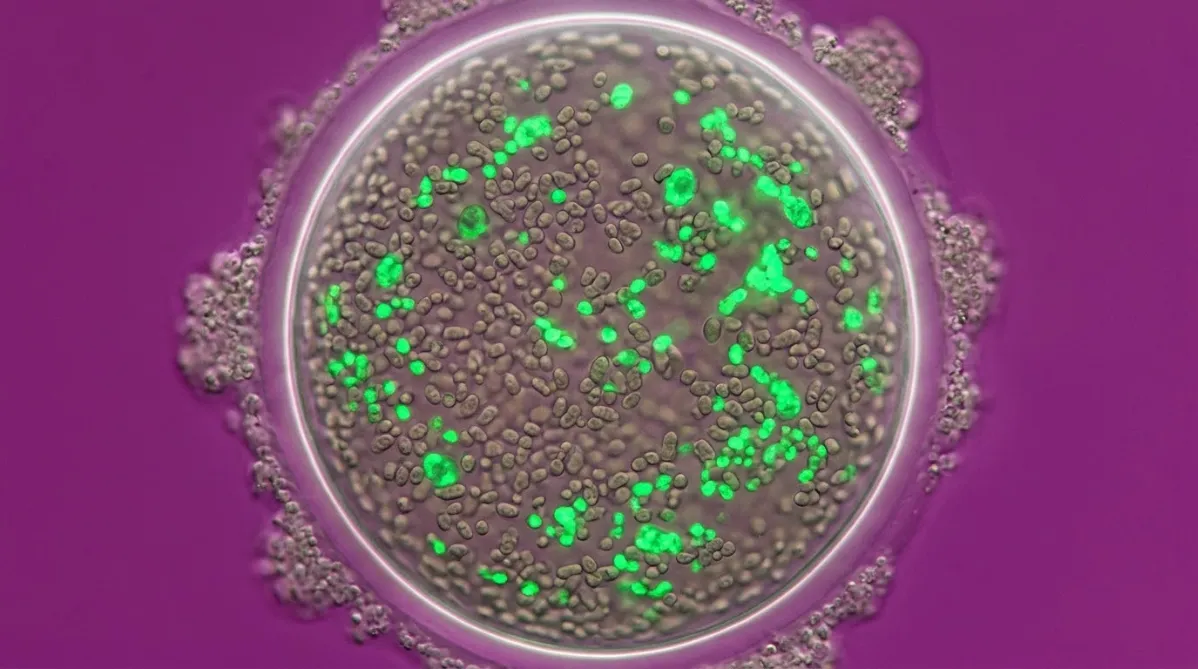
Extreme close-up microscopy-style image of a single mouse oocyte, a translucent spherical egg, shot straight on at its equator. Inside the cytoplasm, hundreds of mitochondria appear as tiny glowing grains. Most are a muted grey-amber, while a scattered subset of small and large organelles glows vivid electric green (#00e676), clustered unevenly to suggest an uneven response. Fine granular cumulus cells cling to the egg's edge, slightly out of focus. The backdrop is a saturated, flat magenta-violet field, with soft rim light wrapping the egg's glassy membrane and shallow depth of field blurring the edges. The mood is quiet, precise and slightly uneasy, a closer look revealing what the averages hid. Photoreal confocal-meets-studio look, with no text and no labels.
longevity

NMN Rejuvenated Hidden Mitochondria in Aged Eggs, But Not Evenly

BY NOVA CHEN ·

Aged mouse eggs looked mitochondrially normal on average, but a new single-organelle study says the averages were hiding something. Specific subpopulations, high-membrane-potential and small mitochondria, carried elevated mtDNA copy number with age. NMN pulled those back toward young levels, yet pushed large mitochondria the opposite way, and in surrounding cumulus cells it overshot young levels in some groups. No fertility or pregnancy outcomes were measured, the work was in mice, and some authors have patent and company ties. Here is what it means, and does not mean, for women weighing NMN for fertility.

Approach 4, conceptual metaphor, in palette D, bold color field.

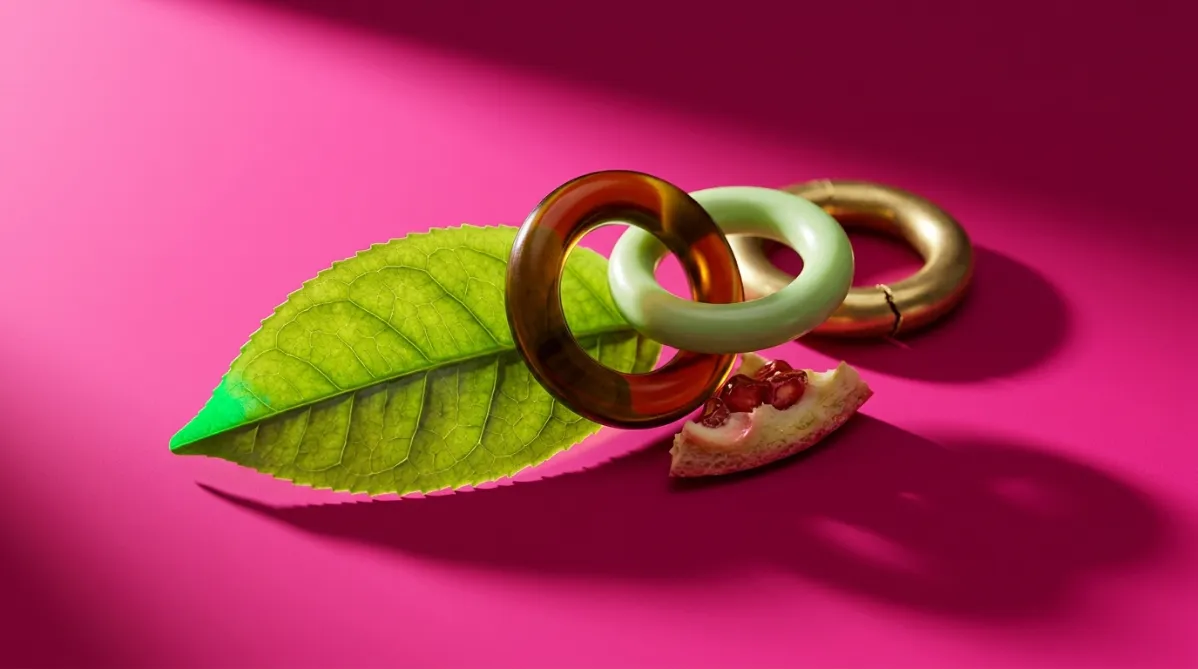
A single translucent green tea leaf, its veins backlit, lies on a saturated magenta seamless backdrop beside a small pomegranate rind fragment. Together they form a split, two-part chain: a bright brass chain link made of two interlocking rings, one ring dark amber and one pale green, rests on top. Behind it, one ring has a hairline crack. Shot from a low three-quarter angle with a shallow depth of field, the front link razor sharp and the background softly blurred. Lighting is a crisp, hard key light from the upper left with a soft magenta bounce and a long defined shadow across the surface. The palette is vivid magenta, deep amber, and a small accent of electric green (#00e676) on the leaf edge. The mood is curious and skeptical: promising but unproven, with two parts joined yet not fully tested.
longevity

Urolithin A + Green Tea EGCG in Alzheimer's Mice: The Catch

BY NOVA CHEN ·

Two natural compounds, urolithin A and green tea's EGCG, were given together to Alzheimer's-model mice, and the animals' mitochondria looked markedly different afterward. Treated mice showed shifts in fission and fusion genes, higher mitophagy-associated markers, longer mitochondria and more ATP. The combination often outperformed the regimen without EGCG across mitochondrial and neuronal measures. But this was injected dosing in mice, and the authors say mitophagic flux, respiration and EGCG's specific role still need testing. Here's what the study found, what it can't tell us, and why it isn't a supplement recommendation.

This page is available in